Post-Impressionist painting is usually taught as a roster of geniuses who happened to overlap in time. That is the wrong way in. What binds Cézanne to Gauguin, and Gauguin to van Gogh, is not a shared brushstroke or a common palette. It is a shared difficulty. By the early 1880s the Impressionists had won their argument. They had proven that a canvas could hold the shimmer of an afternoon, the broken color of leaves moving in wind, the exact temperature of light at four o'clock. And then the most ambitious painters of the next decade looked at that victory and felt something missing. The world had been turned into weather. Where was the structure, the meaning, the thing that would still be standing tomorrow?
So this essay defends a single claim: Post-Impressionism is best understood not as a style but as a question, and the painters we file under that label are simply the people who gave the most serious, and the most incompatible, answers. The question runs roughly like this. Once you accept that light dissolves solid form into colored sensation, what do you put back? Cézanne answered with architecture. Gauguin answered with symbol and flat, willed color. Van Gogh answered with feeling pushed through the brush until it bent the visible. Seurat answered with a system, almost a science. None of them agreed. That disagreement is the movement. Read this way, the famous incoherence of the term stops being an embarrassment and becomes the point.
A name invented after the fact
Nobody at the time called themselves a Post-Impressionist. The word arrived late, from England, and from a critic rather than a painter. Roger Fry coined it for a London show he organized at the Grafton Galleries in the autumn of 1910, titled simply for Manet and the painters who came after, an account preserved by the Tate. Fry needed a banner under which to hang Cézanne, Gauguin, and van Gogh, all dead or near it by then, and the prefix did the honest minimal work of saying: this is what happened next. The vagueness was built in from the first day. It marks a sequence in time, not a creed.
That looseness has consequences for how the period gets bounded. The core years are usually placed at roughly 1880 to 1900, and even there the four central figures are so different that nobody would group them together on the evidence of the paintings alone. They are grouped by chronology and by a shared dissatisfaction. That is worth holding onto, because it explains why any honest gallery of Post-Impressionism is going to look like a quarrel rather than a school.
Cézanne: build it back, plane by plane
Start with the answer that turned out to matter most for what came after. Paul Cézanne distrusted the way Impressionism let a scene melt into atmosphere. He wanted the solidity back without giving up what the Impressionists had learned about color. His famous ambition, recorded by the Tate, was to re-do Poussin from nature: to recover the calm, load-bearing geometry of the old masters using nothing but observation in the open air. He kept painting from the motif. He just refused to let the motif stay liquid.
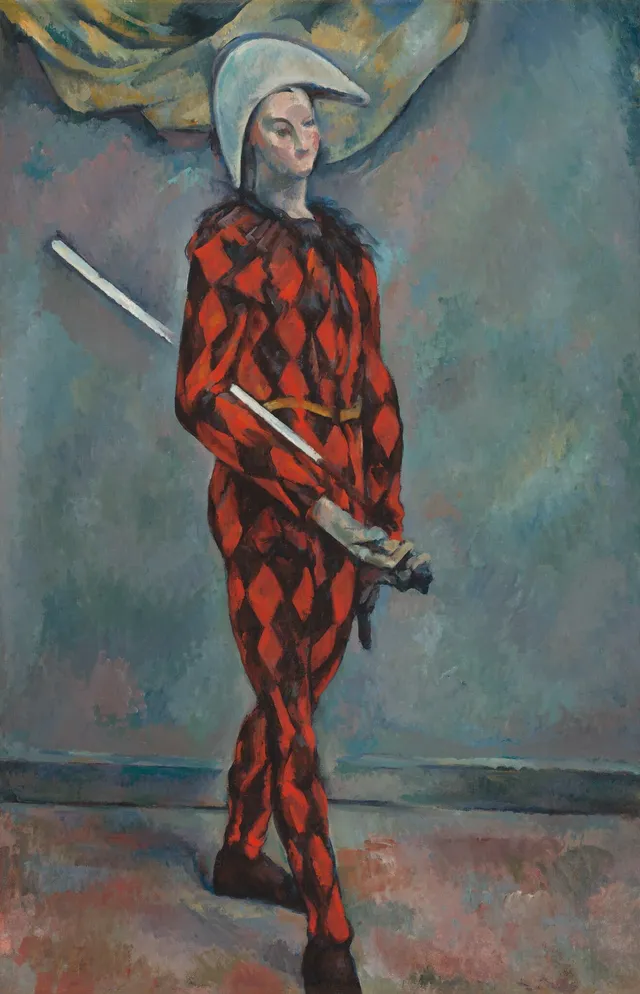
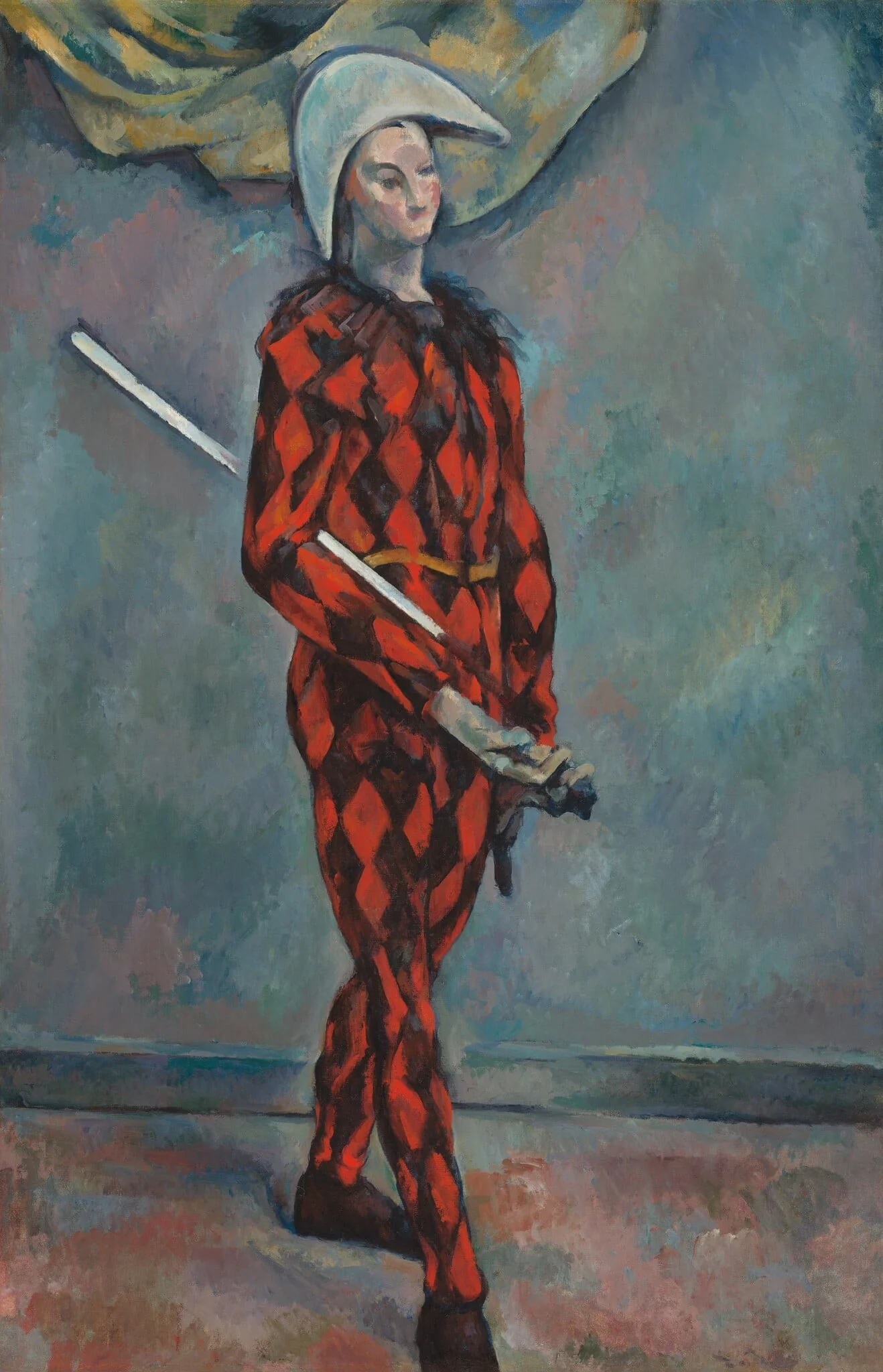
Look hard at his Harlequin. The costumed figure stands almost the full height of the canvas, and the first thing you notice is that he leans. The body tilts off true, the head set at an angle that no posing model could hold for long, and the whole silhouette seems pulled slightly to one side as if the picture's gravity does not point straight down. The diamond pattern of the costume is not painted as fabric stretched over a moving body. It is laid on as a flat grid of red and dark lozenges, and where the grid meets the bend of an arm it simply tilts, registering the turn the way a wall would, not the way cloth would. The face is barely a face. A few planes, a shadow, a mouth held without expression. Cézanne is not telling us who this performer is or what he feels. He is testing whether a standing human figure can be made as structurally inevitable as a building, whether the slouch and the costume and the hair can be reduced to a few weights that balance. The leaning is the proof of the experiment. He would rather the man fall slightly out of plumb and keep the composition rigid than stand him up straight and let the canvas go slack.
The same logic governs the work most people meet first. In The Card Players, the table between the two men tilts up toward the viewer, flattening the very depth Cézanne everywhere else insists on, and the bottle planted near the center sits a hair too far forward, a deliberate wrongness that pins the two halves of the picture together. The men are constructed from the same blunt planes as the wall behind them. He is not recording a card game in a Provençal café. He is rebuilding the room until it will hold still. Within a generation, two young painters in Paris named Picasso and Braque would take that lesson, that a picture is a built thing answerable to its own logic, and break the visible world into facets with it. Cubism is Cézanne's question, asked louder.
Gauguin: color you decide on
Where Cézanne wanted structure, Paul Gauguin wanted meaning, and he was willing to lie about the look of things to get it. His answer to the Impressionist problem was to stop treating color as a report on what the eye received and start treating it as a decision the painter makes for the sake of the idea. A field could be pink. A shadow could be vermilion. The justification was not optics but feeling and symbol. He chased this conviction out of Brittany and finally to the South Pacific, looking for a subject matter that had not already been worn smooth by European habit.
His Tahitian Ia Orana Maria shows what the program produces. He takes a Christian Annunciation, the angel and the haloed mother, and resets it among Tahitian women under tropical foliage, the holy figures given golden halos and bare feet at once. The color is laid in broad flat zones, edged and deliberate, with little of the broken Impressionist flicker. Distance is signaled by decorative arrangement rather than by air. The picture asks to be read as much as seen, its sacred borrowing pressed against an island world the European audience treated as exotic. Whatever we now make of that gaze, and there is plenty to question in it, the formal move is unmistakable: paint serves the symbol, and the symbol is chosen, not found. That door, once open, leads straight to the Fauves and their proudly unnatural color, and on to the Symbolists who cared more for the dream than the daylight.
Van Gogh: feeling pushed through the brush
The third answer is the one everyone thinks they know, and it is more disciplined than the legend allows. Vincent van Gogh also turned color loose from observation, but his aim was neither structure nor symbol. It was expression, the direct transfer of an emotional state into pigment and stroke. After he moved south to Arles in 1888, his pictures took on the hot light and high contrast of Provence, and he began bending the seen world to raise its emotional voltage. This was method, not accident.
The Rijksmuseum records that in one 1888 wheatfield he deliberately intensified the blue of the mountains and sky specifically to drive up the contrast with the dominant yellow of the grain. He was not copying the hue in front of him. He was tuning it, the way a musician sharpens a note, so the canvas would hit harder. That single choice tells you everything about his half of the movement. The color is true to the feeling, not to the meter reading.
You can watch the same temperament govern a portrait. In L'Arlésienne, his study of a woman of Arles, the sitter is set against a flat plane of strong color with her dark dress drawn as a few decisive shapes. There is almost no modeling, little of the careful chiaroscuro a salon portrait would demand. The contour does the work, blunt and sure, and the face is held with a gravity that owes nothing to flattery. Van Gogh is not after a likeness in the photographic sense. He is after the weight of a person, set down fast and certain. The speed is real and the control is also real, and that combination, raw urgency under tight formal grip, is exactly what later Expressionists would try to learn from him and mostly fail to match.
Seurat: make a method of it
The fourth answer is the coldest and, in its way, the most radical. Georges Seurat agreed that Impressionist color was right and Impressionist looseness was wrong, and he proposed to fix the looseness with rigor borrowed from the laboratory. Instead of mixing pigments on the palette, he set down small touches of pure color side by side and let the eye blend them at viewing distance, a method that would be called pointillism and would anchor the offshoot known as Neo-Impressionism. His vast Sunday scene on an island in the Seine, painted across 1884 to 1886, is the founding statement of the technique, and according to the record of the painting, it first hung at the eighth and final Impressionist exhibition in 1886, the show that effectively ended the old group and announced the new one. The figures in it stand frozen, almost ceremonial, the casual leisure of the Impressionists turned to stone. Seurat took the most fleeting subject available, a crowd relaxing in dappled light, and made it permanent by submitting it to a system.
Set the four answers next to each other and the family resemblance is only in the question. Cézanne wants the picture to stand up. Gauguin wants it to mean. Van Gogh wants it to feel. Seurat wants it to obey a law. A survey is tempted to smooth this into a single forward march out of Impressionism. It was not a march. It was four roads leaving the same town in four directions, and the twentieth century would send traffic down every one of them.
Works discussed in this article
What the archive shows about the edges
There is a tidy version of this story with four names in it and a hard border around them. The corpus tells a messier and more honest one. Artifact World Gallery holds 5,716 works tagged Post-Impressionist, made by 1,374 artists and scattered across 113 venues, with dates running from roughly 1850 to as late as 1974. Hold that against the textbook frame. The naming dates to 1910 and the core to a single generation around 1880 to 1900. Yet the catalog stretches the label across more than a century and more than a thousand hands. That gap is not a tagging error. It is the proof that Post-Impressionism functions less as a period than as a tendency, a way of painting that long outlived its decade.
The wide spread of artists explains why the edges of the movement blur into the academic and the regional. Consider Thomas Hovenden, whose The Last Moments of John Brown is a narrative history painting, sober and finished, far from any flat Tahitian field or pointillist haze. Or Frank Millet, whose quiet domestic interior keeps a refined, almost academic surface. Or Paul Émile Chabas, a Salon favorite of polished nudes. These painters share a half-century and a continent with Cézanne, and a corpus that sorts by period will inevitably catch them in the same net. The four canonical figures are the sharp center. The thousand others are the long, soft margin, and the margin is where most of the actual painting of the era happened.
Why the disagreement still pays out
Roger Fry, who named the thing, spent the following decade trying to explain what he had seen. He gathered his thinking about form and the deeper purpose of a picture into a book of essays published in London in 1920. The argument that runs through it is that the value of a painting lies in its formal design, in the ordering of shapes and colors, more than in the story it illustrates or the scene it copies. That idea, formalism, is itself a child of the painters Fry was looking at. He could only arrive at it because Cézanne had made structure visible, Gauguin had made color willful, and Seurat had made the whole surface a deliberate construction. The critic learned to see from the canvases, then handed the lesson to the next century of critics.
The reason this period rewards a second look is precisely that its members refused to converge. Impressionism had been, for all its early scandal, a relatively unified project about light and the moment. The painters who came after broke that unity open. Each kept one thing the Impressionists had won, the liberation of color, and threw the rest in a different direction. Out of those divergent throws came nearly every major path of early modern art. Structure became Cubism. Willed color became Fauvism and Neo-Impressionism's systematic offspring. Expression became the German and Northern Expressionists. The map of the modern was drawn by people answering one question four ways.
So the next time the term turns up flattened into a single look, a vague memory of thick paint and bright fields, push back on it. Go and stand in front of the works. Watch Cézanne's table tilt up to keep the room rigid. Watch van Gogh sharpen a blue mountain until it makes the wheat ring. Watch Gauguin set a golden halo over bare island feet and dare you to read it. The question they were all chasing has never actually been answered, because after the light there is no single thing that comes next. There are as many next things as there are painters willing to build, to mean, to feel, or to obey. The honest gallery keeps all four doors open, and lets you walk out whichever one you choose.
Sources & further reading
- Post-Impressionism (art term) — Tate
- Wheatfield (1888): intensified blue for color contrast — Rijksmuseum
- A Sunday Afternoon on the Island of La Grande Jatte — Wikipedia
- Arles: View from the Wheatfields (van Gogh, 1888) — The J. Paul Getty Museum
- Vision and Design (1920) — Internet Archive, Chatto & Windus