Artwork
Ia Orana Maria
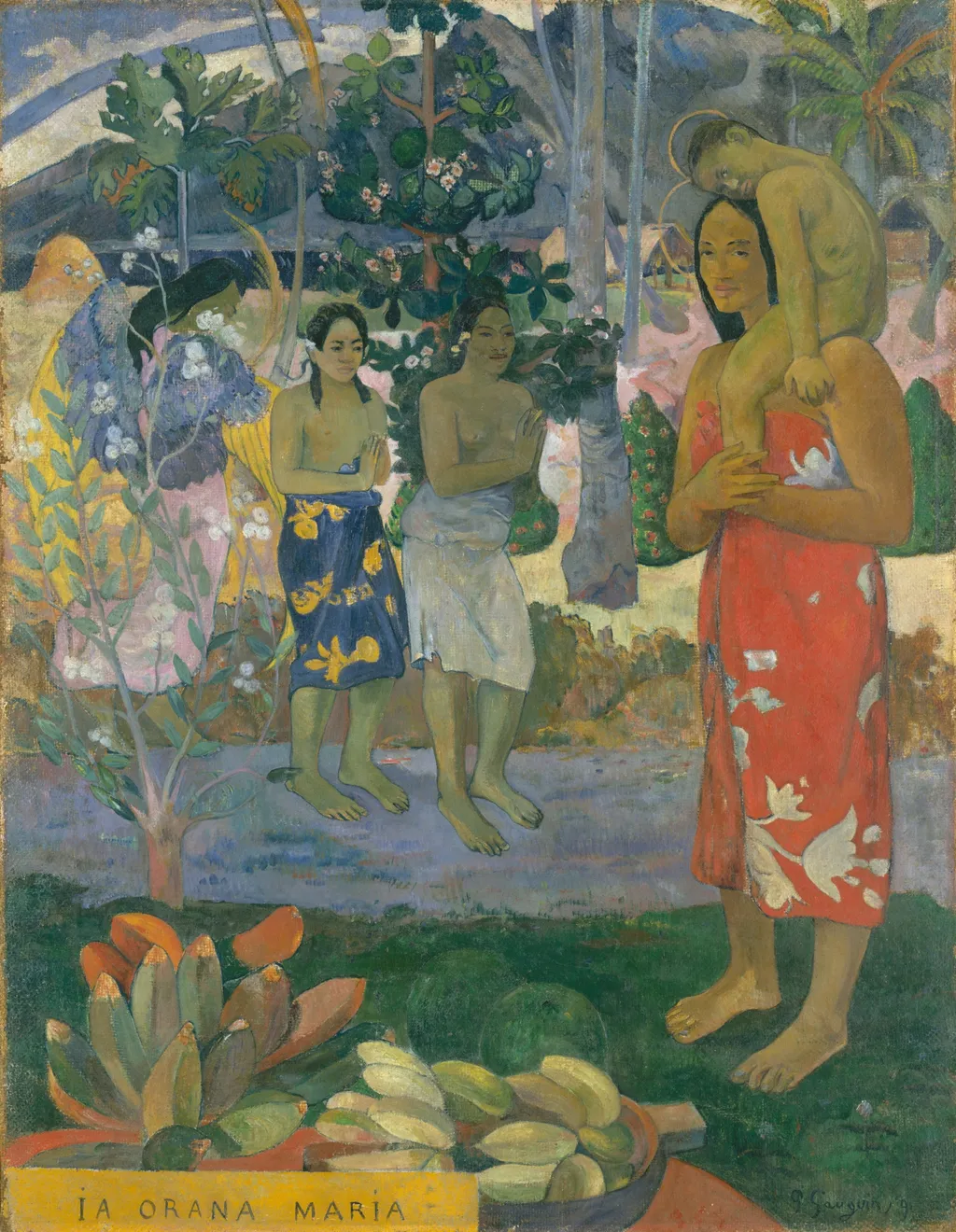
Ia Orana Maria is an oil painting by the Les Nabis artist Paul Gauguin. It dates from 1896 and is held in the collection of the Metropolitan Museum of Art.
About this work
A yellow-winged angel hovers at the left edge of Paul Gauguin's canvas, guiding two Tahitian women toward a haloed mother and child.
A yellow-winged angel hovers at the left edge of Paul Gauguin's canvas, guiding two Tahitian women toward a haloed mother and child. The figures wear bright pareus against a somber, mountainous landscape of flowering trees and bananas. Painted soon after Gauguin reached Tahiti, the scene recasts the Christian Annunciation in Polynesian dress. The Metropolitan Museum holds it, bequeathed by Sam A. Lewisohn in 1951.
Subject & Meaning
Ia Orana Maria reimagines the Christian Madonna and Child within a Tahitian context, blending Western religious iconography with local cultural elements. The composition centers on a Tahitian mother and child, depicted as Mary and Jesus, being revealed by an angel to two Polynesian women in prayer. This syncretic scene merges the Annunciation with the Adoration of the Shepherds, set in a lush, Edenic landscape.
Gauguin drew inspiration from Borobudur reliefs for the figures' poses, and the angel's palm branch introduces a symbol of martyrdom, adding complexity to the idyllic vision. The title, meaning "Hail Mary" in Tahitian, and the artist's own description affirm the Christian subject. Critics like Octave Mirbeau noted the work's fusion of barbaric splendor, Catholic liturgy, and exotic symbolism.
Technique & Style
Ia Orana Maria is an oil-on-canvas painting executed in 1891. Gauguin employed a simplified, frieze-like composition with figures posed in shallow, relief-like space, inspired by Javanese temple reliefs. He used bold, non-naturalistic colors and strong outlines, heightening the sense of vision and otherworldliness.
The artist abolished chiaroscuro, rendering the Polynesian women's drapery primarily through coloristic means while maintaining a vigorous plastic presence. The composition balances horizontal and vertical lines, path, horizon, arms, and trees, engendering a calm, ceremonial order. The work exhibits a potent chromaticism and a strong decorative quality, amalgamating Eastern decorative sense with ancestral Western solidity, and emphasizes 'primitive' features with large feet and marked facial traits. No condition information is provided in the sources.
History & Provenance
Paul Gauguin painted Ia Orana Maria in 1891 shortly after arriving in Tahiti during his first stay, marking one of the earliest major works of his Tahitian period. It is the only explicitly Christian painting from that trip. Gauguin described the composition in an 1892 letter to Daniel de Monfreid.
The painting was first exhibited at Galerie Durand-Ruel in Paris in 1893. Gauguin attempted to donate it to the Musée du Luxembourg but was refused. It was sold to publisher Michel Manzi for 2,000 francs.
In 1919, Manzi sold it to the American dealer Knoedler for 58,000 francs. It was then acquired by lawyer and banker Samuel A. Levisohn, who bequeathed it to the Metropolitan Museum of Art in 1951.
Ia Orana Maria is held at the Metropolitan Museum of Art in New York (accession 51.112.2), which received the painting in 1951 as a bequest from Samuel A. Levisohn. The work was first exhibited in Paris at the Galerie Durand-Ruel in November 1893, following Gauguin's return from Tahiti. Gauguin had offered the painting to the Musée du Luxembourg, but curator Henry Roujon refused it.
It was sold to the publisher Michel Manzi for 2,000 francs, then purchased by the dealer Knoedler in 1919 for 58,000 francs, and later acquired by Levisohn. The painting is number 428 in the Wildenstein catalogue raisonné.
Context
Painted in 1891 during Gauguin's first Tahitian stay, Ia Orana Maria is considered a landmark work of his Tahitian period, marking his first major attempt to fuse Western Christian iconography with Polynesian subjects. Its composition draws inspiration from the reliefs of Borobudur, merging Buddhist and Catholic visual languages. Upon its 1893 Paris exhibition at Durand-Ruel, the painting received praise from critic Octave Mirbeau, who called it an "inquiétant et savoureux mélange de splendeur barbare, de liturgie catholique, de rêverie hindoue, d'imagerie gothique, de symbolisme obscur et subtil".
However, it was rejected by curators at the Musée du Luxembourg for being too exotic. Despite this early rejection, the work is now recognized as an emblematic synthesis of Gauguin's primitivist vision, and is held as a major piece in the Metropolitan Museum of Art.
Overview
Ia Orana Maria (Hail Mary) is a significant oil painting completed by French artist Paul Gauguin in 1891. This canvas, now held by the Metropolitan Museum of Art, marks one of the earliest and most representative works from his time in Tahiti. It presents a distinctive blend of Western religious narrative, specifically the Madonna and Child or Annunciation, with the visual and cultural elements of Polynesian life, setting a precedent for his subsequent artistic explorations in the Pacific.
Own this work as a print
Artist & collection
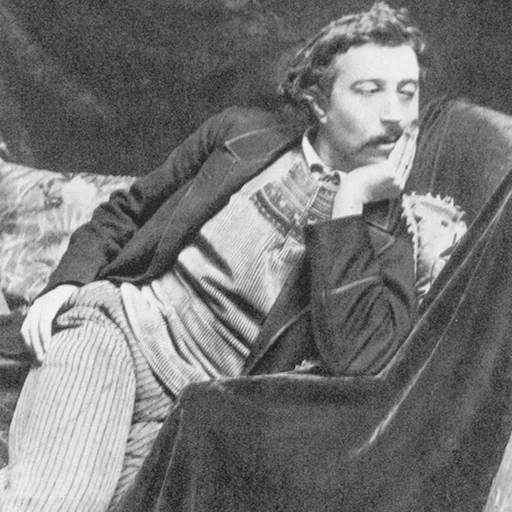
Artist
Eugène Henri Paul Gauguin (; French:; 7 June 1848 – 8 May 1903) was a French painter, sculptor, printmaker, ceramist, and writer, whose work has been primarily associated with the Post-Impressionist and Symbolist movements.