A religious painting is asked to do something no other category of picture demands. A still life only has to convince you of apples and a pewter jug. A portrait answers to a face that once sat in a room. Sacred art has to give weight to a presence no painter ever met, and persuade a viewer to feel that presence steady enough to be studied, prayed to, or wept in front of. The argument of this essay is narrow, and I want to defend it canvas by canvas: the religious genre is not defined by its subjects but by this single task of fixing attention on the unseen, and the surest way to watch a painter solve it is to stand in front of one work and refuse to look away.
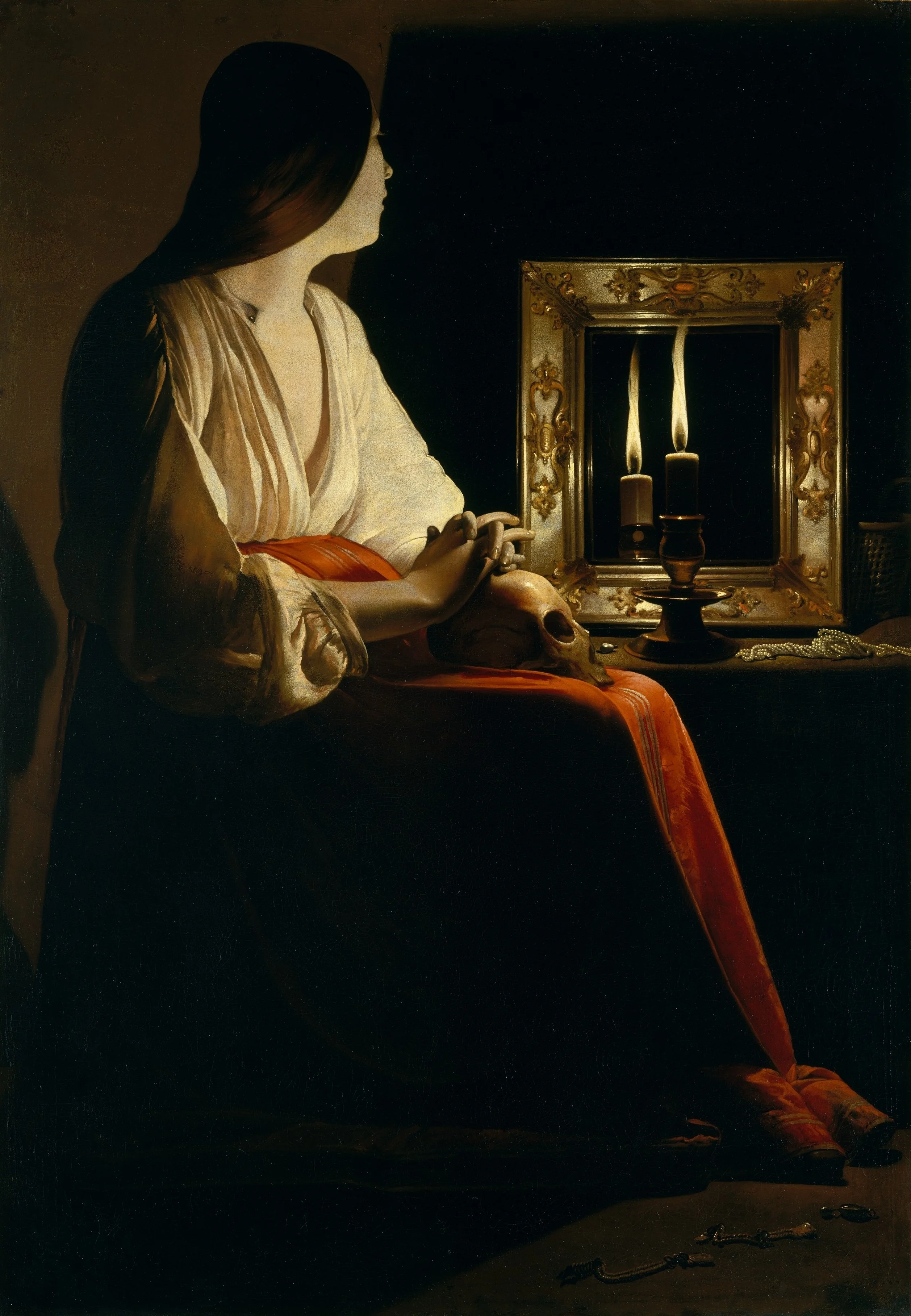
I will use one defining picture to carry the whole case, Georges de La Tour's The Penitent Magdalen, and let the rest of the genre fall in behind it: the iconic Madonnas, the narrative martyrdoms, the saints carrying their fixed attributes like name tags. La Tour's solution to the problem is subtraction. He strips the story almost to nothing and leaves a woman, a flame, a skull, and a long silence. Once you have seen how little he needs to make the sacred hold still, every other religious painting in the building starts to read as a set of choices about how much to add back.
The thing a religious picture has to do
Begin with the problem before the solution. Sacred subjects come pre-loaded with meaning, which sounds like an advantage and is actually a trap. Everyone in La Tour's France already knew who the Magdalen was, already knew the skull meant death and the flame meant the brevity of a life. A painter who simply assembles the props has made an inventory, not a picture. The deeper task is to make a viewer who knows all of this anyway slow down and feel it as if for the first time. That is a problem of attention, and it is why religious painting, more than any other genre, lives or dies on how a composition controls the eye.
Art historians sort sacred images into two broad kinds, and the distinction is genuinely useful at the easel. There are iconic images, which simply present one or more holy figures in static dignity, and narrative images, which catch a moment inside a story (Wikipedia, Religious art). A Madonna enthroned is iconic. A Crucifixion is narrative. The two modes ask for opposite kinds of attention: the iconic image wants you to settle and adore, the narrative image wants you to read forward in time. What makes La Tour's Magdalen so strange, and so instructive, is that it sits between the two. Nothing happens in it, yet it is saturated with a story that has already ended.
One candle: looking at La Tour's Magdalen
Stand close. The whole picture is built around a single candle flame, and almost everything in it is an answer to that flame. The light is low and warm, the kind that only reaches a few feet before the dark swallows it. The Magdalen sits in profile, turned away from us, her face caught at the edge of the glow so that one cheek and the bridge of her nose are lit while the back of her head dissolves into brown shadow. Her hands rest in her lap, fingers laced over a skull. She is not gesturing. She has stopped.
Look at how La Tour rations the brightness. The flame itself is partly screened, so the strongest light in the canvas is not the fire but the reflection it throws: a mirror, set behind the candle, catches and doubles the glow and bounces it back across the scene. That mirror is the quiet engine of the picture. It turns one small flame into two sources, and it puts a second, ghost candle in the painting that you only notice on a long look. The Magdalen is studying that reflection. Vanity's old instrument, the looking glass, has been repurposed into a meditation on a light that will gutter out, the way a life does.
Then the colour. A long fall of red skirt anchors the lower half of the canvas, the single warm note allowed to spread, and against it her white blouse and bare forearm read almost as paper. The skull sits in her lap, ivory against the red, lit just enough to show the curve of the cranium and the dark of the eye socket. La Tour gives you the geometry of a still life and the patience of a portrait, and refuses you the event of a narrative. Nothing tells you what second this is. That is the point. He has taken a saint with one of the most dramatic stories in the canon, the courtesan who washed Christ's feet with her hair, and painted the moment after all the drama, when only the thinking is left.
This is the subtraction I mean. There is no Christ in the frame, no crowd, no ointment jar being poured, no tears mid-fall. The sacred is made present by what has been removed. A Baroque contemporary in Rome would have given you the whole convulsion of repentance in flying drapery and upturned eyes. La Tour gives you a woman, a flame, and a skull she will not put down, and trusts the dark to do the rest. It is the most economical answer to the genre's problem I know, and it works because every element left in the frame is load-bearing.
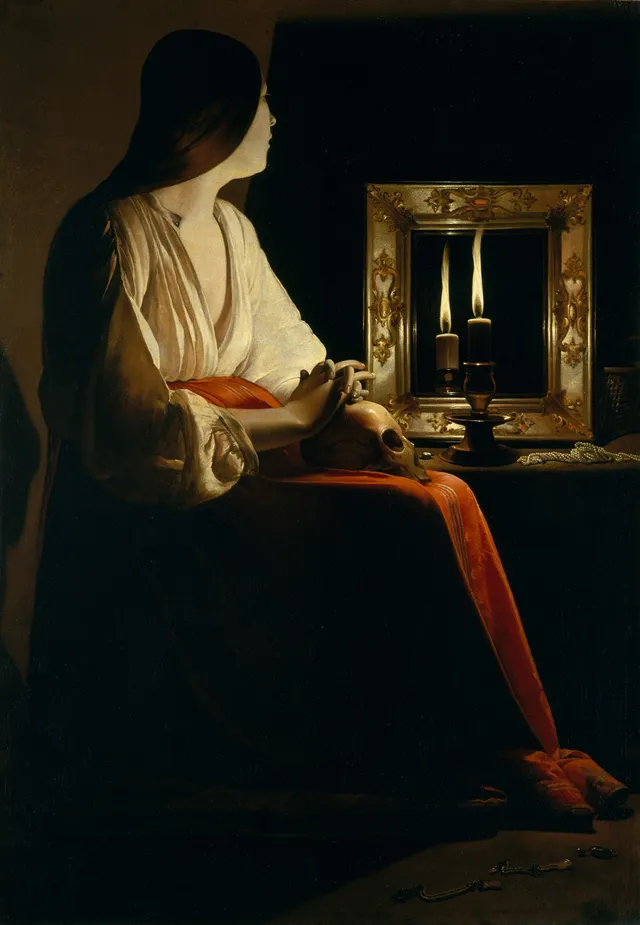
La Tour painted this subject more than once, and the variants are themselves a lesson in how small adjustments change the prayer. The Gallery also holds his Repentant Magdalen, where the staging shifts, the mirror and skull rearranged, the light recalculated. Set the two beside each other and you watch a painter testing how far he can push the same handful of objects before the meaning tips. That is close-looking turned into method: the difference between two nearly identical canvases is where the artist's real thinking lives.
Iconic and narrative, and the saints in between
Carry La Tour's question out into the wider genre and the two modes snap into focus. Hold his stilled Magdalen against Raphael's Saint George and the Dragon, a small panel that does the opposite job with equal precision. Raphael freezes the single most violent instant of the legend: the lance driving down, the horse rearing, the dragon's body coiled under the hooves. It is pure narrative, all forward motion, and it asks you to read the picture left to right like a sentence with a verb in the middle. The painting wants your eye to move. La Tour's wants it to settle. Same genre, opposite instructions to the viewer.
Now the iconic pole. Raphael's The Alba Madonna is a tondo, a circle, and the round format is itself an argument for stillness, because a circle has no end to read toward. Mary sits in a calm landscape with the Christ child and the infant John, and the composition turns gently inside its frame, returning the eye always to the center. There is a story implied, the small cross John offers, the foreknowledge of the Passion in the children's grip on it, but Raphael keeps it iconic. You do not read this picture; you rest in it. A more anonymous example from the same orbit, the Gallery's Madonna and Child by an unnamed Italian hand of the sixteenth century, shows how thoroughly the type had hardened into a workshop formula: the pose, the gaze, the tilt of the head all inherited rather than invented.
Between the poles sit the works that complicate the whole scheme, and they tend to be the most interesting. Henri Regnault's Salome takes a religious narrative, the demand for the Baptist's head, and drains the narrative out of it until what remains is closer to a portrait of a mood: a young woman seated with a charger and a knife, gorgeous, indolent, and faintly menacing. Painted in 1870, it shows the nineteenth century pulling sacred subjects loose from devotion and toward spectacle. The genre by then had become a stage on which a painter could perform technical bravura, the religious story a pretext for satin and skin. La Tour, two centuries earlier, used the same biblical raw material to do the reverse: to quiet the viewer rather than dazzle him.
Where the genre comes from
La Tour's economy makes more sense once you know what it was reacting against, and that history runs deep. The oldest surviving Christian images are modest things: small reliefs carved on Roman sarcophagi from the beginning of the second century, and painted figures hidden in the catacombs (Wikipedia, Christian art). The earliest sacred art was already working with subtraction, partly by necessity, partly by conviction, sketching the shepherd and the fish in a few strokes because the meaning was carried by a community that already knew the code. The panel icon grew out of this. The very word comes from the Greek eikōn, meaning simply 'image', and it named the sacred portrait that became the heart of Byzantine devotion (Smarthistory). An icon is the purest iconic image: a face, gold, and the demand that you meet its gaze.
The explosion of religious painting we associate with the genre came later, and it had patrons. Production of devotional images in Florence rose sharply in the early fourteenth century with the rise of the mendicant orders, the Franciscans and the Dominicans, who sponsored much of the art the city made (The J. Paul Getty Museum). Preaching orders needed pictures that taught, and so the narrative cycle flourished, the life of Christ told panel by panel across a chapel wall, a subject the Metropolitan Museum treats as central to Italian painting of the period. By La Tour's day in the 1630s and 1640s, the genre had absorbed a thousand years of this machinery, and a thoughtful painter had to decide which parts of the apparatus to keep. La Tour kept the candle and threw away the gold.
What the archive shows
Set La Tour's single candle against the scale of the thing and the contrast sharpens. Across Artifact World Gallery the religious genre is the largest single body of work we hold: 20,928 paintings spread over 231 venues, made by 3,527 named hands, the earliest reaching back roughly a thousand years and the latest finished in 2021. That span, from medieval panel to a canvas painted in living memory, is the longest continuous run of any genre in the collection, and it tracks exactly what the Getty observes about Florence, that sacred painting grew where institutions paid for it. The works cluster around the centuries when the Church and its orders were the largest patrons in Europe, then thin and scatter as that patronage gives way to private collectors and, eventually, to painters working the old subjects for reasons of their own.
The numbers also explain why a single defining work is the right lens rather than a survey. Twenty thousand religious paintings cannot be characterized by their average; the average religious picture is a competent Madonna from a workshop whose master we will never name, like the sixteenth-century panel above. The genre's intelligence lives in its outliers, the handful of artists who looked at an inherited subject and found a new way to make it hold still. La Tour is one. El Greco, with the ninety-odd works the Gallery holds under his name, is another kind of answer entirely, stretching saints into flame-shaped bodies so the spiritual charge reads as physical distortion. Fra Bartolomeo, a Dominican friar who burned his own early work in Savonarola's bonfire and then spent a career rebuilding sacred composition on calm geometry, is a third. The genre is not one solution. It is the same problem solved thousands of times.
Works discussed in this article
Reading the signs
There is one more reason the religious genre rewards close-looking above any other, and it is the matter of iconography. Sacred painting is written in a fixed symbolic vocabulary that the period viewer could read fluently and the modern viewer mostly cannot. A lamb stands for Christ, a dove for the Holy Spirit, and these were not decorative flourishes but legible signs, as precise as words (Tate, iconography). The skull in La Tour's lap is one such sign, the memento mori that turns a portrait into a meditation. The mirror is another, vanity converted to contemplation. To look closely at a religious painting is partly to read it, and the genre assumes a literacy most of us have lost.
This is where the close-looking method pays its largest dividend. You cannot recover the period viewer's instant fluency, but you can earn a slower version of it by staying with one picture until its signs declare themselves. The skull resolves from a still-life object into a thought about death. The mirror stops being a glass and becomes the soul examining its own brief light. The averted face stops being a compositional choice and becomes the refusal of the saint to perform her penitence for us; she is doing it for herself, in the dark, and we are permitted only to watch. None of that is legible from a thumbnail or a wall label. It is the reward of standing still in front of the work, which is the same discipline the painting is depicting.
Which returns the argument to where it began. The religious genre asks a painter to make the unseen hold still, and it asks a viewer to slow down enough to feel it. La Tour built a picture in which both demands are the same gesture: a woman sits motionless, examining a flame, and the painting hands you her stillness as the only way in. The Madonnas and martyrdoms and dragon-slayers around it are louder, and some are greater, but none states the genre's core task more plainly. Find a religious painting you can stand in front of for ten minutes. Then notice that ten minutes is exactly what it was built to ask of you.
Sources & further reading
- Religious art — Wikipedia
- Iconography — Tate
- Devotion and the Mendicant Orders in Florence — The J. Paul Getty Museum
- Icons, an introduction — Smarthistory
- Christian art — Wikipedia
- Christ Washing the Disciples' Feet — Rijksmuseum
- Painting the Life of Christ in Medieval and Renaissance Italy — The Metropolitan Museum of Art
- Sacred and Profane Beauty: The Holy in Art — Internet Archive