Artist
Charles-Émile Jacque

France
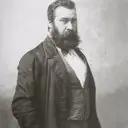
Charles-Émile Jacque is a France Barbizon school artist. 106 works are cataloged here, principally at Cleveland Museum of Art.
Charles-Émile Jacque (23 May 1813 – 7 May 1894) was a French painter of Pastoralism and engraver who was, with Jean-François Millet, part of the Barbizon School. He first learned to engrave maps when he spent seven years in the French Army.
Overview
Charles-Émile Jacque (23 May 1813 to 7 May 1894) was a French painter and engraver who played a foundational role in the Barbizon School. Recognized as a prominent animalier, he is best known for his realistic depictions of pastoral life, focusing on shepherds, flocks of sheep, poultry, and farm interiors. Alongside his friend Jean-François Millet, Jacque relocated to Barbizon in 1849 to escape a cholera epidemic in Paris, a move that cemented his commitment to rural subject matter and direct observation of nature. Beyond painting, Jacque was instrumental in the nineteenth-century revival of etching, producing over 500 prints in his lifetime and earning praise from critics like Charles Baudelaire for the boldness and freedom of his copperplate work, which recalled the Old Masters.
Biography & dates
Born in Paris to a family of peasants, Jacque began an apprenticeship with a map engraver in 1830. That same year, he joined the French Army to support the July Revolution and Louis-Philippe I, participating in the siege of Antwerp during the Belgian Revolution. During his military service, which lasted until 1835 when he was discharged with the rank of corporal, he produced his first drypoint etching of a rural landscape. After leaving the army, he spent time in Épervans with relatives, sketching rural life in Burgundy. From 1836 to 1838, he traveled to London to work on wood engravings for literary works, including editions of Shakespeare. Returning to Paris around 1838 or 1840, he established a large studio and contributed satirical lithographs to publications like Le Charivari. He made his Salon debut in 1844 with an etched reproduction of a landscape by Théodore Rousseau, earning critical attention and government commissions. In August 1849, fleeing the Paris cholera outbreak, he settled in Barbizon with Millet, buying property and even breeding poultry. He left Barbizon in 1854, later acquiring a home in Le Croisic in 1871. Jacque continued working from his studio on the Boulevard de Clichy in Paris until his death in 1894. He is buried in Père-Lachaise Cemetery.
Style & movement
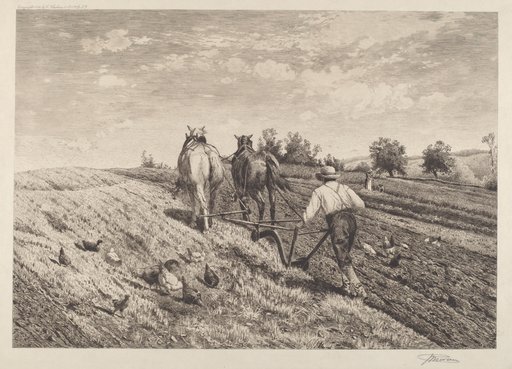
Jacque was a central figure in the Barbizon School and the Realist movement, prioritizing unidealized depictions of nature and agricultural life. While Millet emphasized the human laborer, Jacque focused on the animals and their activity, producing sensitive, realistic portrayals of shepherds and flocks. As an engraver, he was credited, alongside Félix Bracquemond and Félix Buhot, with reviving seventeenth-century etching techniques. Scholar Henri Béraldi divided Jacque's printmaking into two periods: an early phase of spontaneous, Dutch-inspired vignettes, and a later, more famous period of larger plates where the Dutch character of his work became less prominent. His paintings evolved toward looser, life-sized compositions, and his practical immersion in animal husbandry informed his accurate, zootechnical approach to livestock, particularly merino sheep and purebred poultry, distinguishing his work from romanticized pastoral idylls.
Major works
Jacque's oeuvre includes numerous pastoral paintings and over 460 etchings created by 1866, eventually surpassing 500. His government-commissioned painting Les Boeufs à l'abreuvoir (1848) is held at the Musée des Beaux-Arts in Angers. Other notable paintings include Hammelherde in einer Landschaft at the Musée du Luxembourg in Paris, Schafherde im Eichenwald at the Swedish National Museum in Stockholm, Im Schafstall (1853) at the Hamburger Kunsthalle, and Schafherde am Feldrand at the Museum der bildenden Künste Leipzig. The Metropolitan Museum of Art in New York holds four of his sheep paintings. As an illustrator, he produced steel engravings for Charles Perrault's Contes du temps passé and woodcuts for Oliver Goldsmith's The Vicar of Wakefield, as well as works for La Grèce pittoresque and Versailles ancien et moderne. He also authored the practical treatise Le Poulailler in 1857.
Influences & students
Jacque was largely self-taught in painting, drawing his primary influence from Rembrandt and seventeenth-century Dutch masters, whose works he copied early in his career. His technique was also shaped by Théodore Rousseau and Narcisse Diaz de la Peña. A significant art historical debate concerns his relationship with Jean-François Millet. While traditional accounts suggested Millet influenced Jacque's rustic style, scholars like Jean Guiffrey and Loys Delteil argued that Jacque preceded Millet in painting rural scenes and peasants, and that Jacque's penetrating intelligence influenced Millet's spirit and his decision to move to Barbizon. Jacque's own circle included his sons Émile and Frédéric, who became painters and engravers of rural subjects. His brother Léon and a daughter were also his pupils, though his daughter ceased artistic activity after marrying his student Camille Dufour. His friend Auguste Delâtre assisted him in printing his early etchings.
Legacy
Jacque achieved significant official recognition during his lifetime, receiving medals at the Salon from 1850 to 1864, a gold medal at the 1889 Exposition Universelle, and being named a Chevalier of the Legion of Honour in 1867. By 1870, his animal paintings were highly regarded by connoisseurs and fellow artists, including the German animal painter Carl Jutz. After his death, a sale of his atelier was held in November 1897. His works entered major museum collections across Europe and America, including the Louvre, the Musée d'Orsay, the Hermitage Museum, and the Isabella Stewart Gardner Museum. His grandson, Marcel Jacque, later managed the Rousseau Museum in Barbizon. Modern scholars and collectors have experienced a resurgence of interest in Jacque, recognizing both his technical innovations in etching and his critical, early role in the Realist movement. The Museum Goch held a notable exhibition of his work from late 2014 to early 2015.
Works by Charles-Émile Jacque
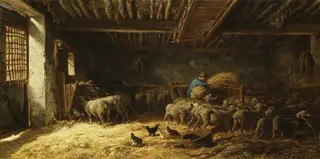 The Sheepfold
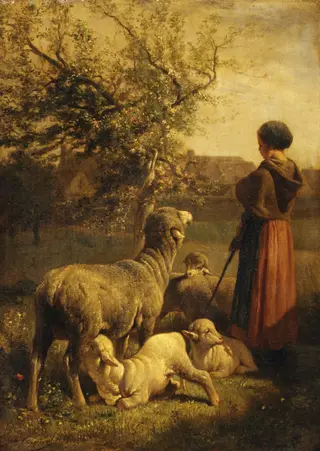 Springtime
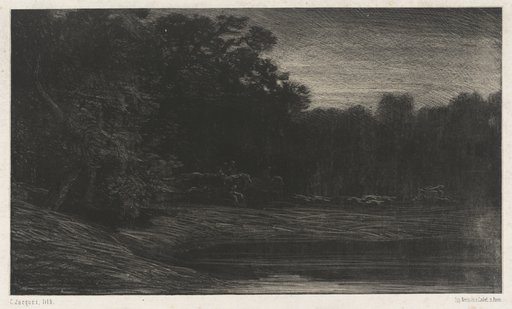
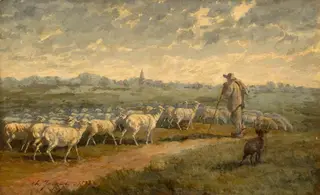 Landscape with a Herd
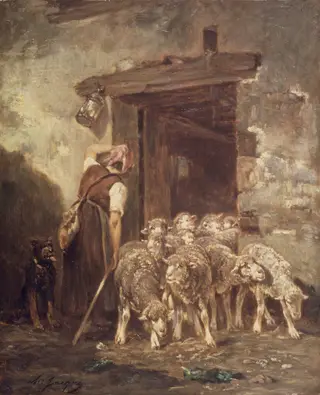 Leaving the Sheep Pen
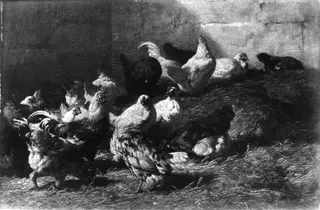 Chickens
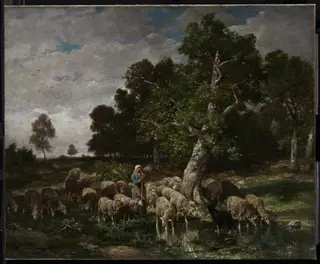 Shepherdess Watering Sheep
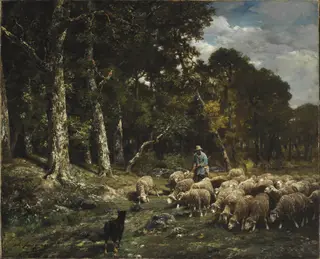 The Flock
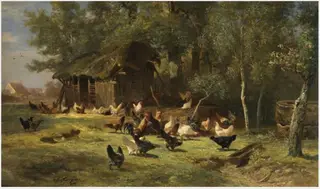 Poultry among Trees
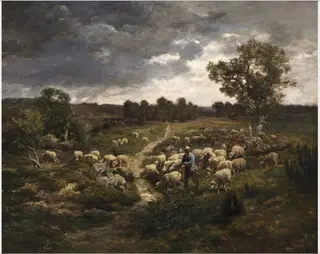 Sheep
Sheep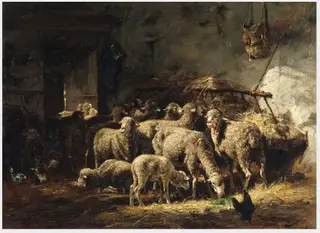 Sheep in a Barn
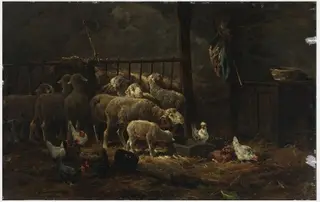 Sheep and Chickens in a Barn
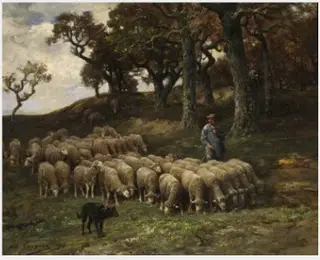 A Shepherd and Flock
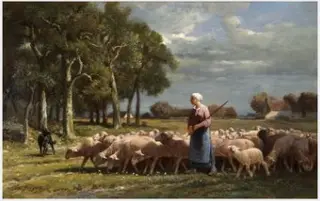 A Shepherdess near a Wood, Barbizon
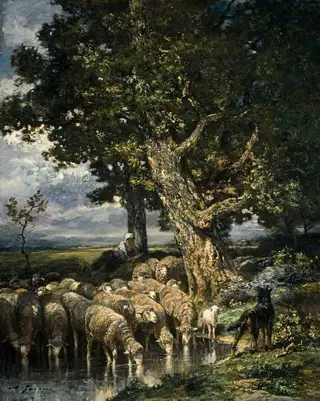 Sheep at a Watering Place
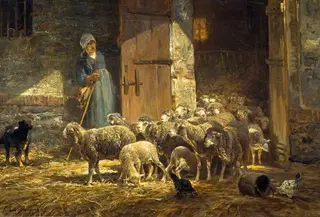 Leaving the Stall
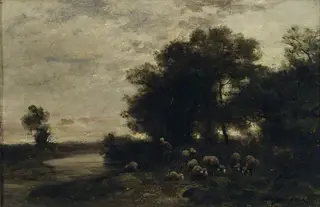 Shepherdess watering her Flocks
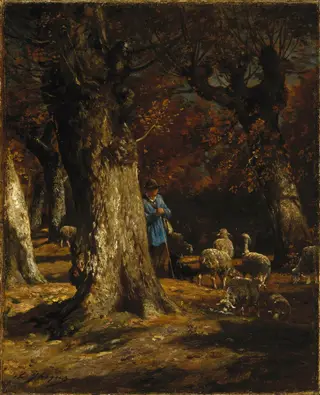 The Old Forest
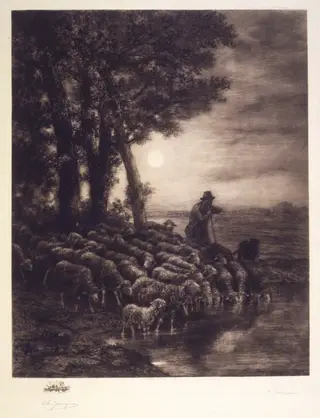 Moonlight
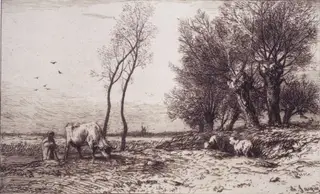 Winter
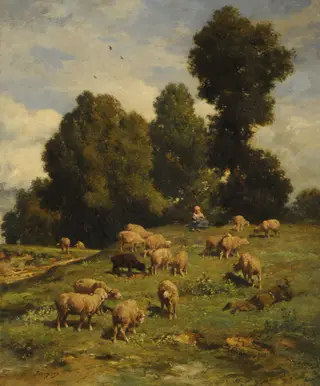 Sheep in pasture
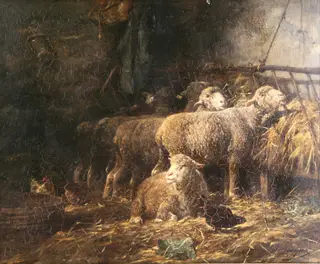 Bergerie
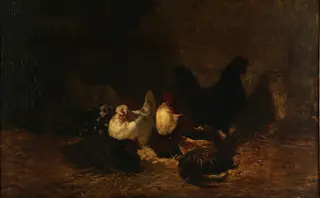 The henhouse
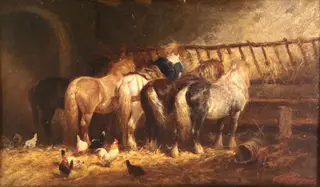 Ecurie (El Establo)
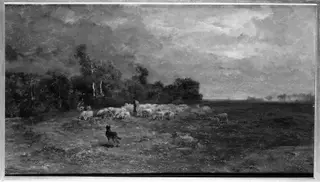 Shepherd and Sheep on the Edge of a Plain
106 works in the catalog · 24 shown
Collections represented


Artists in a similar vein