Artwork
Annunciation
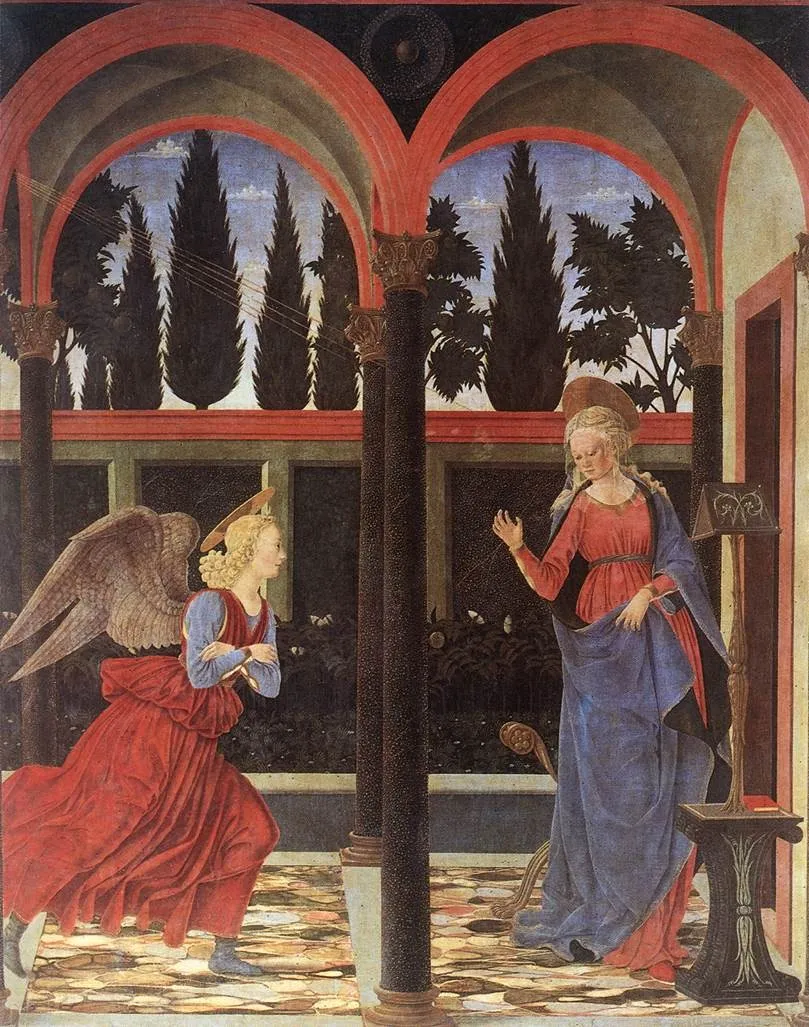
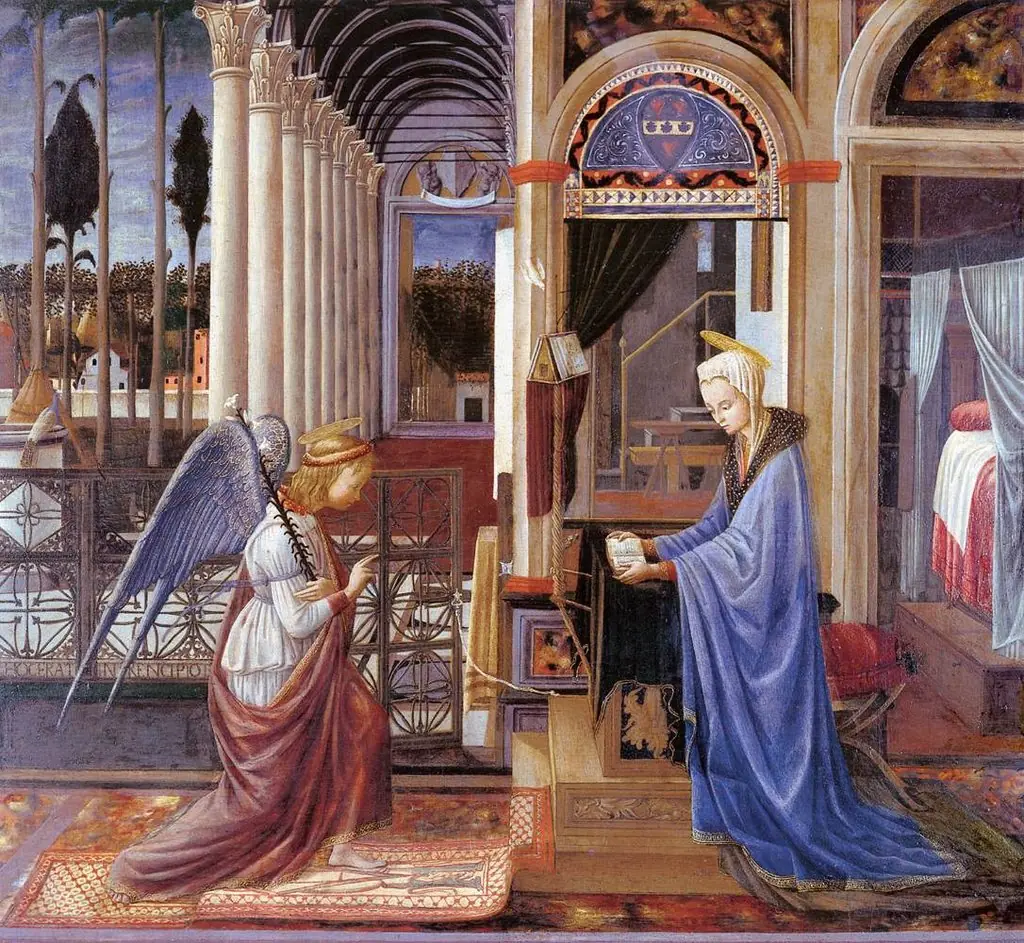
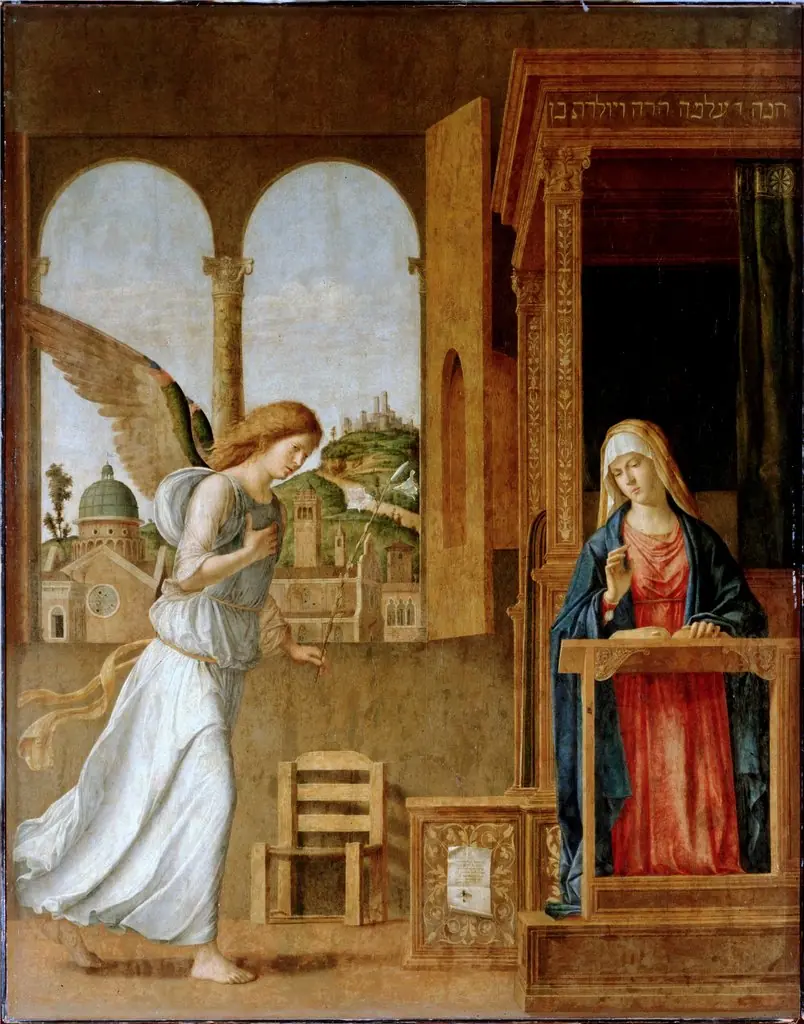
Annunciation is a tempera painting by the Early Renaissance artist Alesso Baldovinetti. It dates from 1457 and is held in the collection of the Uffizi Gallery.
About this work
Subject & Meaning
Set in a Renaissance loggia, the composition centers on Mary rising from a chair, her gesture conveying surprise as she pauses from a red-covered book.
The painting depicts the biblical Annunciation, showing the archangel Gabriel announcing to the Virgin Mary that she will conceive Christ, a scene drawn from Luke 1:26–38. Set in a Renaissance loggia, the composition centers on Mary rising from a chair, her gesture conveying surprise as she pauses from a red-covered book. Gabriel enters from the left, his billowing robe and crossed arms signaling reverence, while golden rays descend from above, indicating the moment of divine conception.
Behind Mary, a flowering hedge evokes the hortus conclusus, a traditional emblem of her purity, and a door appears as a standard iconographic motif. The marble pavement and architectural forms reflect the influence of Fra Angelico and Michelozzo, while the luminous palette and thick, saturated color in Gabriel’s robe reflect Baldovinetti’s engagement with Domenico Veneziano’s lessons.
Technique & Style
Baldovinetti's Annunciation is executed in tempera on a wood panel measuring 167 × 137 cm. The scene is set within an open loggia closed at the rear by a high wall, beyond which the tops of cypresses and a fruit tree, evocative of the Tree of Paradise, emerge. The Virgin's elegantly elongated figure rises from her seat beside a small table holding a red booklet and a tall badalone, while the angel enters from the left in a wind-tossed robe, arms crossed in humility as golden rays of divine fecundation descend from above.
The architecture is simple and airy, recalling Michelozzo's designs, and the colored marble pavement is inspired by Fra Angelico. The luminosity reflects the lessons of Domenico Veneziano, though the pastose, intense color of the angel's robe is a personal experiment later taken up by other Quattrocento painters. A pentimento is visible in the Virgin's head beneath an impalpable transparent veil, and behind her the standard door of the iconography appears beside a flowering hedge alluding to the hortus conclusus.
History & Provenance
The work was commissioned for the Sylvestrine monks and painted in 1457 by Alesso Baldovinetti for the church of San Giorgio alla Costa in Florence.
It remained in situ until transferred to the Uffizi Gallery, where it is conserved today. Giorgio Vasari mistakenly attributed the panel to Pesellino upon seeing it in the church.
The painting’s dimensions are 167 cm in height and 137 cm in width.
The painting is currently held by the Uffizi Gallery in Florence, Italy. It was originally created for the Sylvestrine monks at the church of San Giorgio alla Costa, from where it was later transferred to the museum. While specific inventory or accession numbers are not provided in the available sources, the work is documented in the official catalog of the Polo Museale Fiorentino and referenced in the Federico Zeri Foundation database.
Historical records indicate that Giorgio Vasari once misattributed the piece to Francesco di Pesellino upon viewing it in its original location. No specific exhibition history dates or titles are detailed in the provided texts.
Context
The critical reception of Alesso Baldovinetti's Annunciation has been shaped by its Renaissance context and scholarly interpretation. Early commentators such as Giorgio Vasari misattributed the work to Pesellino, reflecting the challenges of attributing pieces within a crowded Florentine workshop environment. Modern scholarship, as noted in French and Italian encyclopedic sources, emphasizes the painting's innovative use of perspective, naturalistic detail, and emotional nuance, situating it within the broader trajectory of 15th-century devotional art.
Its placement in the Uffizi Gallery continues to inform studies on Renaissance religious painting and the evolution of Annunciation iconography.
Legacy
The Annunciation has shaped later religious painting through its spatial clarity and emotional restraint. Art historians note its architectural framing and the subtle use of light that influenced subsequent Florentine works. The painting's composition was widely studied in the 15th century and cited by contemporary chroniclers as a model for devotional imagery.
Its reputation grew after Vasari mistakenly attributed it to Pesellino, a confusion that sparked scholarly debate about Baldovinetti's innovations. Modern assessments highlight its technical experimentation with tempera and its role in bridging early and High Renaissance aesthetics.
Overview
Alesso Baldovinetti’s Annunciation (1457) is a tempera panel that presents the biblical moment when the Archangel Gabriel informs the Virgin Mary of her forthcoming role. Executed during the early Renaissance, the work is part of the Uffizi Gallery’s collection and exemplifies the artist’s engagement with religious narrative.
Artist & collection
Artist
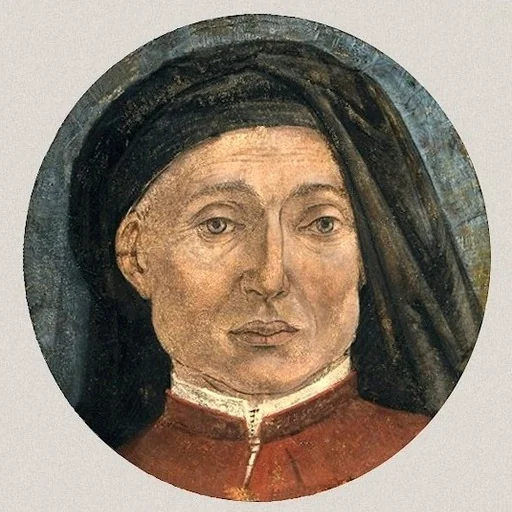
Alesso or Alessio Baldovinetti (14 October 1427 – 29 August 1499) was an Italian early Renaissance painter and draftsman.