Artwork
The Bridge at Argenteuil
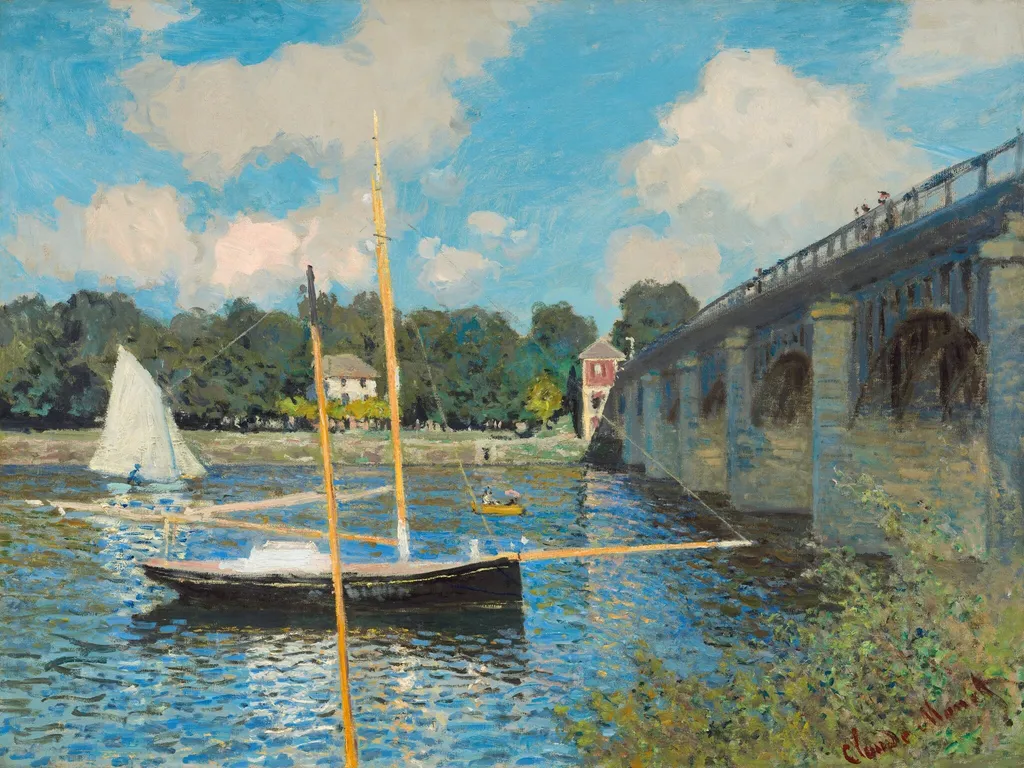
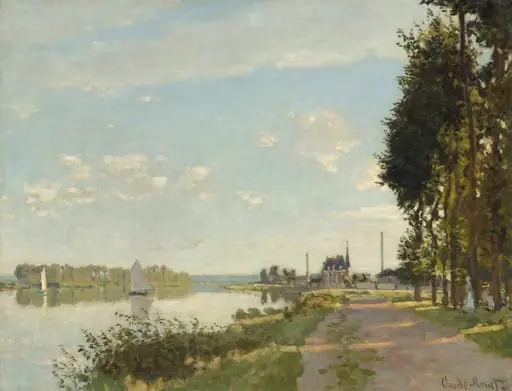
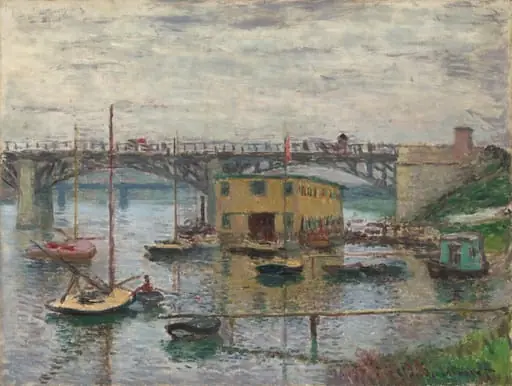
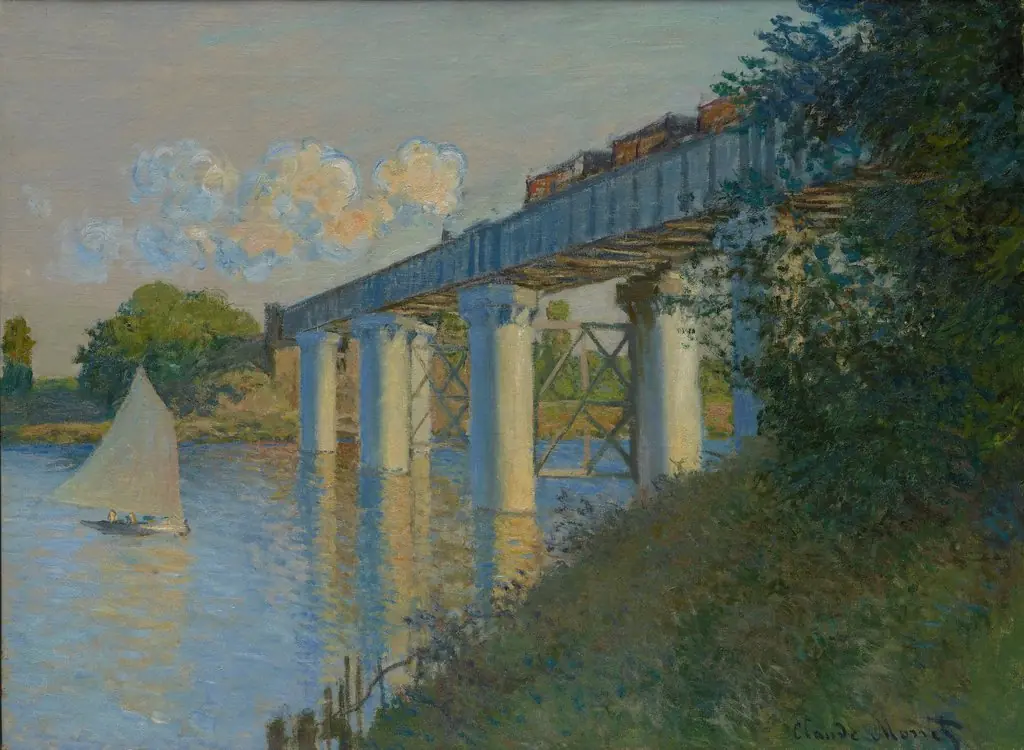
The Bridge at Argenteuil is an oil painting by the Impressionist artist Claude Monet. It dates from 1874 and is held in the collection of the National Gallery of Art.
- Inscription
- Inscribed:lower right: Claude Monet
About this work
Technique & Style
Monet employs a low-angle perspective on the right side to imbue the static, modern structures with a sense of power.
Executed in 1874, this work is an oil painting on canvas measuring 60 by 79.7 centimeters. As an Impressionist marine scene, the composition utilizes the dark mass of the road bridge to create a stark contrast with sunlit elements, effectively anchoring the narrative of modernity. Monet employs a low-angle perspective on the right side to imbue the static, modern structures with a sense of power.
The spatial dynamics are further manipulated through two masts framing a house, which guide the viewer's eye, while a mast extending toward the bottom edge visually expands the pictorial space. A bush situated in the lower right corner provides necessary visual balance to the overall representation, demonstrating the artist's deliberate construction of space through specific compositional techniques.
History & Provenance
Monet painted The Bridge at Argenteuil in 1874, an oil on canvas (60 × 79.7 cm) depicting a river scene with a boat and trees. After leaving Paris post‑1870, he settled in Argenteuil, where the titular bridge inspired the composition. The work passed through Durand‑Ruel in Paris before being sold in 1890 to collector Henri Vever, who later disposed of it at Galerie Georges Petit in February 1897 to the dealer Georges Petit, acting for the vicomte de Curel.
The painting remained in the de Curel family until its 1961 sale, after which it entered the collection of Hector Brame and was acquired for Paul Mellon, eventually being gifted to the National Gallery of Art in 1983. Ownership records also list Vever and Albert de Curel as prior owners.
La peinture « Le Pont à Argenteuil » (1874) fait partie de la collection du National Gallery of Art à Washington, D.C., où elle a été offerte par Paul Mellon en 1983. L'œuvre, acquise antérieurement par le collectionneur Henri Vever puis par le vicomte Albert de Curel, est répertoriée dans les dossiers du musée comme un cadeau de Mellon. Elle a été présentée dans le cadre de deux expositions d'impressionnisme et de postimpressionnisme organisées à Moscou et à Leningrad en 1986, qui ont mis en avant des chefs-d'œuvre majeurs du mouvement.
Overview
The Bridge at Argenteuil, painted by Claude Monet in 1874, depicts the railway bridge spanning the Seine at Argenteuil, a suburb west of Paris where the artist resided from 1871 to 1878. The composition centers on the iron lattice structure of the bridge, which cuts diagonally across the upper third of the canvas, contrasting the industrial geometry with the fluid, natural elements below. A steam train traverses the bridge, emitting a plume of white smoke that merges with the pale blue sky and soft, feathery clouds.
Below, the calm river reflects the sky and the bridge's supports, while a small boat drifts near the right bank. The riverbanks are lined with trees rendered in loose, rapid brushstrokes characteristic of Impressionism, capturing the fleeting effects of light and atmosphere rather than precise detail. This work exemplifies Monet's mature style during his Argenteuil period, where he frequently explored modern leisure and infrastructure within the landscape.
The painting reflects the artist's commitment to painting en plein air and his interest in the changing relationship between nature and modernization in the French countryside. It stands as a significant example of his exploration of light, water, and the transient qualities of the natural world.
Subject & Meaning
This painting depicts the bridge and river at Argenteuil, a location Monet frequently explored in his art. Rather than a static representation, the work reflects his ongoing study of how light, weather, and time of day transform a familiar scene. The presence of both a train and a small boat suggests a blending of industrial progress with the enduring tranquility of nature, a common theme in Impressionist landscapes of the era.
Context
Monet lived in Argenteuil, a commune on the Seine River, for several years in the 1870s, making it a pivotal site for his artistic development. During this period, he repeatedly depicted the local landscape, including this particular bridge and river. This serial approach allowed him to systematically investigate the subtle shifts in light and atmosphere, a hallmark of his Impressionist practice and a key aspect of his contribution to modern art.
Own this work as a print
Artist & collection
Artist
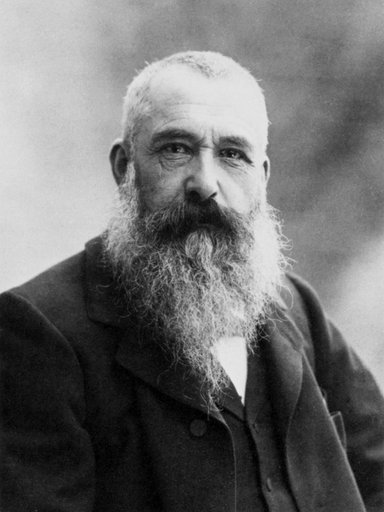
Oscar-Claude Monet was a French painter and founder of Impressionism who is seen as a key precursor to modernism, especially in his attempts to paint nature as he perceived it.