Artwork
Lithographer
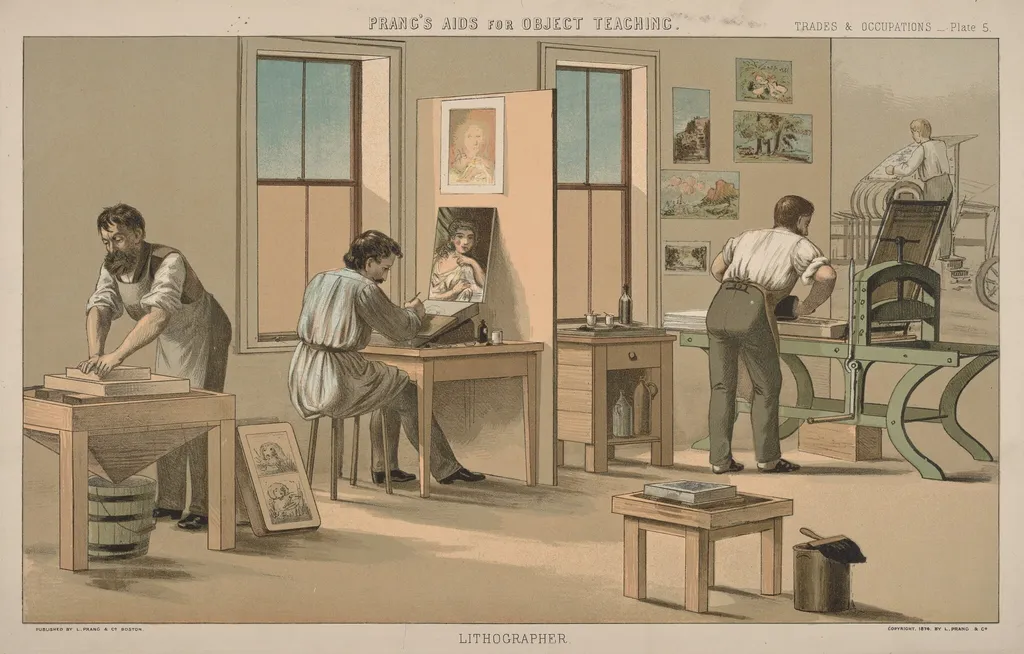
Lithographer is an ink print by the Impressionist artist American 19th Century. It dates from 1874 and is held in the collection of the National Gallery of Art. The work is a color lithograph depicting a workshop where three men are engaged in distinct stages of print production.
- Inscription
- Inscribed:recto: in stone, above image, at center: PRANG'S AIDS FOR OBJECT TEACHING.; in stone, above image, at right: TRADES & OCCUPATIONS._PLATE 5; in stone, below image, at left: PUBLISHED BY L. PRANG & CO. BOSTON; in stone, below image, at center: LITHOGRAPHER; in stone, below image, at right: COPYRIGHT, 1874. BY L. PRANG & CO.
About this work
Overview
Framed images line the walls and daylight pours in through two tall windows, situating the scene within a well‑lit studio.
The work is a color lithograph depicting a workshop where three men are engaged in distinct stages of print production. One figure carves a wooden block at a low table, another sketches at a desk while a mirror reflects a painted portrait, and the third operates a large printing press. Framed images line the walls and daylight pours in through two tall windows, situating the scene within a well‑lit studio.
Subject & Meaning
The composition illustrates the collaborative nature of traditional lithographic practice, emphasizing the division of labor among carving, drawing, and press work. By presenting each task side by side, the image underscores the technical skill and coordination required to produce a finished print, offering a visual narrative of the craft’s workflow.
Technique & Style
Executed as a color lithograph, the piece employs the medium’s characteristic flat areas of hue and fine line work to render the interior space and figures. The artist’s use of perspective and controlled lighting creates depth, while the palette highlights the contrast between the warm wooden surfaces and the cooler daylight streaming through the windows.
History & Provenance
The lithograph reflects a period when printmaking was performed manually, prior to mechanized processes. Its subject matter and visual details suggest an origin in the late 19th or early 20th century, a time when lithography was a prominent commercial and artistic technique. The work’s provenance is not specified beyond its identification as a color lithograph.
Context
Lithography, developed in the late 18th century, allowed artists to draw directly onto stone or metal plates, later transferred to paper. Workshops like the one depicted were common in urban centers, where artisans specialized in carving, drawing, and press operation to meet the demand for illustrated books, posters, and fine art prints.
Artist & collection

Artist
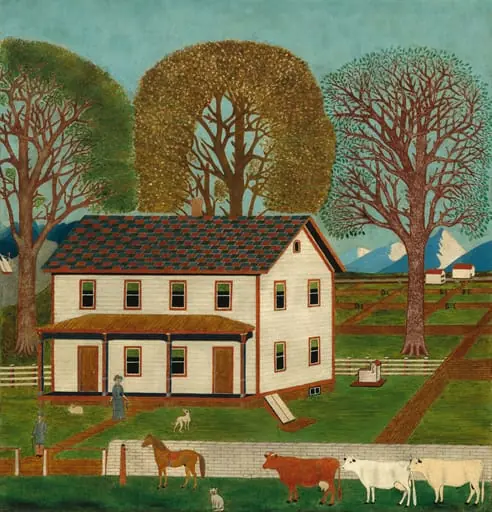
Scenes of everyday American life in the 1800s. Farmhouse in Mahantango Valley is a quiet, sunlit view of rural Pennsylvania; Boy and Girl shows two children standing close, faces turned outward. A small woodcut, The…