Artwork
Watermelon
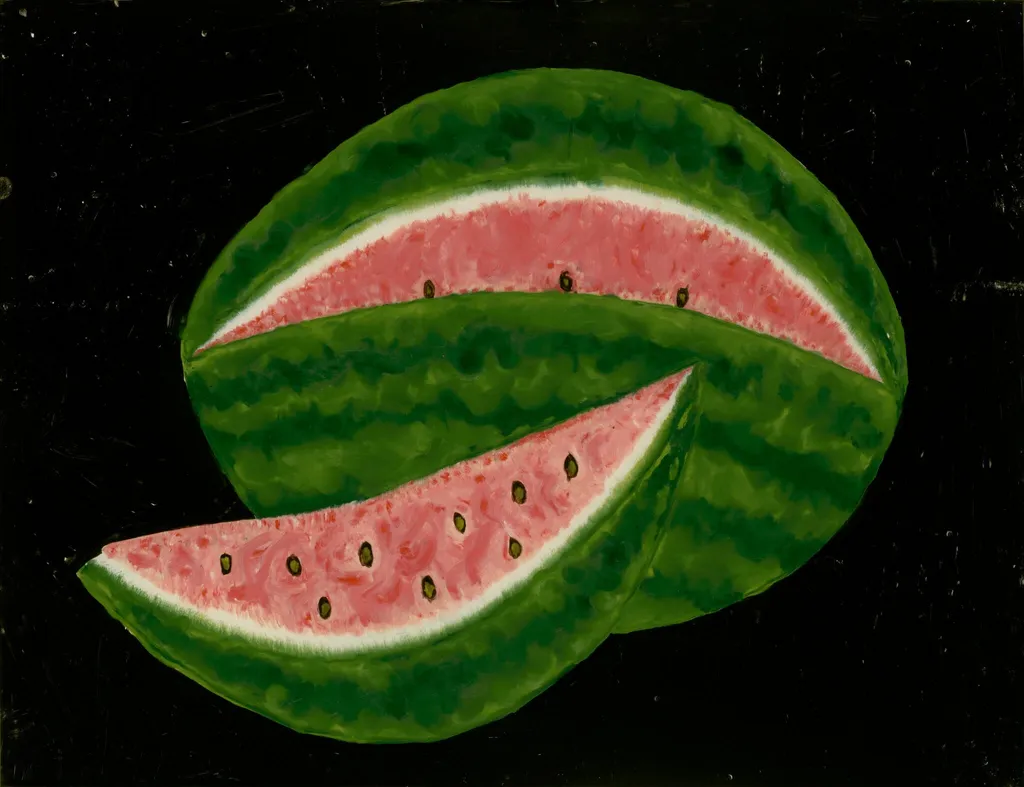
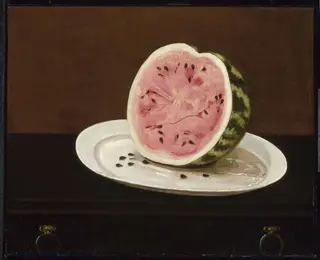
Watermelon is a glass painting. It dates from 1850 and is held in the collection of the National Gallery of Art.
About this work
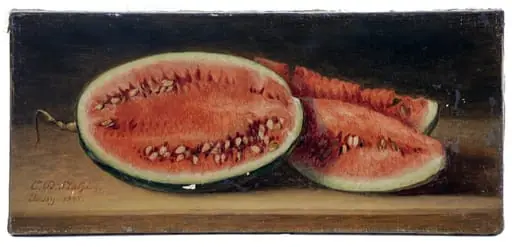
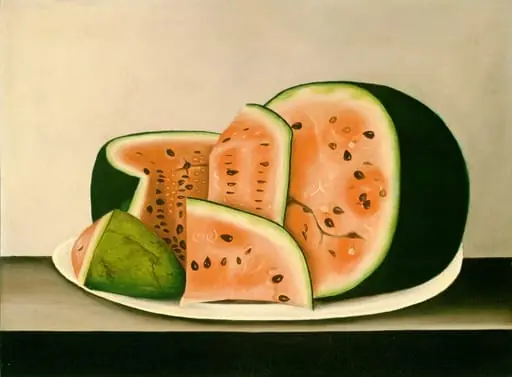
The painting shows a whole watermelon with two slices cut out. The watermelon has a green rind and pink insides with black seeds.
The painting is titled "Watermelon" and was created in the mid 19th century. It's a reverse painting on glass.
If you like this painting, you might also want to check out other works from the movement: Romanticism.
Technique & Style
Reverse painting on glass produces a luminous surface where pigment is applied to the back of the pane, allowing light to pass through and intensify colors.
Reverse painting on glass produces a luminous surface where pigment is applied to the back of the pane, allowing light to pass through and intensify colors. The work’s still life genre is rendered with precise detail and a restrained palette, emphasizing the tactile quality of the fruit’s rind and flesh. The painting’s modest dimensions, recorded as 35.5 cm in height and 45.7 cm in width, are typical of mid‑century American domestic subjects.
Its handling appears delicate, reflecting the fragility inherent to glass supports, while the formal composition balances compositional stability with subtle brushwork that suggests three‑dimensionality. The piece remains in good condition, showing only minor surface wear consistent with its age.
The stylistic approach aligns with 19th‑century American realism, where everyday objects are elevated through careful observation and a focus on material texture. The reverse technique contributes to a flat yet vibrant visual field, distinguishing the work from more conventional oil on canvas practices of the period.
History & Provenance
Created in 1850 as a reverse painting on glass, Watermelon is recorded as originating from New York. The early ownership chain of the artwork remains unrecorded until the twentieth century, when it was held by Harry Stone in New York. Stone sold the painting in 1944 to Edgar William and Bernice Chrysler Garbisch. The Garbisches subsequently donated the artwork to the National Gallery of Art in Washington, D.C., in 1964.
Watermelon is held by the National Gallery of Art in Washington, D.C., where it entered the collection as a gift from Edgar William and Bernice Chrysler Garbisch in 1964. The work had previously been owned by Harry Stone of New York, who sold it in 1944 to the Garbischs. No exhibition history is documented in the available sources.
Overview
Created in the middle of the 1800s, this work presents a single watermelon rendered in vivid detail. The composition displays the fruit whole, with two interior slices removed, revealing the pink flesh, dark seeds and the characteristic green rind.
Subject & Meaning
The painting focuses on a commonplace summer fruit, emphasizing its natural colors and textures. By isolating the watermelon from any surrounding objects, the artist draws attention to the simple visual pleasure of the fruit’s contrast between rind, flesh, and seed.
Artist & collection