Artwork
The Melon
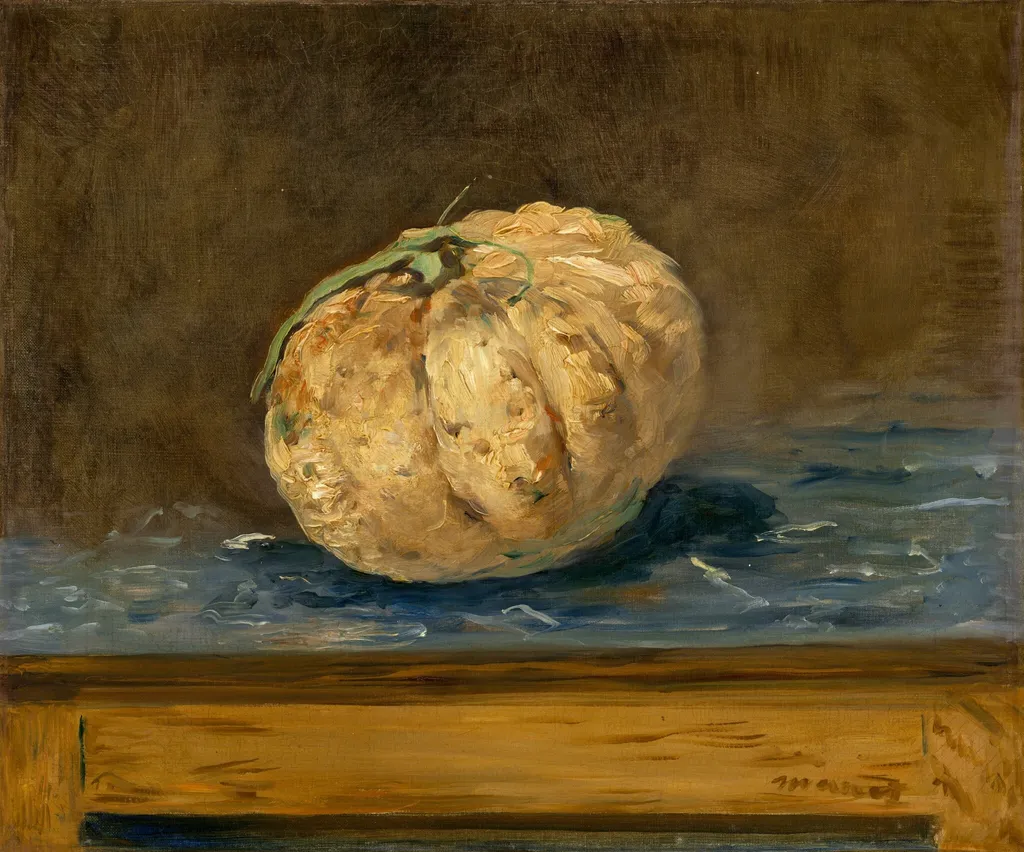
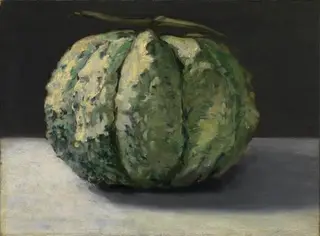
The Melon is an oil painting by the Impressionist artist Édouard Manet. It dates from 1880 and is held in the collection of the National Gallery of Art.
- Inscription
- Inscribed:lower right: Manet
About this work
Subject & Meaning
As a genre painting, the piece centers on the everyday object without incorporating narrative figures or complex allegorical settings.
Edouard Manet's 1880 painting, titled The Melon, is a still life that focuses exclusively on a single melon. The work depicts the fruit as its sole subject, isolating it against a neutral background to emphasize its form and texture. As a genre painting, the piece centers on the everyday object without incorporating narrative figures or complex allegorical settings.
The composition reflects the artist's late-career interest in the study of ordinary subjects, presenting the melon with a directness that highlights its physical presence rather than assigning it broader symbolic meaning within the provided records.
Technique & Style
The Melon is an oil painting on canvas created by Édouard Manet in 1880. The work belongs to the still‑life genre and portrays a single ripe melon rendered with the artist’s characteristic brush handling and a restrained palette that accentuates the fruit’s texture and subtle color shifts. Measured at 46.67 cm by 56.52 cm, the canvas supports a smooth application of oil paint that defines the melon’s form against a plain background.
The painting’s provenance records a sale from the artist to M. Pertuiset in 1888 and later ownership by the Bloch family before its acquisition by the National Gallery of Art in Washington, D.C.
History & Provenance
Édouard Manet completed this still life in 1880. The artist originally sold the canvas to M. Pertuiset in Paris. Following Pertuiset's death, the work appeared in his estate sale at the Hôtel Drouot on June 5, 1888, where it was acquired by either Isidore Bloch or Hermann Paechter of Berlin.
By 1925, the painting belonged to the German artist Max Liebermann. Upon his death, ownership passed to his daughter, Mrs. Kurt Riezler (née Käthe Liebermann), who held the work in Berlin and later New York. The piece subsequently entered the inventory of Wildenstein and Co. in New York before being sold to Paul Mellon in 1959.
Mellon bequeathed the painting to the National Gallery of Art in 1999, retaining a life interest for his wife, Rachel Lambert Mellon.
Edouard Manet's 1880 oil painting, The Melon, is held in the collection of the National Gallery of Art in Washington, D.C. The work entered the museum's holdings in 1999 through the bequest of Paul Mellon, who had acquired it in 1959 from Wildenstein and Co. Prior to this acquisition, the painting passed through several distinguished owners, including Max Liebermann in Berlin and his daughter, Käthe Liebermann (later Mrs. Kurt Riezler). The National Gallery of Art lists the work in its collection, though the provided sources do not specify a distinct inventory or accession number, nor do they detail a history of public exhibitions.
Context
The Melon is an oil on canvas painting by Édouard Manet completed in 1880, measuring 46.67 × 56.52 cm and depicting a single melon. It belongs to the still‑life genre and is part of the National Gallery of Art’s collection in Washington, D.C. The work’s provenance traces from the artist’s sale to M. Pertuiset, through the Bloch family and Max Liebermann, to Paul Mellon in 1959 and finally to the National Gallery of Art by bequest in 1999. Its inclusion in a major American museum illustrates the painting’s significance within Manet’s late output and the continued interest in his still‑life subjects.
Overview
The Melon is an oil on canvas still life painted by Édouard Manet in 1880, near the end of his life. The composition features a single, uncut green melon resting on a wooden table against a dark, neutral background. Manet employs a loose, rapid brushwork style characteristic of his late period, prioritizing the immediate visual impression over meticulous detail.
The light source, seemingly from the upper left, highlights the textured rind and the fruit's volumetric form while casting soft shadows that anchor it to the surface. This work exemplifies Manet's shift toward a more direct, painterly approach in his final years, where the act of painting and the materiality of the canvas became as significant as the subject itself. By isolating a mundane object and treating it with the same compositional rigor as his portraits or historical scenes, Manet elevates the still life genre.
The painting reflects the influence of Impressionism in its handling of light and texture, yet retains the structural solidity associated with his Realist roots. It stands as a testament to his enduring focus on the interplay of form, light, and surface, created during a time when his health was failing but his artistic vision remained sharp.
Own this work as a print
Artist & collection
Artist
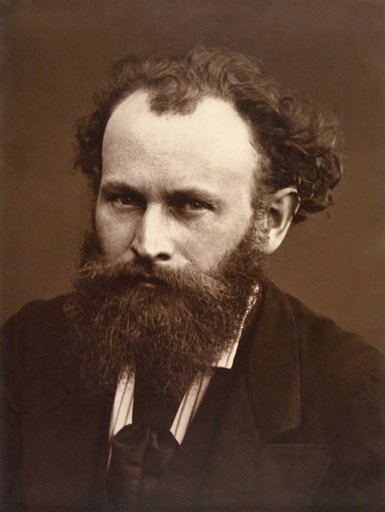
Édouard Manet was a French modernist painter. He was one of the first 19th-century artists to paint modern life, as well as a pivotal figure in the transition from Realism to Impressionism.