Artwork
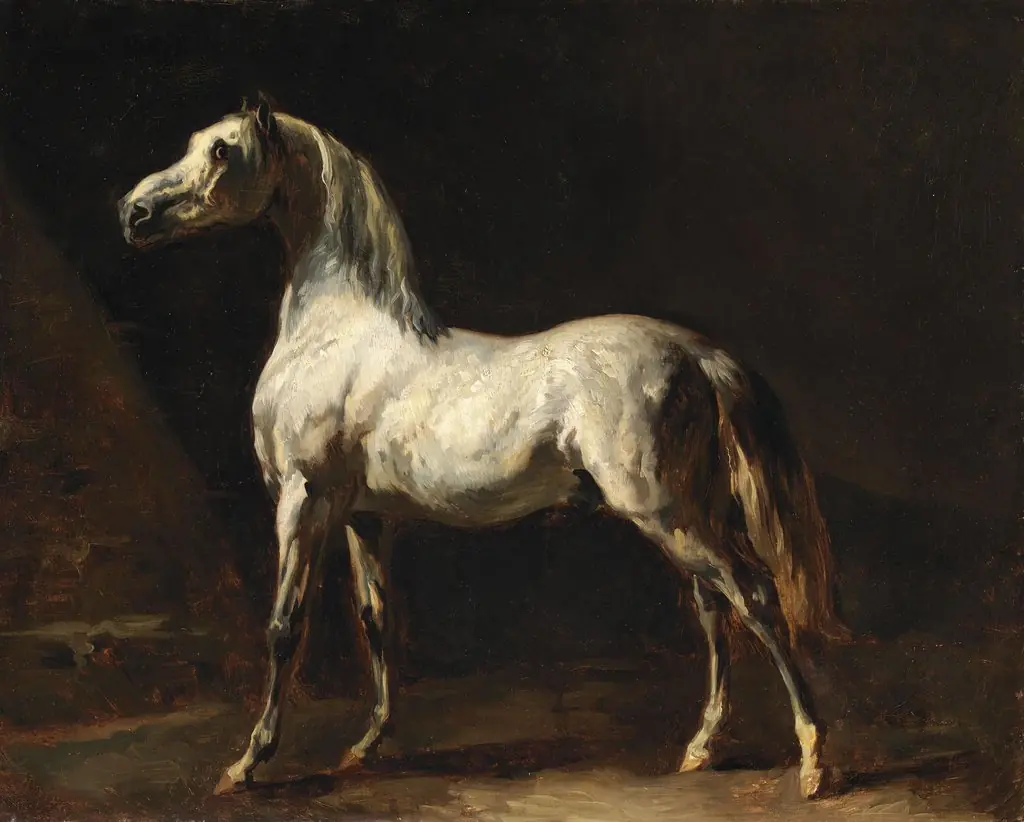
Gray Stallion
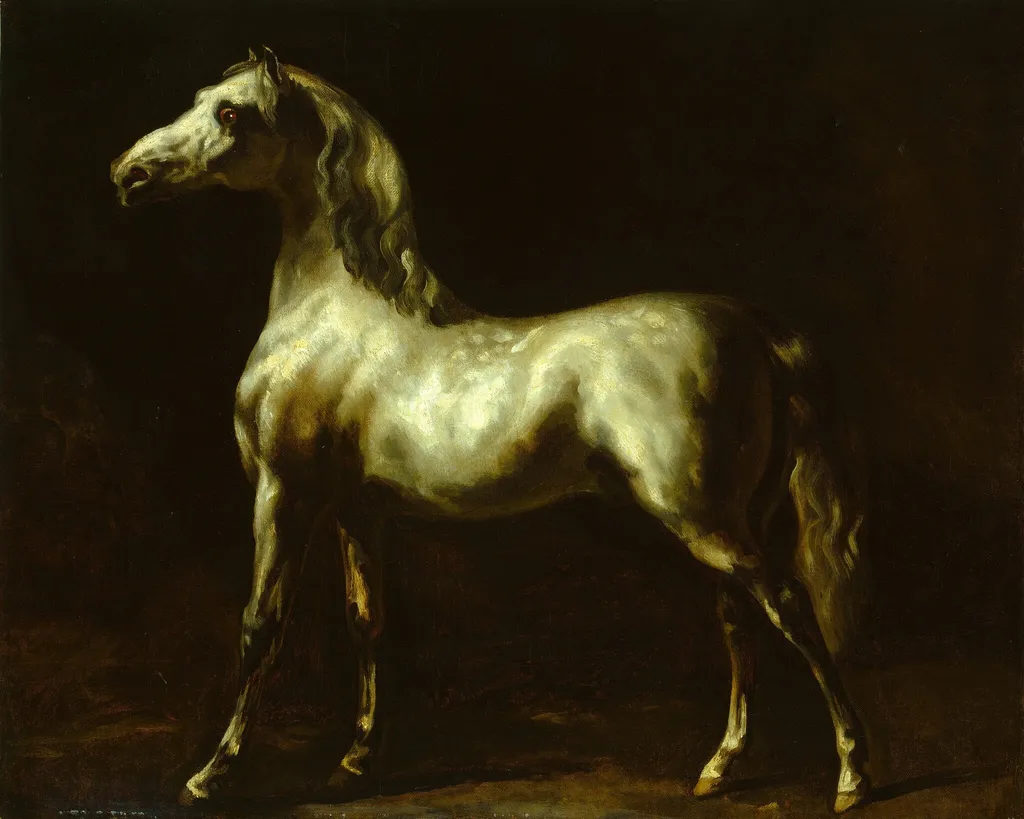
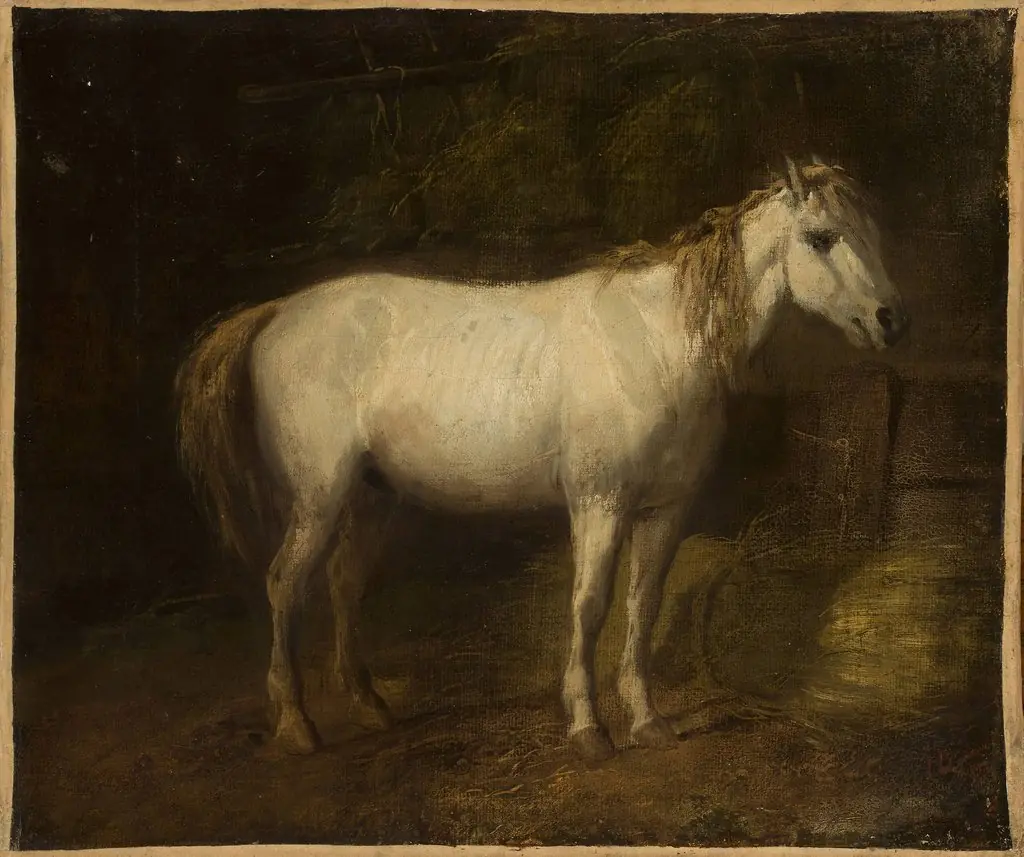
Gray Stallion is an oil painting by the Impressionist artist after Théodore Gericault. It dates from 1850 and is held in the collection of the National Gallery of Art.
- Inscription
- Inscribed:falsely inscribed lower left: Gericault
About this work
Overview
Gray Stallion is an oil on canvas painting created circa 1850 or later as a work after Théodore Géricault.
Gray Stallion is an oil on canvas painting created circa 1850 or later as a work after Théodore Géricault. Measuring 59.7 by 74.4 cm, the composition isolates a single, unsaddled gray horse against a dark, undefined background. The painting is distinguished by a false signature of Géricault inscribed on the lower left, indicating its status as a posthumous imitation or replica rather than an autograph work by the French master. Today, the painting is held in the collection of the National Gallery of Art in Washington, D.C., having entered the museum as a gift in 1984.
Subject & Meaning
The subject is a robust gray stallion standing in profile facing left, devoid of any saddle, bridle, or human accompaniment. The animal turns its head slightly toward the viewer, its mouth open to reveal teeth and a dark interior, while one visible reddish eye imparts a vivid, somewhat agitated presence. The wavy locks of the mane and the long, flowing tail reinforce a sense of vitality. By isolating the horse in an undefined, near-black space without landscape or architecture, the composition focuses entirely on the animal's physical presence and raw, natural power, echoing Géricault's lifelong fascination with equine subjects and his Romantic emphasis on visceral emotion over Neoclassical order.
Technique & Style
Executed in oil on canvas, the painting employs a restrained palette of warm gray and silver tones set against deep browns and near-black shadows. Light strikes the stallion from the left, illuminating the shoulder, flank, and face, while leaving the underside and legs in shadow. The brushwork varies across the surface: the body features blended, smooth passages that suggest musculature and sheen, whereas the mane and tail are rendered with looser, more textured strokes. A narrow band of lighter brown beneath the hooves indicates the ground plane. The overall finish is painterly rather than highly detailed, reflecting an atmospheric, Romantic style that breaks from refined Neoclassical conventions.
History & Provenance
Dated circa 1850 or later, the work was created well after Géricault's death in 1824, as corroborated by its false signature. The documented provenance begins with Henry Nugent Banks (1828-1883) and Percy Moore Turner (died by 1951), followed by the Honorable Mrs. Rupert Baring (1913-1970). The painting passed through the London dealers Frank Partridge and Sons before entering the collection of Mr. and Mrs. Paul Mellon in Upperville, Virginia, by 1967. Offered at the Mellon sale at Christie's in New York on November 15, 1983 (lot 3), the work was bought in and subsequently gifted to the National Gallery of Art in 1984, receiving accession number 1984.29.2. It was exhibited at the Virginia Museum of Fine Arts in 1967 and placed on extended loan to the U.S. Department of Agriculture in Washington, D.C., from 1993 to 1995.
Context
The painting exists within the broader context of Théodore Géricault's profound influence on French Romanticism, a movement characterized by its focus on emotion, individuality, and the sublime. Géricault was a lifelong equestrian enthusiast who frequently depicted dramatic, rearing horses, absorbing lessons from Old Masters like Michelangelo and Rubens while employing brisk, energetic brushstrokes and contrasting light effects. Although Gray Stallion is a later copy, it directly engages with Géricault's iconic equine subjects. Scholarly cataloguing of the work includes entries by Philippe Grunchec in 1978, the National Gallery of Art in 1985, Germain Bazin in 1989, and Lorenz Eitner in 2000, situating the replica within the ongoing critical assessment and cataloguing of Géricault's oeuvre.
Legacy
As a posthumous imitation, Gray Stallion demonstrates the enduring market demand and cultural appetite for Géricault's equine imagery throughout the nineteenth century. The deliberate falsification of the signature underscores the commercial value attached to Géricault's name and his reputation as a preeminent painter of horses. While the work lacks the autograph authority of Géricault's own hand, its inclusion in the Paul Mellon collection and the National Gallery of Art's systematic catalogue highlights its role in the broader historical and scholarly understanding of Géricault's afterlife and the dissemination of his Romantic vision.
Artist & collection
Artist