Artwork
The Trumpeter
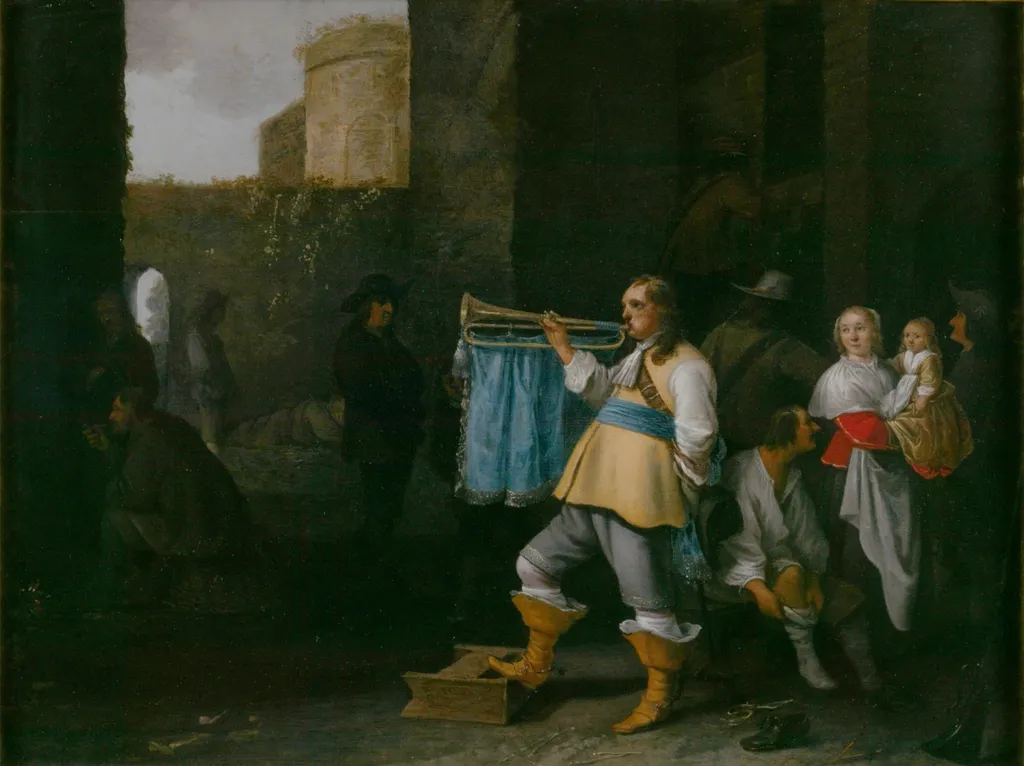
The Trumpeter is an oil painting by the Dutch Golden Age artist Anthonie Palamedesz. It dates from 1654 and is held in the collection of the Victoria and Albert Museum.
About this work
Overview
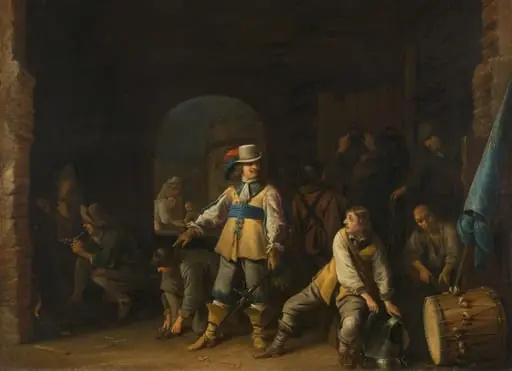
The Trumpeter is a genre scene painted by Anthonie Palamedesz in 1654.
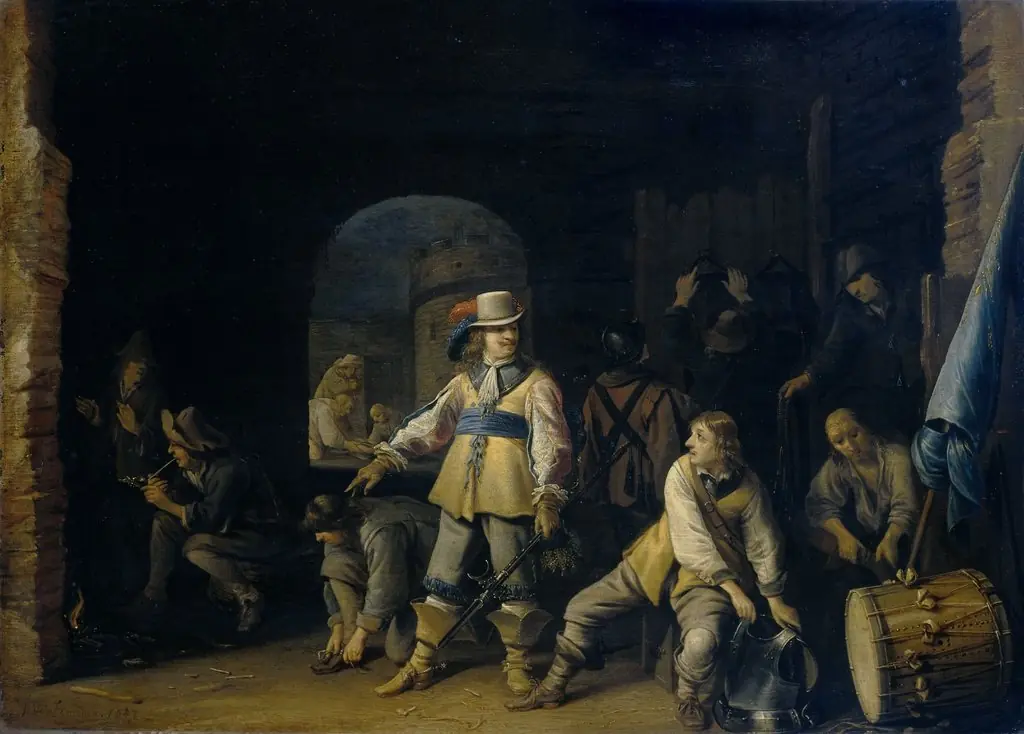
The Trumpeter is a genre scene painted by Anthonie Palamedesz in 1654. Executed in oil on oak panel, the work measures 36.7 by 48 centimeters and is signed and dated lower left. It depicts a Dutch army trumpeter sounding his horn within a cavernous guardroom interior, surrounded by soldiers and camp followers engaged in mundane activities. The painting is held in the Victoria and Albert Museum in London, accessioned as 1350-1869 following its bequest by the Reverend Chauncey Hare Townshend in 1868.
Subject & Meaning
The painting captures a moment inside a Dutch military guardroom, known as a cortegaard. At the center, a trumpeter stands with one foot on a wooden box, blowing a long brass trumpet draped with a blue clarion flag. His task was to alert soldiers to march out following a commander's orders. The figures around him seem largely oblivious to the call, continuing their daily business of dressing, smoking, and warming themselves by a fire. A seated man pulls on a boot, a standing woman in white with a red sash holds a small child, and shadowy figures gather nearby. Scholars continue to debate whether such genre scenes carry metaphorical meanings or simply depict contemporary events, though they are generally associated with health, pleasure, and liberty. Palamedesz uniquely includes women as mothers rather than courtesans, embodying a broader 17th-century Dutch trend of masculinity pacified by feminine domestic motherhood.
Technique & Style
Palamedesz executed the work in oil on an oak panel support. The composition is dominated by browns and blacks, establishing a dark, cavernous interior that opens at the left to a bright exterior with a round stone tower visible through an archway. Strong chiaroscuro illuminates the central group against the shadowy background. Highlights of yellow, blue, and white catch the light on the trumpeter's yellow tunic and blue sash, the woman's white dress, and the blue fabric banner. The surface shows smooth brushwork in the figures, contrasted by looser, less refined handling in the dark background. A pipe and small objects lie scattered on the stone floor, contributing to the genre's characteristic detail.
History & Provenance
Created and signed in 1654, The Trumpeter entered the Victoria and Albert Museum's collection after being bequeathed by the Reverend Chauncey Hare Townshend in 1868, receiving the accession number 1350-1869. The painting's earlier ownership chain prior to Townshend is not documented in the available records. It remains in the Victoria and Albert Museum's collection as a representative example of Palamedesz's guardroom scenes from the 1650s.
Context
Born in Leith, Scotland in 1601 or 1602, Anthonie Palamedesz moved to Delft where he joined the Guild of St. Luke in 1621. He studied under Michiel Jansz. van Mierevelt and possibly Hendrik Pot, and his work shows awareness of Haarlem and Amsterdam genre painters like Dirck Hals, Pieter Codde, and Willem Duyster. Guardroom scenes became a popular subject for Palamedesz in the 1640s and continued as a core repertoire until his death in 1673. This genre flourished after the end of the Twelve Years' Truce with Spain in 1621, depicting soldiers at rest during long periods without military action. While early guardroom scenes showed morally questionable behavior, a second phase starting around 1645 reflected growing civility, omitting booty and showing middle-class people interacting with soldiers. Palamedesz's compositions from this period often recall designs by Duyster and Jacob Duck, but feature a looser technique and frequently include women in maternal roles.
Legacy
The trumpeter was clearly a popular and recurring motif for Palamedesz, who painted several different compositions depicting the figure with a clarion flag hung from the instrument. He often repeated figures in his oeuvre, and the upper half of the trumpeter in the Victoria and Albert Museum painting reprises the seated figure in the center of a 1654 guardroom scene now in the National Museum in Warsaw. The motif appeared in other works, including a single figure painting of a trumpeter standing at a balustrade sold at Sotheby's Amsterdam in 2004, and a similar interior with a trumpeter from 1665 sold at Christie's in 2006. Through these repetitions, Palamedesz solidified the trumpeter as a signature element of his guardroom scenes, contributing significantly to the development of genre painting in Delft in the mid 17th century.
Own this work as a print
Artist & collection
Artist
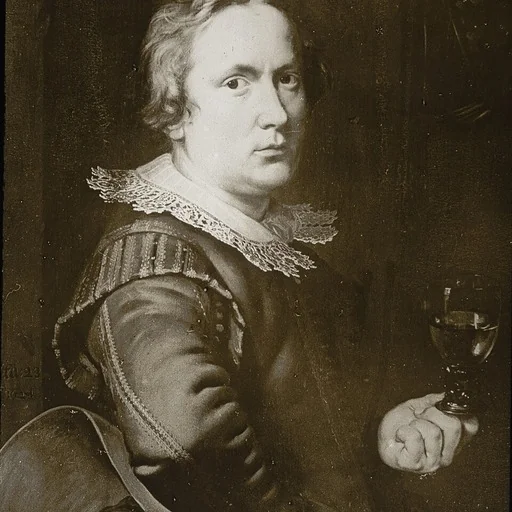
Anthonie Palamedesz., also Antonie Palamedesz, birth name Antonius Stevens, was a Dutch portrait and genre painter.