Artwork
Esther before Ahasuerus
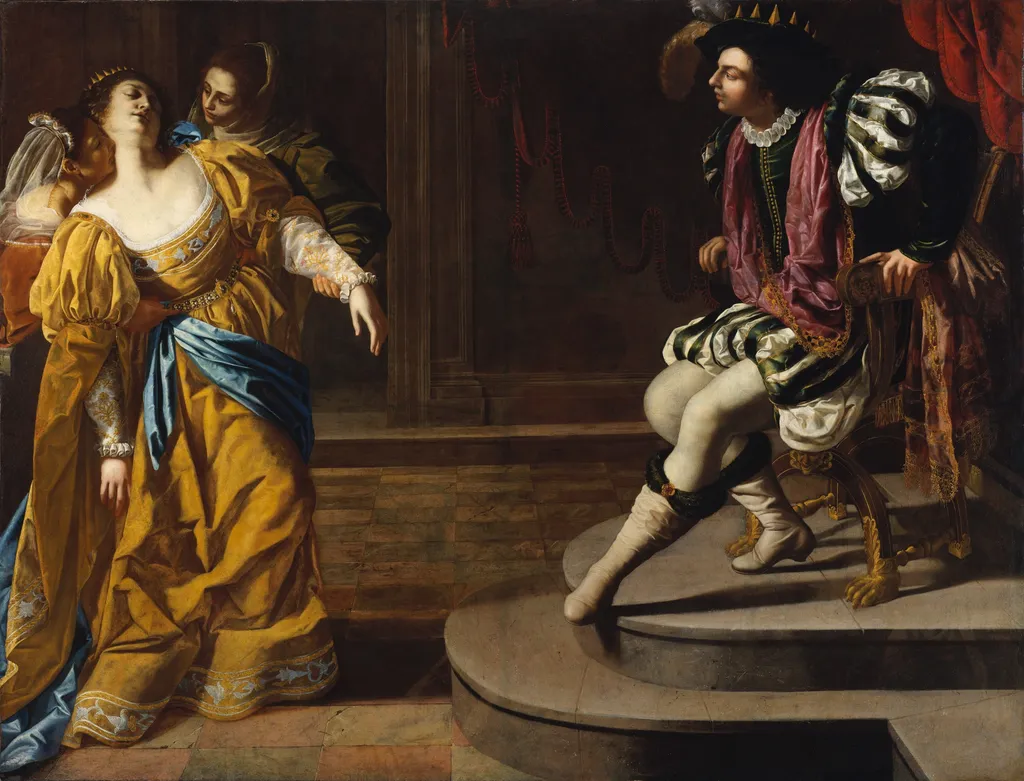
Esther before Ahasuerus is an oil painting by the Early Baroque Italian artist Artemisia Gentileschi. It dates from 1629 and is held in the collection of the Metropolitan Museum of Art.
About this work
Subject & Meaning
The composition captures the precise instant of collapse, with Esther supported by her attendants while the monarch rises from his throne in alarm.
The painting depicts the biblical narrative from the Book of Esther, specifically the moment the Jewish heroine faints before King Ahasuerus after approaching him unsummoned to plead for her people's survival. This dramatic scene, drawn from the Counter-Reformation version of the text approved by the Council of Trent, emphasizes Esther's physical vulnerability and the high stakes of her intervention. Visually, Gentileschi employs Baroque theatricality to symbolize Esther's agency and moral strength; she is illuminated in a vibrant yellow dress, contrasting with the king's shadowed, opulent attire.
The composition captures the precise instant of collapse, with Esther supported by her attendants while the monarch rises from his throne in alarm. This staging transforms a moment of weakness into a representation of courage, highlighting the tension between court protocol and the protagonist's desperate mission to prevent a massacre.
Technique & Style
Esther before Ahasuerus is executed in oil paint on canvas, measuring 208.3 × 273.7 cm. Gentileschi's handling reflects the Caravaggesque training she absorbed in her father Orazio's workshop, channeled through the sumptuous, scenographic sensibility of the Venetian painters. She uses a generally muted palette of browns and darkened reds across the background and Ahasuerus's white-and-dark-green costume, against which Esther's vibrantly yellow dress is made to stand out. The composition is built on parallel diagonals: Esther falls backward into her attendants' arms while Ahasuerus leans forward from his throne, with the curtains' diagonals reinforcing the dynamic Baroque staging.
Gentileschi lavishes close attention on materials, rendering the folds of fabric, the stitches along Esther's hem, the fur trim and bejeweling of Ahasuerus's boots, the paws on his chair, and the cracks of the marble floor with a tactile naturalism that makes the surfaces feel tangible. Esther is bathed in stronger light while the king recedes into shadow, marking her as protagonist.
History & Provenance
Artemisia Gentileschi's Esther before Ahasuerus is generally dated between 1628 and 1635, though the painting is not specifically dated and its original patron or commissioner remains unknown. Scholars believe Gentileschi began the canvas in Venice around 1628 and brought it with her when she moved to Naples, a dating that places the work within her first Neapolitan period. The painting is held in the Metropolitan Museum of Art, New York, with the accession number 69.275, having been donated to the museum in 1969 by Elinor Dorrance Ingersoll. The work was later included in the exhibition Artemisia. Héroïne de l'art.
Context
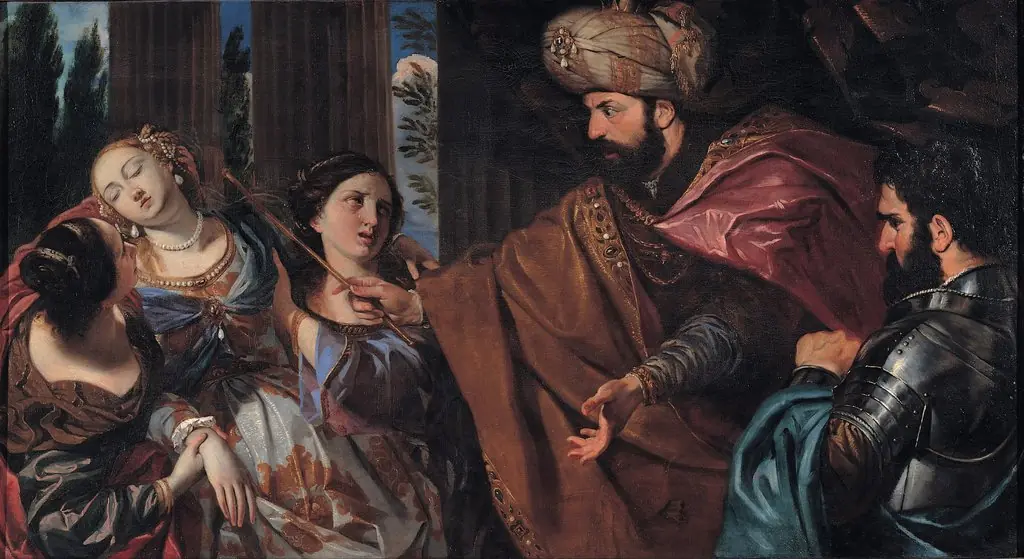
Scholars generally date Esther before Ahasuerus to Artemisia Gentileschi's first Neapolitan period, specifically between 1628 and 1635, though the exact commission remains unknown. Art historians view the work as a pivotal synthesis of her Caravaggesque training and the influence of Venetian masters like Tintoretto and Veronese, whose treatments of the same subject she likely encountered in Venice. The painting is frequently cited as evidence of Gentileschi's adaptation to luxurious, scenographic biblical settings favored by Venetian tradition, while retaining her focus on naturalistic characterization over idealization.
While often overshadowed by her violent narratives such as Judith Slaying Holofernes, this work demonstrates her ability to capture a dramatic, theatrical moment of female agency. Critics note how the composition, utilizing diagonal angles and contrasting lighting, elevates Esther's vulnerability and heroism, marking the piece as one of her most ambitious explorations of biblical narrative within the Baroque canon.
Legacy
Esther before Ahasuerus is regarded as one of Artemisia Gentileschi's more ambitious compositions, valued for its theatrical staging of the biblical episode. The painting entered the Metropolitan Museum of Art in New York through a 1969 donation from Elinor Dorrance Ingersoll. It was featured in the exhibition "Artemisia.
Héroïne de l'art," documented in a 2025 publication by Patrizia Cavazzini, Maria Cristina Terzaghi, and Pierre Curie. Scholars note that Gentileschi's treatment of the subject engages with earlier Venetian precedents, including works by Tintoretto and the workshop of Veronese, whose interpretations of the Esther narrative she likely encountered in Venice. While considered one of Gentileschi's lesser known works, the painting is cited for its naturalistic characterization and its place within the artist's broader exploration of biblical heroines.
Overview
Artemisia Gentileschi's oil painting, Esther before Ahasuerus, illustrates a pivotal moment from the biblical Book of Esther. This 17th-century Italian work captures the heroine's courageous appeal to King Ahasuerus on behalf of her people. Though less widely known among her oeuvre, the piece demonstrates Gentileschi's characteristic dramatic flair. It is presently part of the collection at the Metropolitan Museum of Art in New York.
Own this work as a print
Artist & collection
Artist
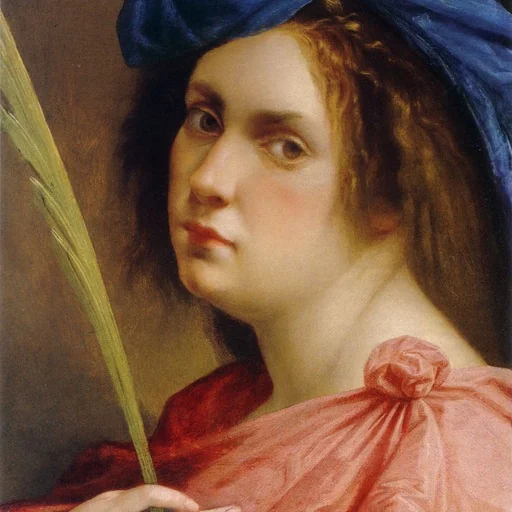
Artemisia Lomi Gentileschi (US: JEN-til-ESK-ee, -teel-; Italian:; 8 July 1593 – after January 1654) was an Italian Baroque painter.

 Compared in the Caravaggio & Baroque course