Artwork
Ferdinand I of Castile welcoming Saint Dominic of Silos
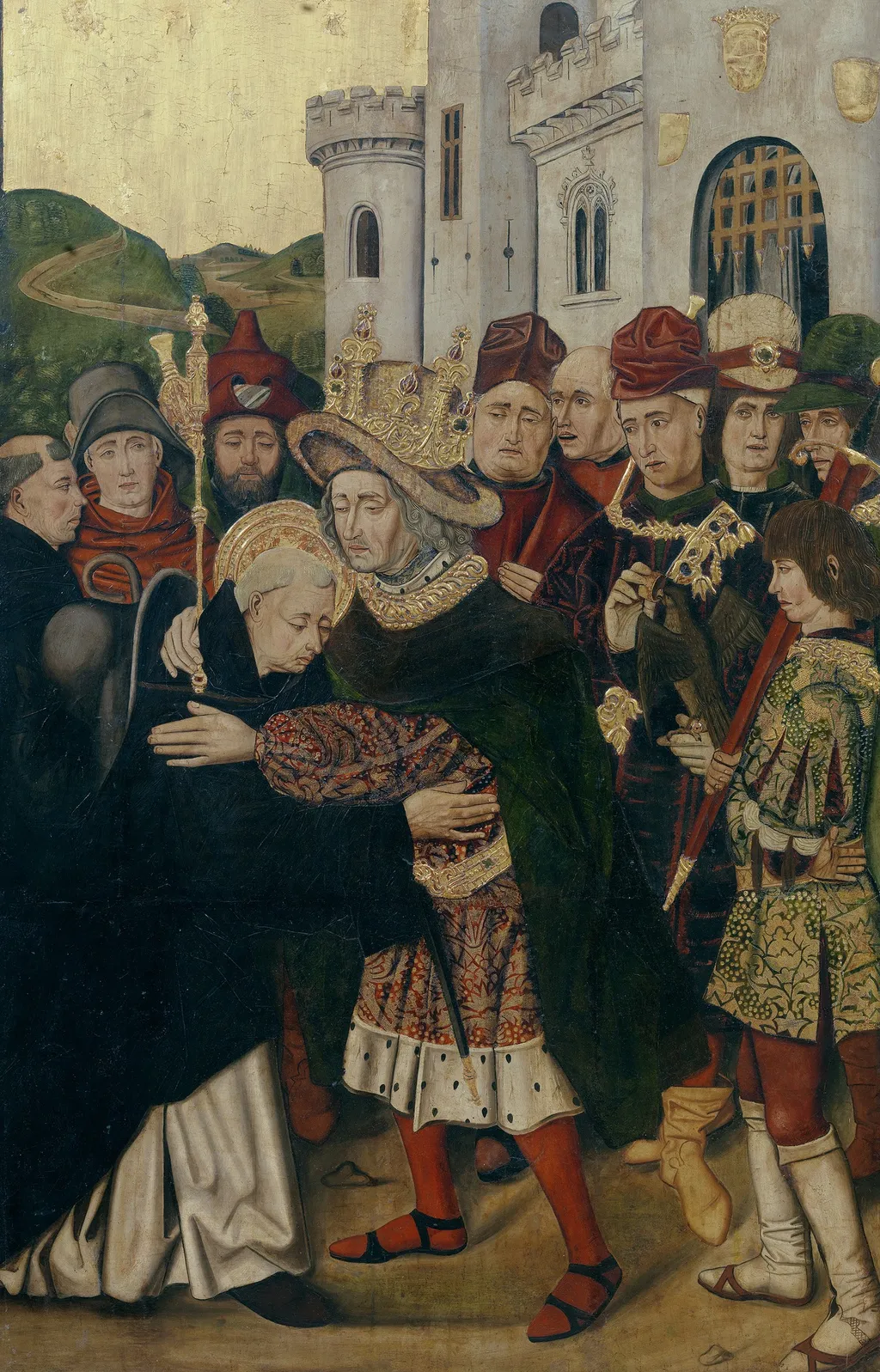
Ferdinand I of Castile welcoming Saint Dominic of Silos is an oil painting by the High Renaissance artist Bartolomé Bermejo. It dates from 1490 and is held in the collection of the Museo del Prado.
About this work
Subject & Meaning
The painting shows Ferdinand I of Castile receiving the habit of Saint Dominic of Silos, a moment that emphasizes royal patronage of the saintly reformer and the integration of sacred authority into secular rule. The composition uses traditional iconographic attributes, Ferdinand’s royal insignia and Saint Dominic’s habit, to convey both temporal power and spiritual humility. The work reflects the broader Renaissance synthesis of devotional imagery with contemporary political messaging, illustrating how art served to legitimize the monarch’s support of religious reform.
Technique & Style
The panel is executed in oil paint on oak, with a vertical format measuring 145 cm in height and 94 cm in width.
The panel is executed in oil paint on oak, with a vertical format measuring 145 cm in height and 94 cm in width. Bermejo’s handling combines meticulous linear definition with subtle tonal modeling, particularly in the rendering of the king’s brocaded mantle and the saint’s vestments, where fine brushwork articulates folds and textures. Architectural elements behind the figures employ linear perspective to structure space, while the coats of arms and patterned surfaces demonstrate the artist’s attention to heraldic and decorative detail within a coherent Renaissance idiom.
History & Provenance
The painting Ferdinand I of Castile welcoming Saint Dominic of Silos was created in 1478 by the artist Bartolomé Bermejo. While Bermejo is the primary creator, some records also attribute the work to Martín Bernat. Executed in oil paint on a panel, the piece measures 145 cm in height and 94 cm in width.
The work belongs to the Renaissance movement and falls within the religious art genre, depicting Ferdinand I of León and Castile alongside Saint Dominic of Silos and various architectural elements. Currently, the artwork is held in the collection of the Museo del Prado.
Context
Critical reception of the work has been shaped by its status within the Museo del Prado collection, where scholars highlight its significance as a high Renaissance religious painting that exemplifies Bermejo's technical mastery of oil on panel. Art historians situate the piece within the broader trajectory of 15th-century Spanish religious art, emphasizing its role in documenting royal patronage and devotional practices of the Castilian court. The painting's composition and iconography have been analyzed in relation to Bermejo's wider oeuvre, particularly his collaborations with Martín Bernat, revealing shared stylistic elements and workshop practices.
Its placement at the intersection of royal iconography and saintly veneration underscores its importance in understanding the cultural and political context of religious art in late medieval Spain.
Legacy
The painting influenced later religious art through its devotional imagery and integration of donor portraiture in the Renaissance. Its presence in the Museo del Prado collection has ensured continued scholarly attention to Bermejo's techniques and the iconography of Castilian saints, reinforcing its reputation as a significant example of 15th-century Spanish religious painting.
Overview
Bartolomé Bermejo’s oil on canvas, dated to 1490, presents a formal encounter between the Castilian monarch Ferdinand I and the monk Saint Dominic of Silos. The composition is set before a fortified palace with towers and arched windows, under a pale sky that recedes into a muted landscape. The work is part of the Prado Museum’s collection and is linked to the artistic currents of the High Renaissance.
Own this work as a print
Artist & collection

Artist
Bartolomé Bermejo was a Spanish painter who adopted Flemish painting techniques and conventions and so is considered as an artist of the Hispano-Flemish style.

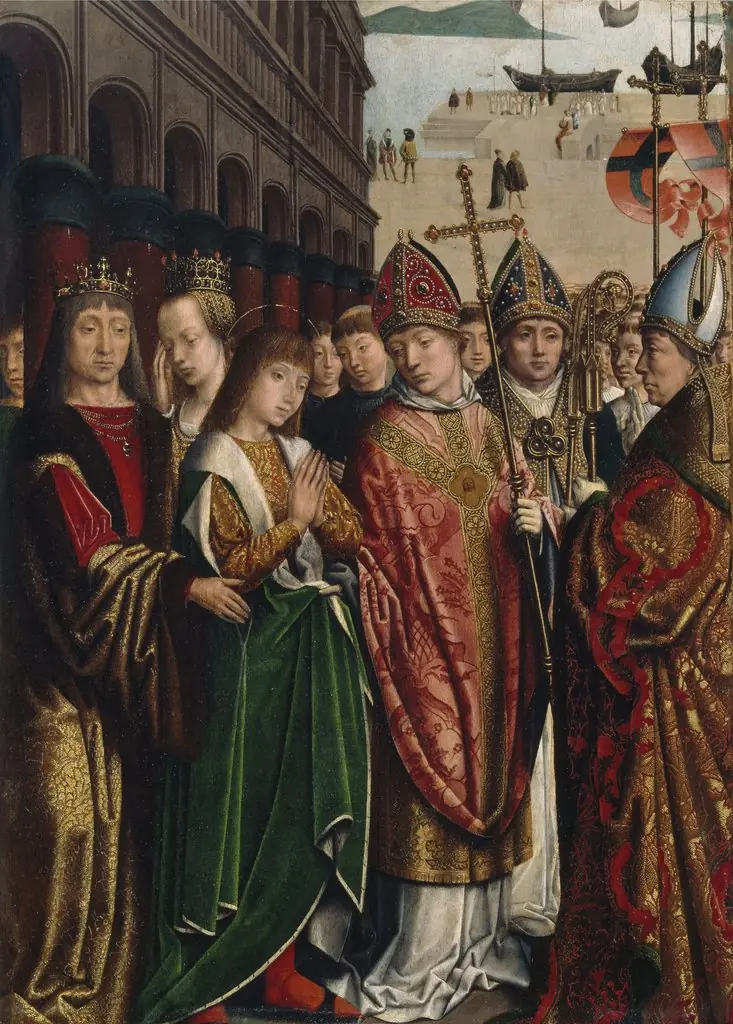 Saint Rumbold Taking Leave of his Parents
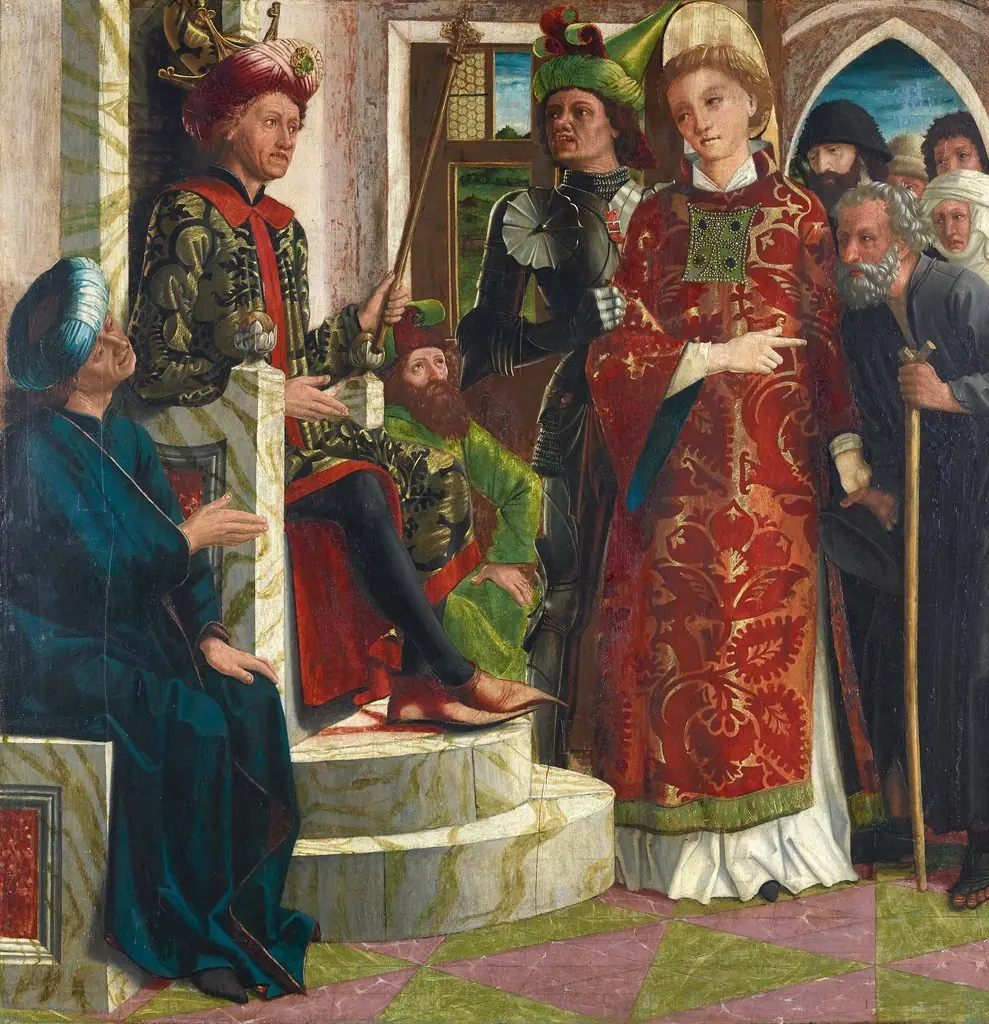 Der hl. Laurentius vor Kaiser Decius
 Die vierzehn Nothelfer
 Saint Leonard Liberating Captives
 The Enthronement of Saint Romold as Bishop of Dublin
 Darmstadt Altarpiece: Constantine and His Mother Helena Venerating the True Cross
 Saint Augustine and Saint Monica in a Sermon by Saint Ambrose
 Saint Vincent Ordained by Saint Valerius
 Saint Vincent before Dacian
 Episodes from the Life of a Bishop Saint
 Pope Sixtus II. bids farewell to St. Lawrence
- The coronation of St. Oswald
 The Pérussis Altarpiece
 Madonna and Child with the Donor, Pietro de' Lardi, Presented by Saint Nicholas
 The Virgin Mary and Five Standing Saints above Predella Panels
 Portrait of a Woman, possibly Ginevra d'Antonio Lupari Gozzadini
 The Seven Sacraments
 Portrait of a Woman Holding a Book
 An Artist Painting a Heraldic Shield in a Cabinet of Curiosities
 Angel Supporting a Heraldic Shield