Artwork
Benjamin Franklin Drawing Electricity from the Sky
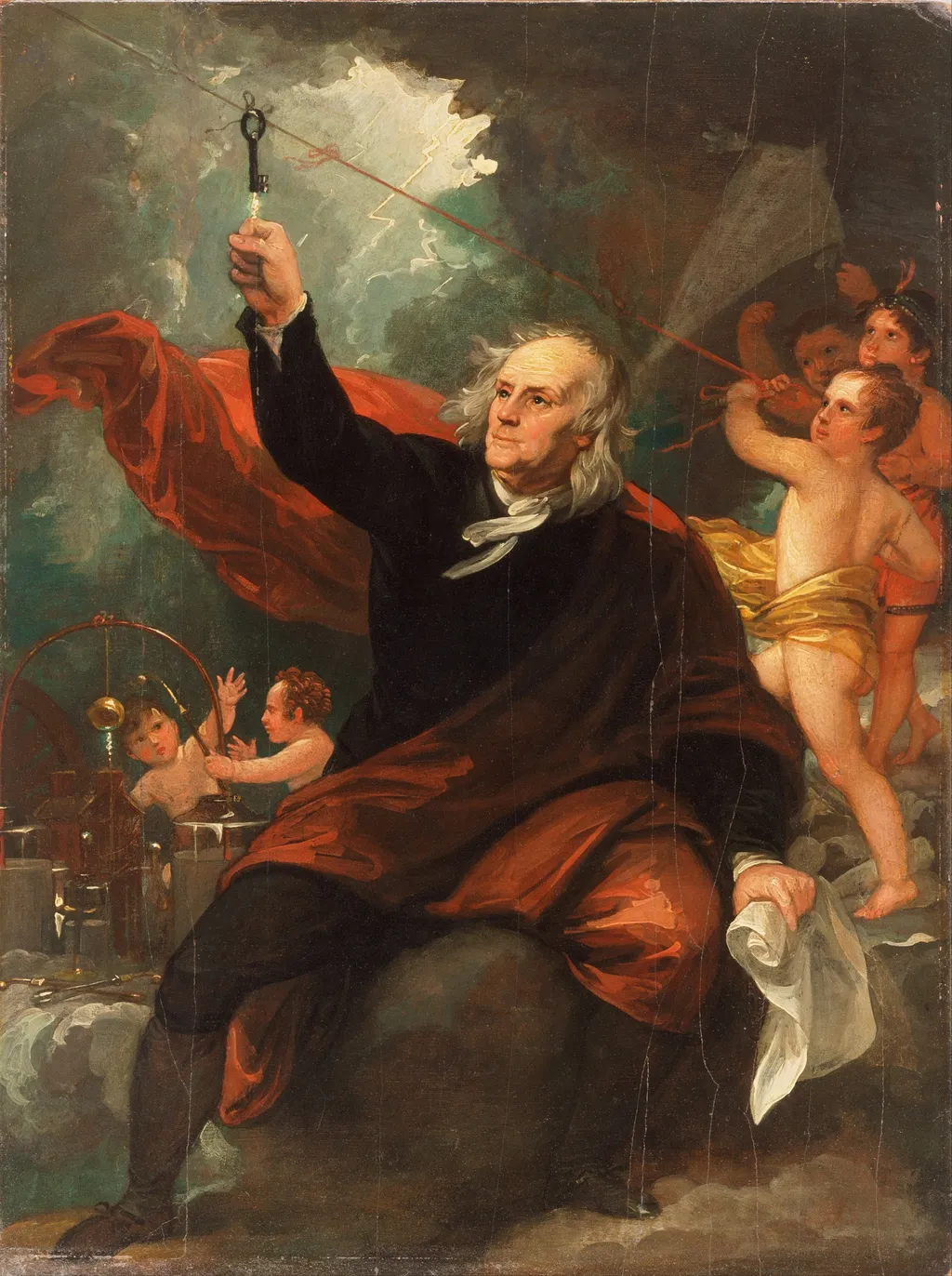
Benjamin Franklin Drawing Electricity from the Sky is an oil painting by Benjamin West. It dates from 1816 and is held in the collection of the Philadelphia Museum of Art.
About this work
Overview
The painting depicts American Founding Father Benjamin Franklin conducting his famous 1752 kite experiment to prove the electrical nature of lightning.
Benjamin Franklin Drawing Electricity from the Sky is an oil on slate painting by Anglo-American artist Benjamin West, created around 1816. Measuring 13.39 by 10.09 inches (340.11 by 256.29 mm), the work is held by the Philadelphia Museum of Art, where it entered the collection in 1954 as a gift from Edgar William and Bernice Chrysler Garbisch, with accession number 1958-132-1. The painting depicts American Founding Father Benjamin Franklin conducting his famous 1752 kite experiment to prove the electrical nature of lightning. It occupies a significant position in West's oeuvre as both a commemorative portrait of a personal friend and a deliberate fusion of Neoclassical and Romantic stylistic elements that elevates a scientific achievement to the realm of heroic myth.
Subject & Meaning
The painting depicts Franklin at the climactic moment of his 1752 experiment, his right hand raised toward a turbulent sky to receive a spark from a metal key suspended on a kite string. West surrounds him with putti, or cherubic figures, who assist in the experiment: one group to Franklin's right holds the string, while another pair to the left interacts with electrical apparatus including a suspended golden orb and glass containers. One cherub wears traditional Native American attire, a symbolic nod to American identity. Franklin holds a rolled paper in his left hand and wears a dark coat with a flowing red cloak and white neckcloth. The composition forms a deliberate triangle between Franklin's right arm and the cherubs flanking him, directing the viewer's eye toward the key and the spark. The cherubs carry strong apotheosis connotations, traditionally used in paintings that deify human subjects, and their presence frames Franklin as a Promethean figure who calls upon the forces of nature and the heavens. The stormy sky with its burst of pale light at upper center evokes the sublime, while the spark between key and hand serves as the pictorial and symbolic fulcrum of the entire work.
Technique & Style
West executed the work in oil on slate, an unusual support that contributes to the painting's intimate scale and distinctive surface quality. The medium allows for strong chiaroscuro effects, with deep browns and blacks in the turbulent sky contrasting against the vivid red of Franklin's cloak, creamy flesh tones, and muted greens and blues. Visible vertical cracks appear throughout the paint surface. The brushwork varies from smooth blending in the flesh to broader, more textured strokes in the drapery and sky. The diagonal, dynamic composition is anchored by the central figure's raised arm, which creates a strong vertical axis against the swirling atmospheric background. West blends elements commonly associated with Romanticism, including religious motifs and sublime aesthetics, with Neoclassical features such as structured composition, themes of masculine heroism, and the idealized presentation of intellectual achievement. This stylistic fusion permits West to combine intelligibility with mystery, rendering scientific discovery as both rational triumph and quasi-divine revelation.
History & Provenance
West created the painting after Franklin's death in 1790, intending it as a study for a much larger portrait he planned to donate to Pennsylvania Hospital in Philadelphia, an institution Franklin had founded. The larger painting was never realized. The work was acquired by the Philadelphia Museum of Art in 1954 as a gift from Edgar William and Bernice Chrysler Garbisch, entering the collection with accession number 1958-132-1. In 1956, the United States selected the painting for a commemorative postage stamp marking the 250th anniversary of Franklin's birth, bringing West's interpretation to a national audience.
Context
West and Franklin shared a significant personal bond that shaped this commemorative work. Both men were Pennsylvanians by origin, West having been born in Swarthmore in 1738 and Franklin having established himself in Philadelphia in early adulthood. They met in London, where West built his career as a history painter, eventually becoming historical painter to King George III and second president of the Royal Academy of Arts. Their friendship was sufficiently close that West asked Franklin to serve as godfather to his second son. West's decision to paint Franklin after his death reflected both personal grief and a desire to honor an American who had achieved international renown in science. The painting belongs to West's broader practice of history painting, which often privileged dramatic and moral impact over strict documentary accuracy, as seen in his 1770 The Death of General Wolfe. Critical reception has noted how West deliberately strayed from historical fact: Franklin was approximately 46 years old and accompanied by his son William during the actual experiment, not the elderly, solitary figure surrounded by cherubs that West portrays. Scholars have compared this idealization to Carl Rohl-Smith's later Statue of Young Benjamin Franklin with Kite, which offers a more age- accurate representation.
Legacy
The painting has become one of the most recognizable visual representations of Franklin's kite experiment, despite or perhaps because of its historical liberties. Its selection for the 1956 commemorative stamp cemented its place in American popular culture as an iconic image of scientific discovery and national founding. The work exemplifies how artistic interpretation can supplant documentary record in the public imagination, as the painting's dramatic embellishments, the cherubs, the advanced age, the exposed stance in the storm, have collectively shaped popular understanding of an event whose actual details remain partially uncertain. The painting's afterlife also illustrates the broader 19th-century project of elevating American founders to mythic status through visual art, a process in which West, as both American by birth and European by training, occupied a uniquely positioned role. Its residence in the Philadelphia Museum of Art maintains its connection to the city where both Franklin's experiment and West's artistic education began.
Own this work as a print
Artist & collection

Artist
Benjamin West (October 10, 1738 – March 11, 1820) was an American-born British painter who specialised in history painting, creating such works as The Death of Nelson, The Death of General Wolfe, the Treaty of Paris,…

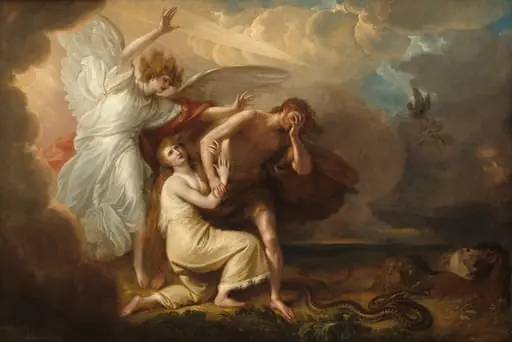 The Expulsion of Adam and Eve from Paradise
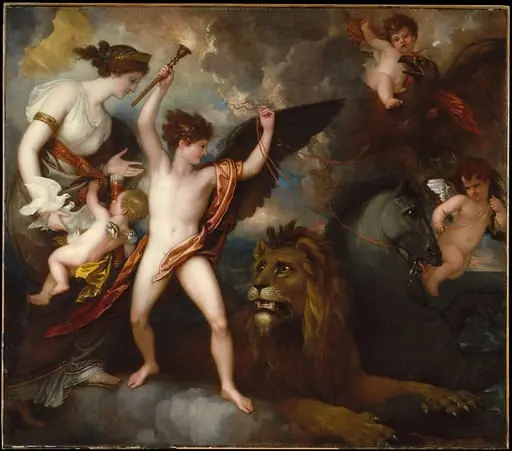 Omnia Vincit Amor, or The Power of Love in the Three Elements
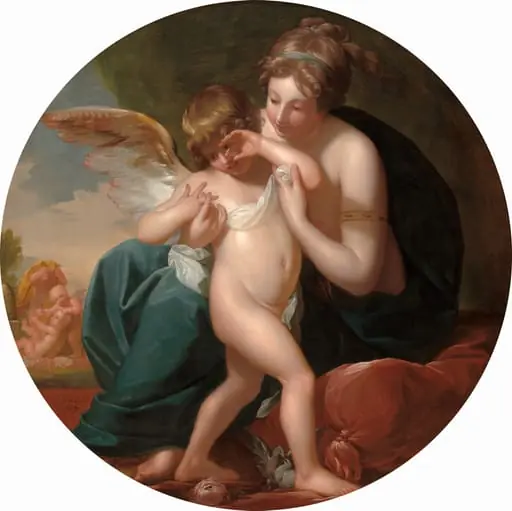 Cupid, Stung by a Bee, Is Cherished by his Mother
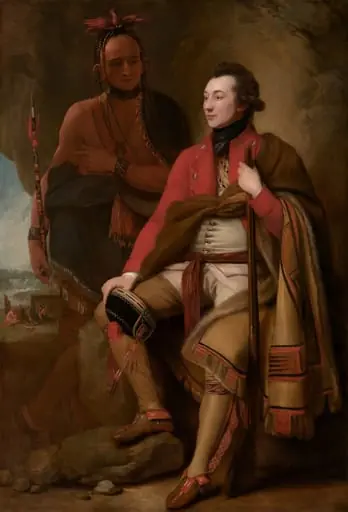 Colonel Guy Johnson and Karonghyontye (Captain David Hill)
 Mary Bethel Boude (Mrs. Samuel Boude)
 Dr. Samuel Boude
 Moses Shown the Promised Land
 Hagar and Ishmael