Artwork
Colonel Guy Johnson and Karonghyontye (Captain David Hill)
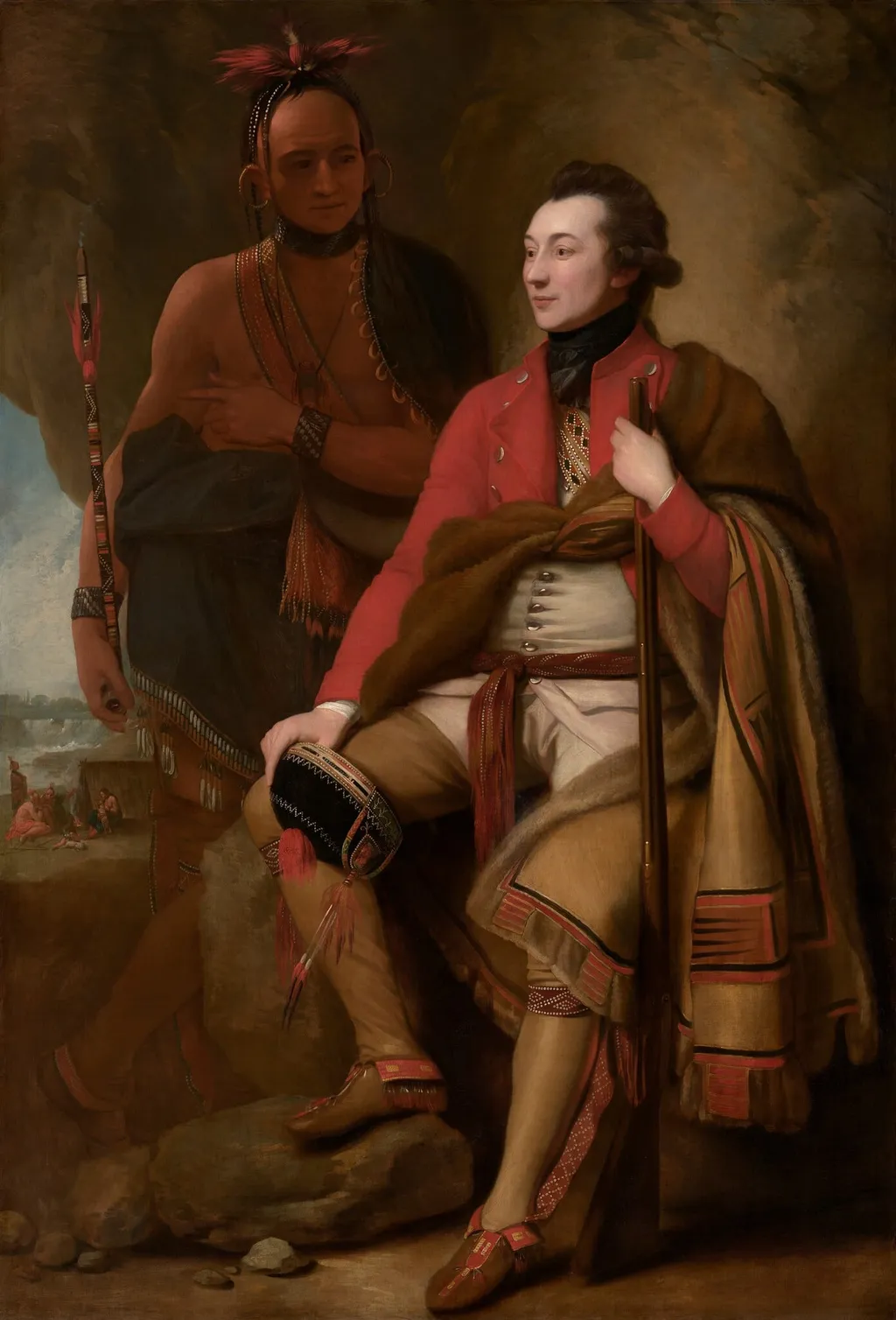
Colonel Guy Johnson and Karonghyontye (Captain David Hill) is an oil painting by the American Impressionist artist Benjamin West. It dates from 1776 and is held in the collection of the National Gallery of Art.
About this work
Subject & Meaning
The work symbolizes the strategic alliance between Britain and Indigenous tribes during the American Revolutionary War, a union that threatened rebel colonists.
Painted in 1776, this dual portrait depicts Colonel Guy Johnson, a British Indian Department officer, alongside Karonghyontye (Captain David Hill), a Mohawk chief. The work symbolizes the strategic alliance between Britain and Indigenous tribes during the American Revolutionary War, a union that threatened rebel colonists. West visually defines Johnson's role as an ambassador through his hybrid attire: a British red-coated uniform paired with moccasins, a wampum belt, an Indian blanket, and a Mohawk cap.
Iconographic details reinforce the theme of enforced cooperation; while Johnson grasps a musket, Karonghyontye points to a peace pipe, suggesting harmony will be maintained at all costs. This narrative of unity extends to the background, where an Indigenous family gathers peacefully before a British military tent, illustrating the intended stability of the British-Indigenous partnership.
Technique & Style
Executed in oil on canvas, the dual portrait measures approximately 202 by 138 centimeters and conforms to the conventions of late-eighteenth-century British portraiture. West deploys a tightly controlled, linear handling characteristic of his academic training, pairing full-length, life-size figures against a unified landscape backdrop. The composition reads as a carefully balanced symbolic exchange: Johnson is outfitted in a red British officer's coat combined with moccasins, a wampum belt, an Indian blanket, and a Mohawk cap, while Karonghyontye gestures toward a peace pipe and Johnson grips a musket.
This juxtaposition of attributes, set against a background in which an Indigenous family gathers peacefully before a British military tent, is rendered with the polished surface and crisp contour typical of West's grand-manner portrait style. The painting is held in the Andrew W. Mellon Collection at the National Gallery of Art in Washington, D.C..
History & Provenance
Benjamin West executed this dual portrait in 1776. The work was commissioned that same year by Colonel Guy Johnson while he was in London seeking confirmation of his appointment as superintendent for the northern colonies of British North America. Johnson traveled from Canada accompanied by the Mohawk chief Karonghyontye (David Hill), who is depicted alongside him.
The painting's early ownership history prior to the twentieth century remains unknown. By 1927, the canvas belonged to Ethel Dixon-Brown of Henfield, Sussex. It was sold at Sotheby's in London on December 7, 1927, where it was misidentified as a portrait of Sir Joseph Banks.
Frank T. Sabin purchased the work, later selling it to M. Knoedler & Co. in New York on November 27, 1936. Knoedler subsequently sold the painting to the A.W. Mellon Educational and Charitable Trust in January 1937, which gifted it to the National Gallery of Art in 1940.
The painting is held by the National Gallery of Art in Washington, D.C., where it entered the collection as a gift in 1940 from the A.W. Mellon Educational and Charitable Trust; its accession is recorded as part of the Andrew W. Mellon collection. Provenance traces from Ethel Dixon‑Brown in Sussex, through a 1927 Sotheby’s sale, to Frank T. Sabin, then to M. Knoedler & Co., and finally to the Trust before donation. No exhibition history is documented in the cited provenance records, catalogues, or Wikidata entry.
Context
The dual portrait is regarded in scholarship as a significant example of Benjamin West's engagement with Anglo‑Indian diplomacy and Enlightenment attitudes toward Indigenous peoples. Art historians note that the work combines conventional British portrait conventions with symbolic details, such as the red coat, wampum belt, and peace pipe, that convey the political alliance between British officials and Mohawk leaders during the American Revolutionary War. As a painting by a co‑founder and long‑serving president of the Royal Academy, it illustrates West's transition from grand historical subjects to nuanced portraiture and underscores his influence on institutional art practices in late‑18th‑century Britain.
Overview
Benjamin West's 1776 oil on canvas, "Colonel Guy Johnson and Karonghyontye (Captain David Hill)," is a dual portrait capturing a British officer and a Mohawk chief. West, an American painter who co-founded London's Royal Academy, was renowned for his historical compositions and portraiture. The painting offers insight into the complex diplomatic relationships between European powers and Indigenous nations during the American Revolutionary War.
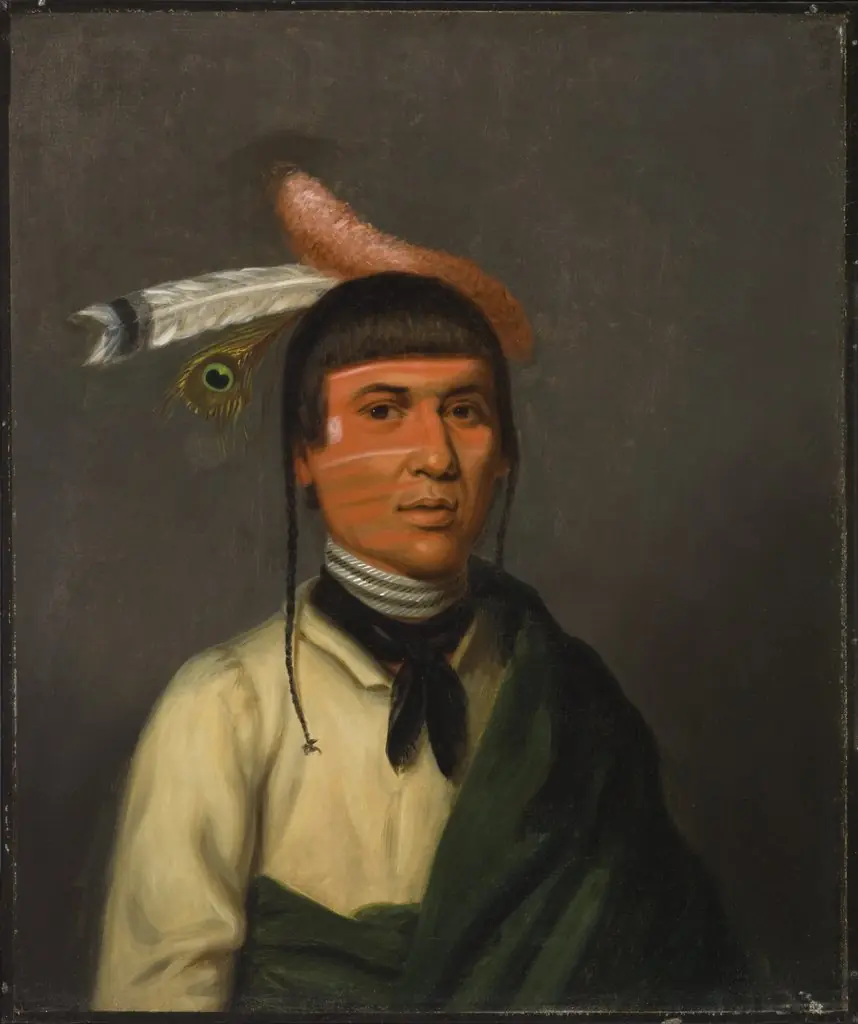
Own this work as a print
Artist & collection

Artist
Benjamin West (October 10, 1738 – March 11, 1820) was an American-born British painter who specialised in history painting, creating such works as The Death of Nelson, The Death of General Wolfe, the Treaty of Paris,…

- No-Tin (Wind), a Chippewa Chief
 Shaumonekusse, Oto Half Chief (Husband of Eagle of Delight)
 Chon-Ca-Pe
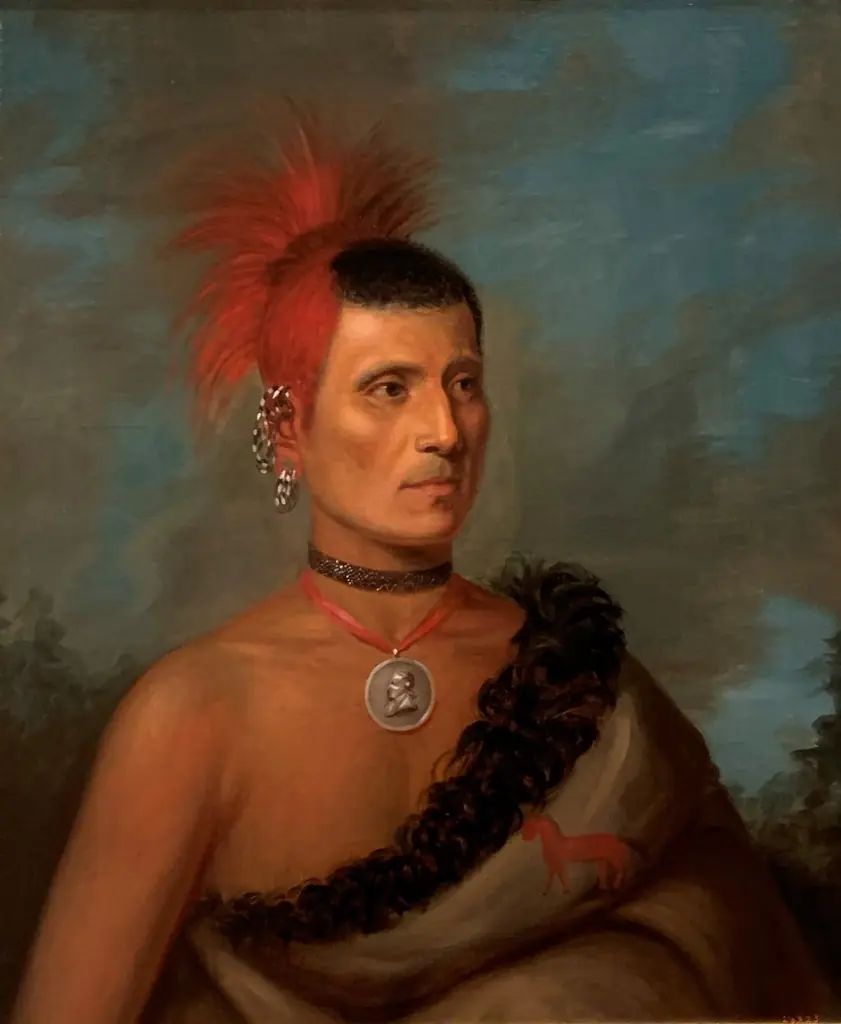 Pes-Ke-Le-Cha-Co
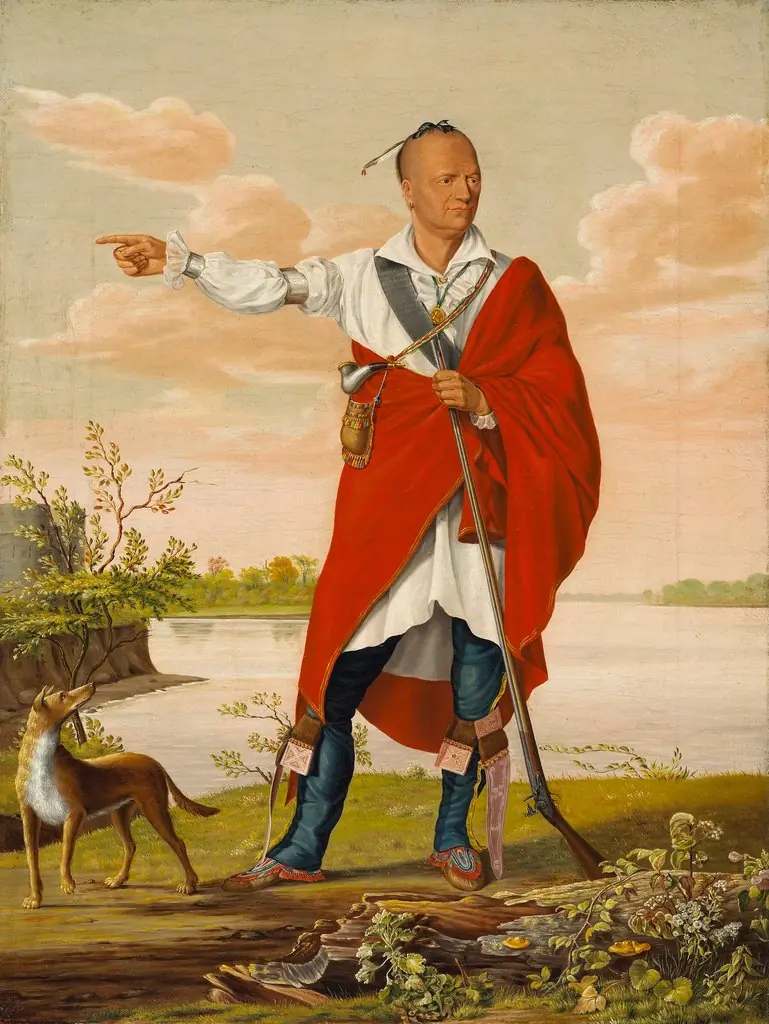 Thayendanegea (Joseph Brant)
 Chief Jumper of the Seminoles
 Osage Warrior
 Mohigan Chief and a Missionary
 The White Cloud, Head Chief of the Iowas
 Thayendanegea (Joseph Brant, c.1743–1807)
 General Johnson Saving a Wounded French Officer from the Tomahawk of a North American Indian
 Kaskaskia Chief, His Mother, and Son