Artwork
The Expulsion of Adam and Eve from Paradise
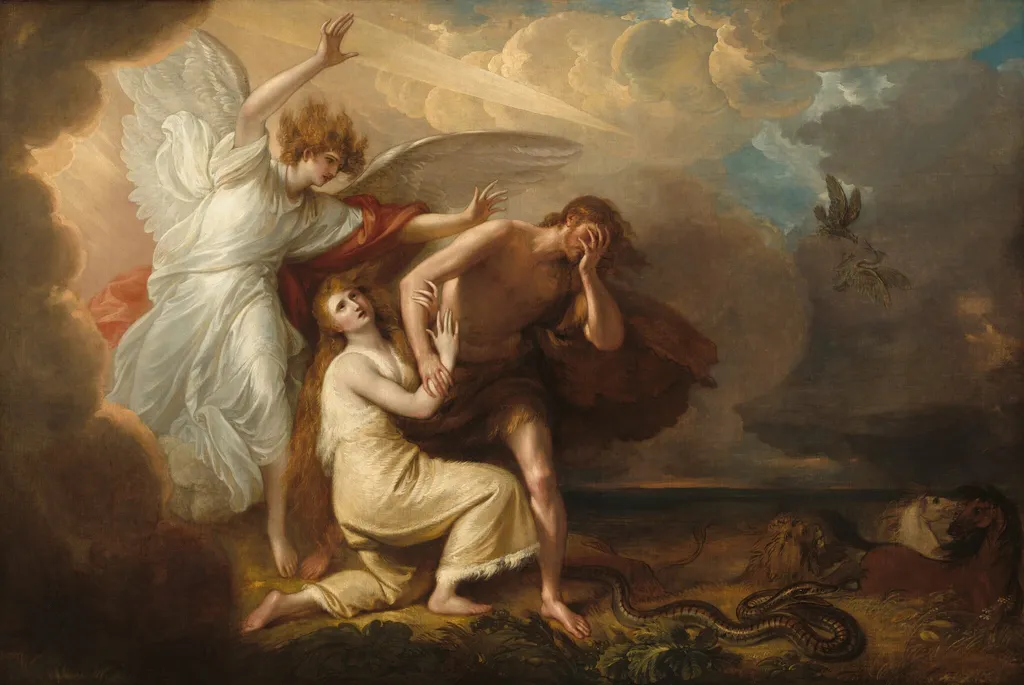
The Expulsion of Adam and Eve from Paradise is an oil painting by the Neoclassicist artist Benjamin West. It dates from 1791 and is held in the collection of the National Gallery of Art.
- Inscription
- Inscribed:lower left: B. West / 1791
About this work
It hung at the Royal Academy in 1791, then vanished into private hands for nearly two centuries before the National Gallery of Art acquired it in 1989.
An angel armed with a beam of light drives the first humans out of Eden in Benjamin West's 1791 canvas, created for King George III's chapel at Windsor Castle but never installed. Measuring over 2.7 metres wide, the work pairs the Archangel Michael's sweeping gesture with a coiled serpent and discord among animals to visualise the moment harmony shattered. It hung at the Royal Academy in 1791, then vanished into private hands for nearly two centuries before the National Gallery of Art acquired it in 1989.
Subject & Meaning
The painting depicts the biblical expulsion of Adam and Eve from the Garden of Eden, with the main subject drawn from the Book of Genesis. The iconography includes Adam and Eve, an angel driving them out of Paradise, and the serpent, the central figure of temptation in the narrative. As a work of religious art, the meaning of the scene lies in the representation of humanity's fall from grace, the loss of innocence, and the divine judgment that follows original sin. The composition thus conveys the moral and spiritual consequences of disobedience as traditionally interpreted in Christian doctrine.
History & Provenance
Painted in 1791 by Benjamin West, this work was commissioned by King George III of England but was never delivered to the monarch. According to West's manuscript accounts from 1797 and 1801, the painting was listed at a price of £525. In 1828, King George IV returned ownership rights to the artist's sons, Raphael Lamar West and Benjamin West Jr. The painting then appeared in sales at George Robins, London, in May 1829 (bought by Smith, apparently for Raphael West) and again in July 1831.
It later entered a private collection in Yorkshire before being sold at Phillips, Son & Neale, London, on 13 December 1988. Purchased by Thomas Agnew and Sons, it was acquired by the National Gallery of Art on 27 February 1989, where it remains.
The painting is held at the National Gallery of Art in Washington, D.C. It was purchased by the museum on 27 February 1989 from Thomas Agnew and Sons, London, following a sale at Phillips, Son & Neale earlier that year.
Overview
Benjamin West's "The Expulsion of Adam and Eve from Paradise," an oil on canvas from 1791, depicts a pivotal biblical moment. This large-scale work, measuring over 2.7 meters wide, was originally conceived for King George III's Royal Chapel at Windsor Castle. Although intended as part of a grand decorative scheme, the painting was never installed in its designated location.
It was exhibited at the Royal Academy in the year of its creation, then entered private hands for nearly two centuries before its acquisition by the National Gallery of Art.
Context
This painting was created as part of an ambitious, multi-decade undertaking commissioned by King George III. The monarch intended to adorn the Royal Chapel at Windsor Castle with a series of works illustrating 'Revealed Religion.' West dedicated considerable effort to this extensive project, yet the entire scheme was ultimately abandoned in 1801, a decade after "The Expulsion" was completed. Consequently, the painting remained in the artist's possession rather than fulfilling its royal purpose.
Own this work as a print
Artist & collection

Artist
Benjamin West (October 10, 1738 – March 11, 1820) was an American-born British painter who specialised in history painting, creating such works as The Death of Nelson, The Death of General Wolfe, the Treaty of Paris,…