Artwork
The Last Judgment
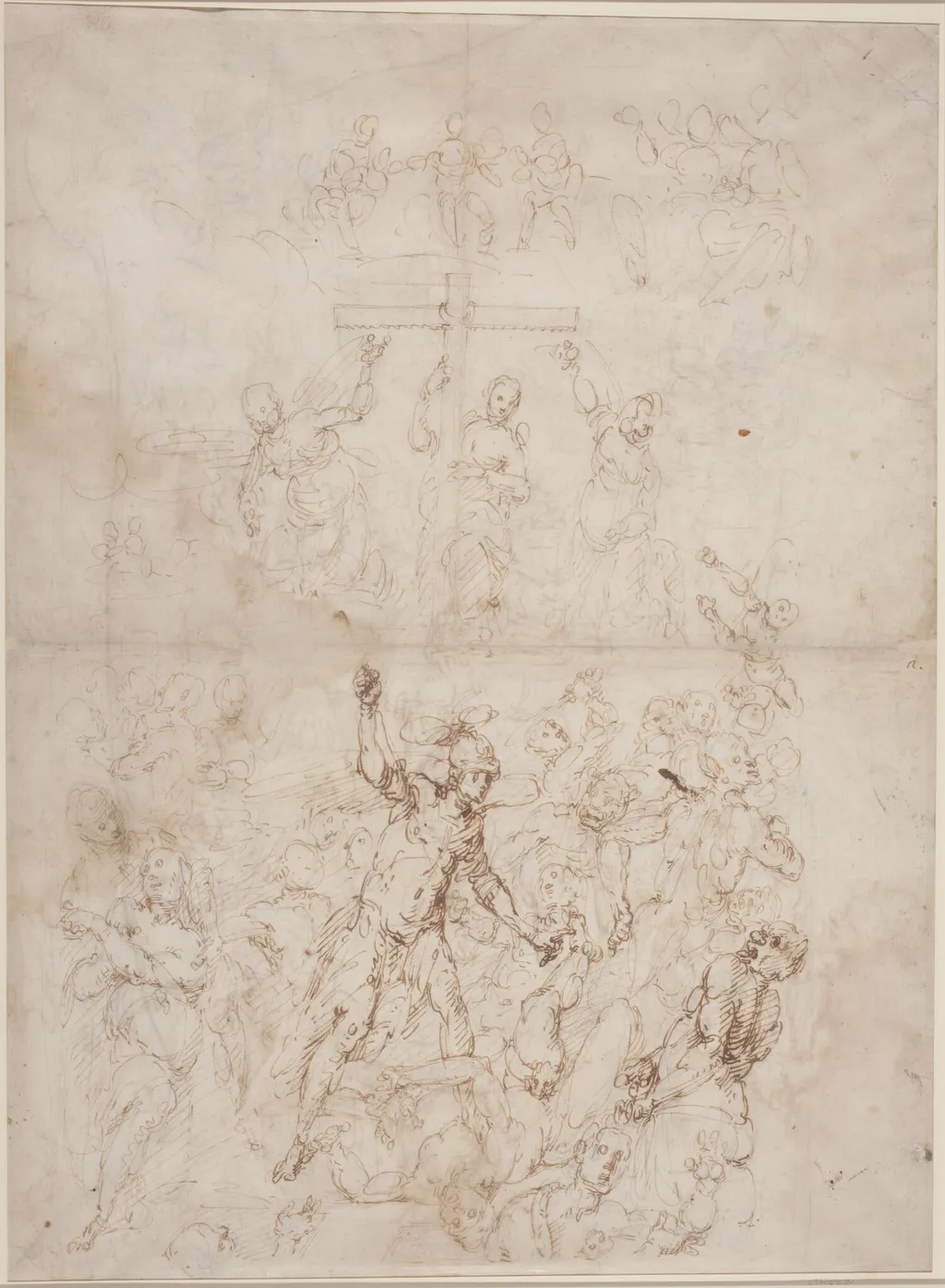
The Last Judgment is an ink drawing by the Baroque artist Giulio Benso. It dates from 1644 and is held in the collection of the National Gallery of Art.
About this work
Overview
At the apex, a cross anchors the scene, drawing the eye upward as souls rise toward salvation, while others struggle downward in a chaotic vortex of movement.
Giulio Benso's 'The Last Judgment,' executed in 1644, is a dynamic study in pen and brown ink on laid paper. The composition captures the apocalyptic moment of divine reckoning with a dense arrangement of figures in various states of ascent and descent. At the apex, a cross anchors the scene, drawing the eye upward as souls rise toward salvation, while others struggle downward in a chaotic vortex of movement.
Benso employs loose, rapid hatching and overlapping forms to convey the turbulence of the event, prioritizing energetic gesture over precise anatomical definition. This sketch exemplifies the artist's mastery of the Baroque idiom, utilizing the fluidity of ink to suggest the weightlessness of the saved and the gravity of the damned. Created during the height of the Italian Baroque, the work reflects the period's fascination with dramatic motion and emotional intensity.
As a preparatory or independent drawing, it demonstrates Benso's ability to translate complex theological narratives into a unified, swirling visual rhythm, characteristic of his contributions to 17th-century Genoese art.
Subject & Meaning
The scene depicts the Christian eschatological theme of the final judgment, where souls are weighed and directed either toward salvation or damnation. Figures are shown in various states of ascent or struggle, suggesting the moral tension between redemption and condemnation that the doctrine traditionally conveys.
Technique & Style
Benso employs swift, loose ink lines without any color, relying on varied pen strokes to suggest volume, gesture, and emotional intensity. Overlapping silhouettes and rapid hatching convey motion, while the brown ink on the slightly yellowed laid paper adds a muted tonal range that emphasizes the drawing’s stark, sketch‑like quality.
History & Provenance
Created in 1644, the drawing remains on its original laid paper, which bears the characteristic aged edges of the period. Its provenance traces back to Benso’s workshop in Genoa, though specific ownership records prior to its museum acquisition are limited.
Own this work as a print
Artist & collection


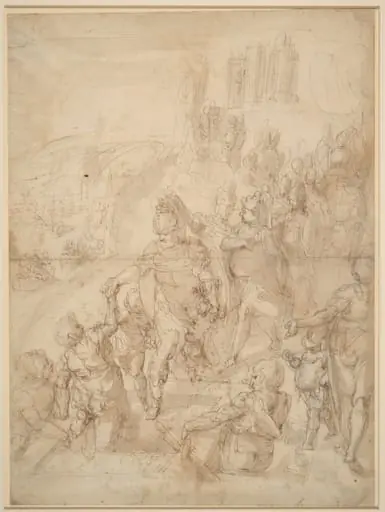
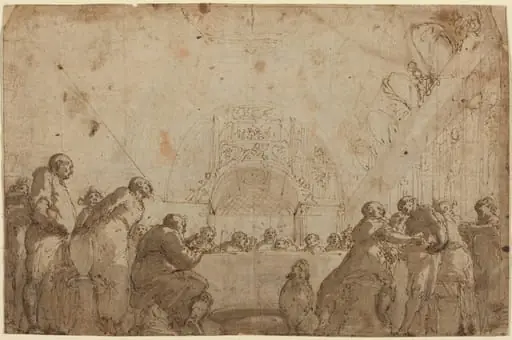
 The Martyrdom of Saint Bartholomew; The Conversion of Saint Paul
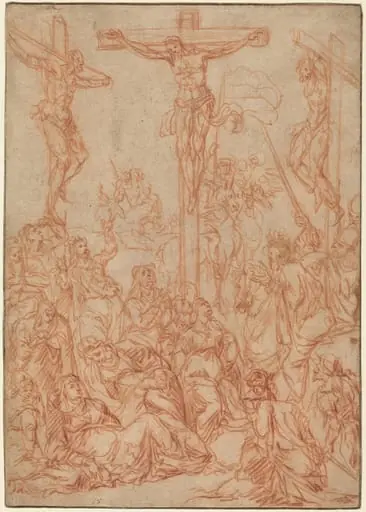 The Crucifixion
![Figure Studies [recto], by Perino del Vaga](https://artifactworldgallery.com/img/perino-del-vaga--figure-studies-recto--c7d34665e14a7057-w320.webp) Figure Studies [recto]
Figure Studies [recto]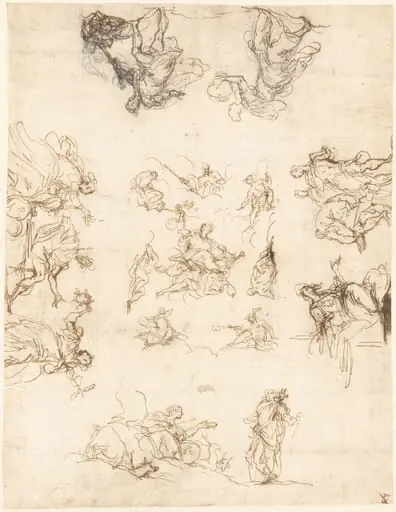 A Compartmented Ceiling with Allegories and Myths
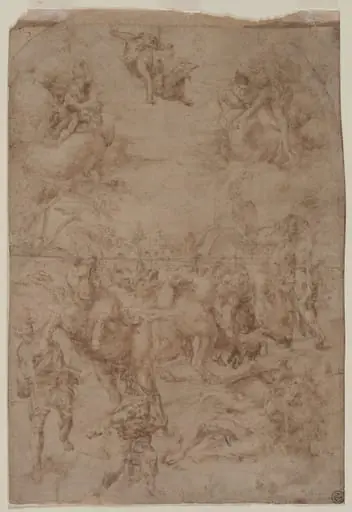 The Conversion of St. Paul
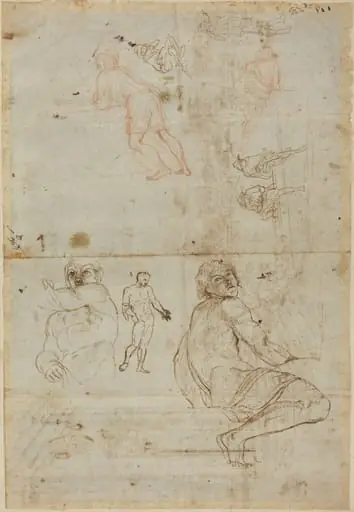 Figures from the Farnese Palace and from Life
![Studies for Judith and Holofernes, David and Goliath, The Finding of Moses, and Others [recto], by Veronese](https://artifactworldgallery.com/img/veronese--studies-for-judith-and-holofernes-david-and-goliath-the-find--e7509a7c8dd48fbb-w320.webp) Studies for Judith and Holofernes, David and Goliath, The Finding of Moses, and Others [recto]
Studies for Judith and Holofernes, David and Goliath, The Finding of Moses, and Others [recto]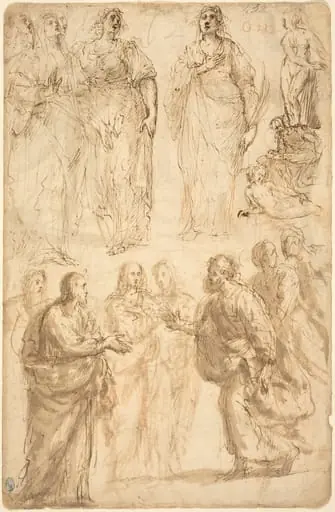 Scenes from the Life of Saint Peter
![Studies for the Rape of the Sabine Women [verso], by Pirro Ligorio](https://artifactworldgallery.com/img/pirro-ligorio--studies-for-the-rape-of-the-sabine-women-verso--b2205f5ea056eb54-w320.webp) Studies for the Rape of the Sabine Women [verso]
Studies for the Rape of the Sabine Women [verso]