Artwork
The Town Fair by the Church of Saint-Jacques in Dieppe, Morning, Sunlight
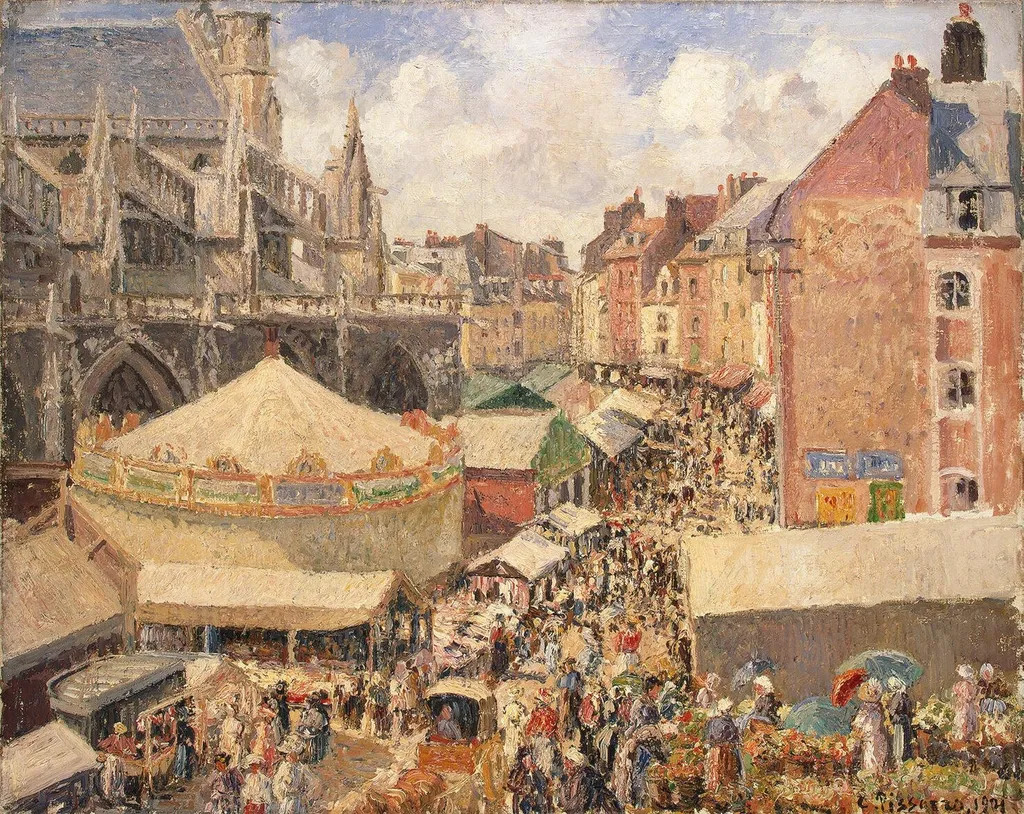
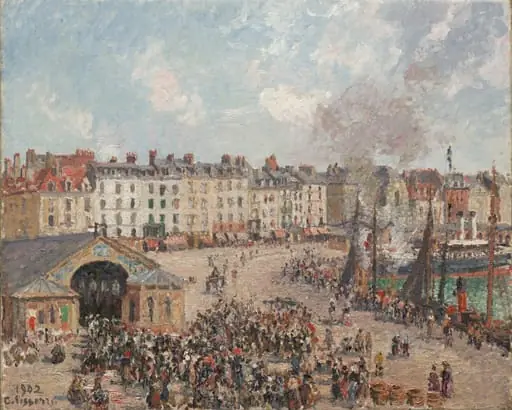
The Town Fair by the Church of Saint-Jacques in Dieppe, Morning, Sunlight is an oil painting by the Impressionist artist Camille Pissarro. It dates from 1901 and is held in the collection of the Hermitage Museum.
About this work
Subject & Meaning
The composition emphasizes the dynamic energy of the gathering, where the architecture of the church and surrounding houses frames the human activity.
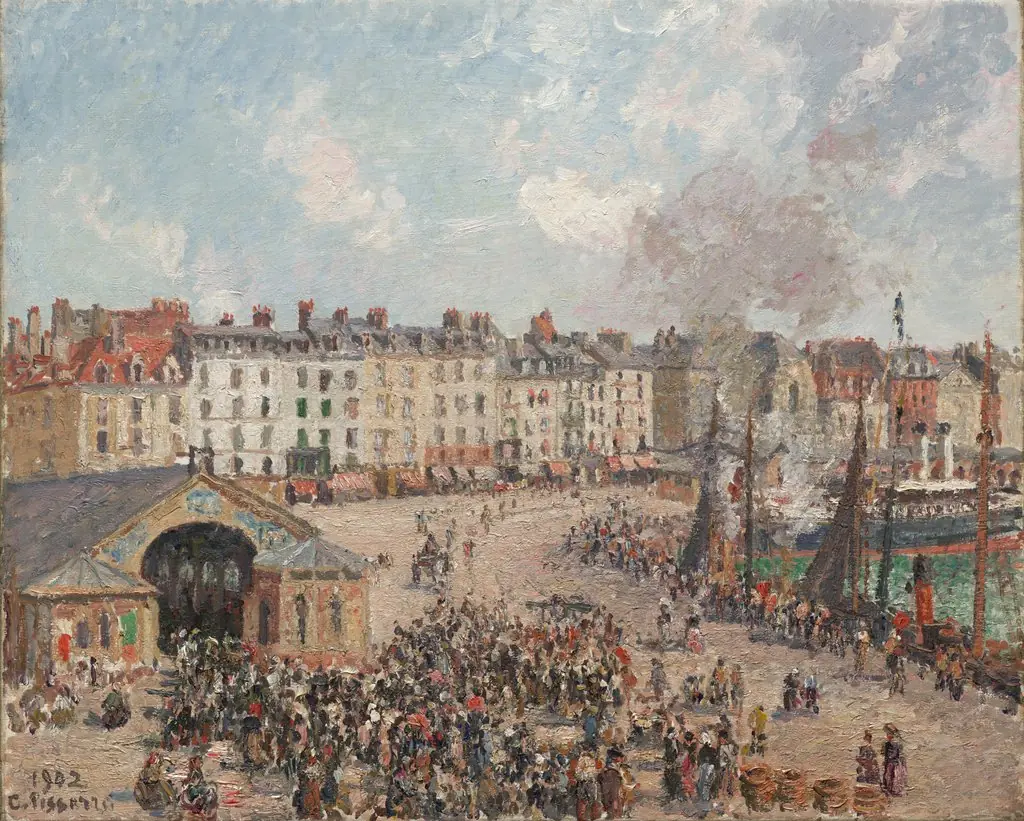
The work depicts a bustling market fair in Dieppe, characterized by a dense crowd surrounding stalls and a circus tent, with the portal of the Church of Saint-Jacques visible in the background. Painted in late summer and early autumn 1901, the scene captures the peak of daily commerce, contrasting with earlier canvases in the series that showed the square empty or under cloudy skies. The composition emphasizes the dynamic energy of the gathering, where the architecture of the church and surrounding houses frames the human activity.
Art historian Lionello Venturi described the painting as a masterpiece of pictorial energy, noting how the interplay of the church, buildings, and the thronging crowd creates a grand, holistic movement. This focus on populated urban life distinguishes the series from contemporaneous serial studies by Monet, which often excluded human figures.
Technique & Style
The Town Fair by the Church of Saint-Jacques in Dieppe, Morning, Sunlight is an oil painting on canvas, measuring 65.3 cm by 81.5 cm. Pissarro employed a loose, impressionistic technique characterized by vibrant brushwork and careful modulation of light to capture the bustling market scene under bright sunlight. The composition balances architectural elements, notably the church portal and circus canopy, with dense human activity, creating a dynamic interplay of space and movement. The work reflects Pissarro’s interest in urban life and his adaptation of Monet’s serial approach to atmospheric effects, while retaining a distinct focus on figural presence.
The painting’s handling of perspective and color underscores its formal synthesis of structure and spontaneity, aligning with Pissarro’s broader exploration of seasonal and diurnal variations. It was created during a pivotal period in 1901, as documented in his correspondence, and exemplifies the synthesis of plein-air observation and studio refinement.
History & Provenance
The work was painted by Camille Pissarro in the late summer and early autumn of 1901 during a concentrated campaign in Dieppe, as documented in his letters to his son Lucien. On 19 July 1901 he wrote from Dieppe’s Hôtel du Commerce, noting that his window faced the left side of the market with the church portal visible, and by 26 July he reported beginning several canvases there, including rainy scenes. By 28 August he recorded completing four canvases in the thirty-format and others in smaller sizes, totaling nine distinct views of the site.
In November 1901 the painting was purchased by the Bernheim-Jeune gallery in Paris and soon sold to Léon Moreau of Paris. Moreau resold it on 29 May 1925 to the successors of Paul Durand-Ruel, which in turn placed it with a Berlin gallery. By 12 January 1928 the canvas had entered the collection of the German industrialist and collector Otto Krebs in Weimar.
After Krebs’s death in spring 1941, the work was stored in a purpose-built safe at his Holzdorf estate near Weimar. In 1945 Soviet trophy teams discovered the concealed collection and shipped it to the Hermitage in 1949. It remained in the museum’s holdings without public display until its first exhibition in 1995, after which it entered permanent display in 2001 and, since late 2014, has been shown in the gallery dedicated to Sergei Shchukin and Ivan Morozov within the Hermitage’s General Staff Building.
The painting belongs to the Hermitage Museum in Saint Petersburg. It was acquired by the Bernheim-Jeune gallery in November 1901 and soon sold to Léon Moreau of Paris. On 29 May 1925, Moreau sold it to the heirs of Paul Durand-Ruel, and on 12 January 1928 it was purchased by a Berlin gallery, which resold it to the German businessman and collector Otto Krebs of Weimar.
After Krebs died in spring 1941, the canvas remained at his estate at Holzdorf near Weimar, where it was stored in a specially built vault during the Second World War. In 1945 Soviet trophy brigades seized the collection and shipped it to the Hermitage in 1949, where it remained largely unknown to the public and most scholars for decades.
The painting was first exhibited publicly in 1995 at the Hermitage exhibition "Trophies of Art." It joined the Hermitage's permanent display in 2001 and since late 2014 has been shown in Room 411 of the General Staff Building, in the gallery dedicated to Sergei Shchukin and the Morozov brothers.
Context
Painted in 1901, The Town Fair by the Church of Saint-Jacques in Dieppe, Morning, Sunlight represents the fourth canvas in a nine-painting series created by Camille Pissarro during his stay in Dieppe that summer and early autumn. Art historians often situate this work within the context of Claude Monet's Rouen Cathedrals, noting that while Monet's variations excluded human presence, Pissarro's series is distinguished by its dense crowds and bustling market activity. Lionello Venturi, the author of the first catalogue raisonné of Pissarro's paintings, described the work as a masterpiece of pictorial energy, praising how the church, houses, circus tent, and crowd combine to create a grand, holistic effect.
The painting remained unknown to the public and most scholars for decades after being seized by Soviet trophy teams in 1945 and transported to the Hermitage Museum in 1949, only receiving its first public exhibition in 1995.
Legacy
Pissarro's Dieppe series, of which the Hermitage canvas is the fourth work, is regarded as a direct response to Monet's Rouen Cathedral paintings shown in 1895, which Pissarro described as a "breathtaking spectacle" and admired for their "extraordinary skill." Unlike Monet's variations, which exclude human presence, Pissarro filled his canvases with figures, producing nine markedly different views of the Saint-Jacques market square. The painting's critical standing was affirmed by Lionello Venturi, author of the first Pissarro catalogue raisonné (1939), who called the work "a masterpiece of pictorial energy," praising the unified movement created by the church, houses, barracks, and crowd as producing a grand, holistic effect.
Long hidden from public view after being transferred to the Soviet Union in 1949, the canvas was first exhibited in 1995 as part of the Hermitage's "Trophies of Art" display. It joined the Hermitage's permanent exhibition in 2001 and has been displayed since late 2014 in the gallery dedicated to Sergei Shchukin and the Morozov brothers (Room 411).
Overview
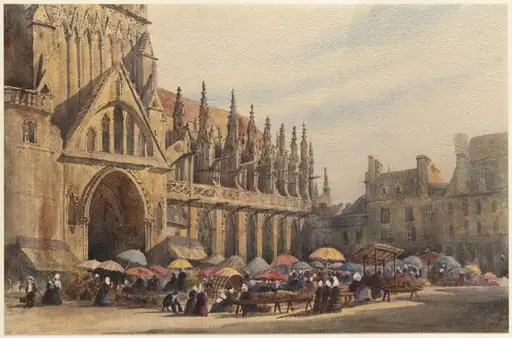
Camille Pissarro’s 1901 oil on canvas captures a lively morning scene in Dieppe, centered on the Church of Saint‑Jacques. A bustling fair fills the town square, with a prominent white tent, colorful umbrellas, and a crowd of figures moving beneath temporary stalls. The composition balances the monumental church on the left with the surrounding streets and red‑tiled roofs that recede into the background.
Artist & collection