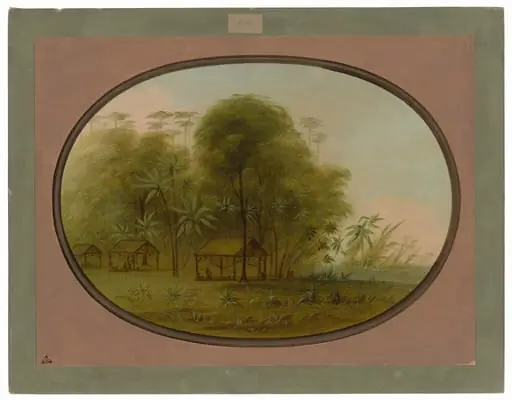
Artwork
An Omagua Village - Boat Sketch
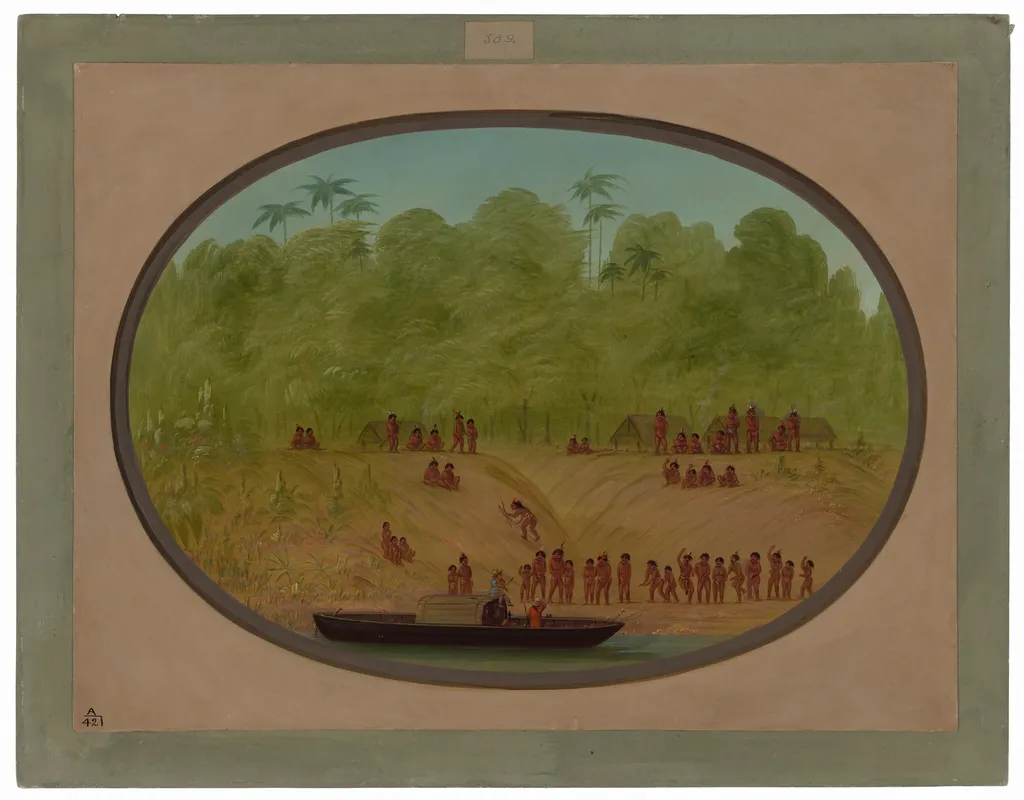
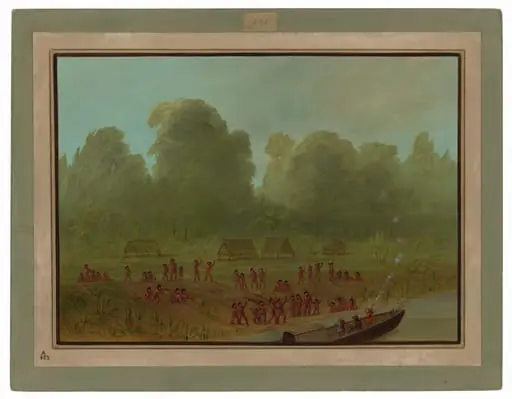
An Omagua Village - Boat Sketch is an oil painting by the Impressionist artist George Catlin. It dates from 1862 and is held in the collection of the National Gallery of Art. Created in 1862, this modest oil sketch measures roughly five by seven inches and is mounted on paperboard.
About this work
Subject & Meaning
The subject reflects Catlin's interest in recording the daily activities and environment of the Omagua people during his travels in South America.
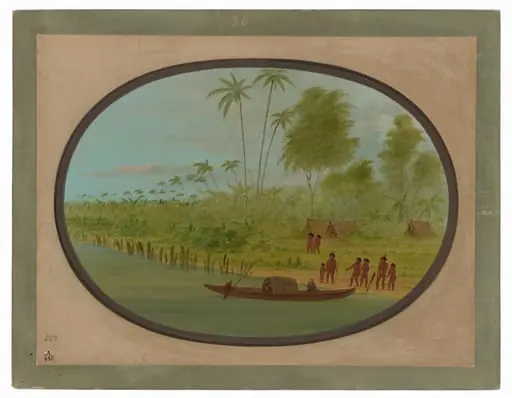
The painting An Omagua Village - Boat Sketch portrays a river scene with a tree central to the composition, reflecting Amazonian indigenous life and the integration of nature in Catlin's documentation of Omagua culture.
The tree functions as symbolic representation of communal gathering and spiritual connection within the village.
The work belongs to the landscape genre and was created in oil on card mounted on paperboard in 1875.
The subject reflects Catlin's interest in recording the daily activities and environment of the Omagua people during his travels in South America.
Technique & Style
According to the corpus record, An Omagua Village - Boat Sketch is an oil painting executed on card mounted on paperboard. The Wikidata entry, by contrast, describes the work as oil paint on canvas and gives dimensions of 47.5 by 62.9 (height by width), though it does not specify the unit. The painting is classified as a landscape, and the depicted subject is a tree.
The two sources disagree on the support, card on paperboard versus canvas, so the precise ground cannot be reconciled from the available material.
History & Provenance
George Catlin created An Omagua Village - Boat Sketch in 1875 as an oil on card mounted on paperboard painting. The work entered the National Gallery of Art's collection through a documented chain of ownership: it descended through Catlin's daughters Clara Gregory Catlin, Louise Catlin Kinney, and Elizabeth Wing Catlin, was purchased from Elizabeth Wing Catlin in 1912 by the American Museum of Natural History, resold in 1959 via Kennedy Galleries in New York to Paul Mellon, and gifted to the National Gallery of Art in 1965. This provenance is recorded in the NGA's collection history and corroborated by the artwork's National Gallery of Art listing.
An Omagua Village - Boat Sketch is held by the National Gallery of Art in Washington, D.C. The work entered the collection through a series of transactions: it was purchased in 1912 from Elizabeth Wing Catlin by the American Museum of Natural History, then sold in 1959 through Kennedy Galleries, New York to Paul Mellon, and finally gifted to the National Gallery of Art in 1965. Its dimensions are 47.5 cm by 62.9 cm, recorded in the National Gallery of Art's collection data, and it has been part of the museum's holdings since the 1965 gift. The artwork is classified as a painting and is part of the National Gallery of Art's collection in Washington, D.C.
Legacy
The work's legacy is defined by its early acquisition and continued public visibility. After passing through the artist's daughters and a 1912 purchase by the American Museum of Natural History, the painting entered the National Gallery of Art's collection in 1965, ensuring sustained scholarly and public attention. Its inclusion in major institutional holdings has reinforced Catlin's reputation as a chronicler of indigenous life, with the piece frequently referenced in discussions of 19th-century ethnographic art. This trajectory underscores its significance within the broader narrative of American artistic engagement with Native American subjects.
Overview
Created in 1862, this modest oil sketch measures roughly five by seven inches and is mounted on paperboard. It portrays a tranquil river scene with thatched dwellings, a wooden boat, and a solitary tree under a bright sky, rendered in swift brushwork that captures fleeting light.
Context
Catlin’s earlier career involved detailed engravings of sites such as the Erie Canal, and his 1830s journeys into the western frontier yielded numerous portraits of Plains Indians. By the 1860s, his focus had shifted toward recording the environments inhabited by the peoples he had previously depicted.
Own this work as a print
Artist & collection

Artist
George Catlin ( KAT-lin; July 26, 1796 – December 23, 1872) was an American lawyer, painter, author, and traveler, who specialized in portraits of Native Americans in the American frontier.

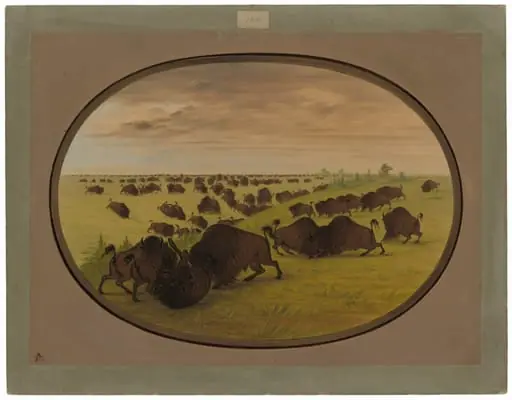 Bulls Fighting
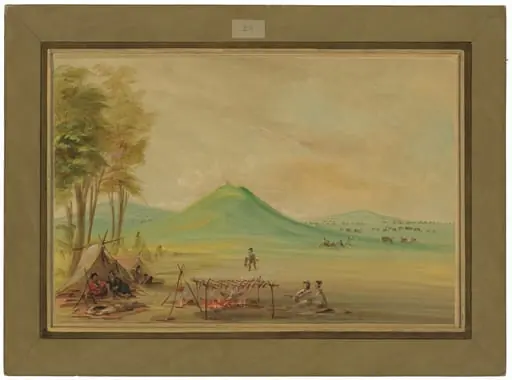 Expedition Encamped on a Texas Prairie. April 1686
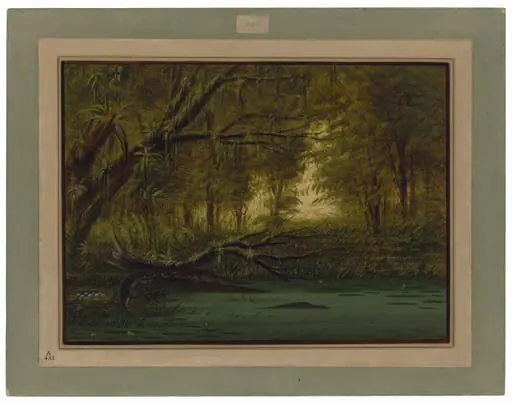 An Alligator's Nest
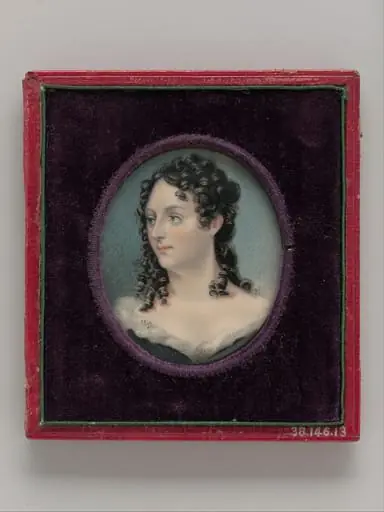 Mrs. George Catlin (Clara Bartlet Gregory)
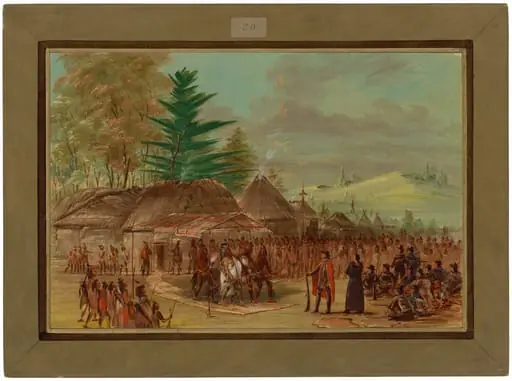 Chief of the Taensa Indians Receiving La Salle. March 20, 1682
 A Small Village - Payaguas Indians
 Omaha Chief, His Wife, and a Warrior
 Father Hennepin Leaving the Mississippi to Join La Salle. May 8, 1680