Artwork
Father Hennepin and Companions Passing Lover's Leap. April 1680
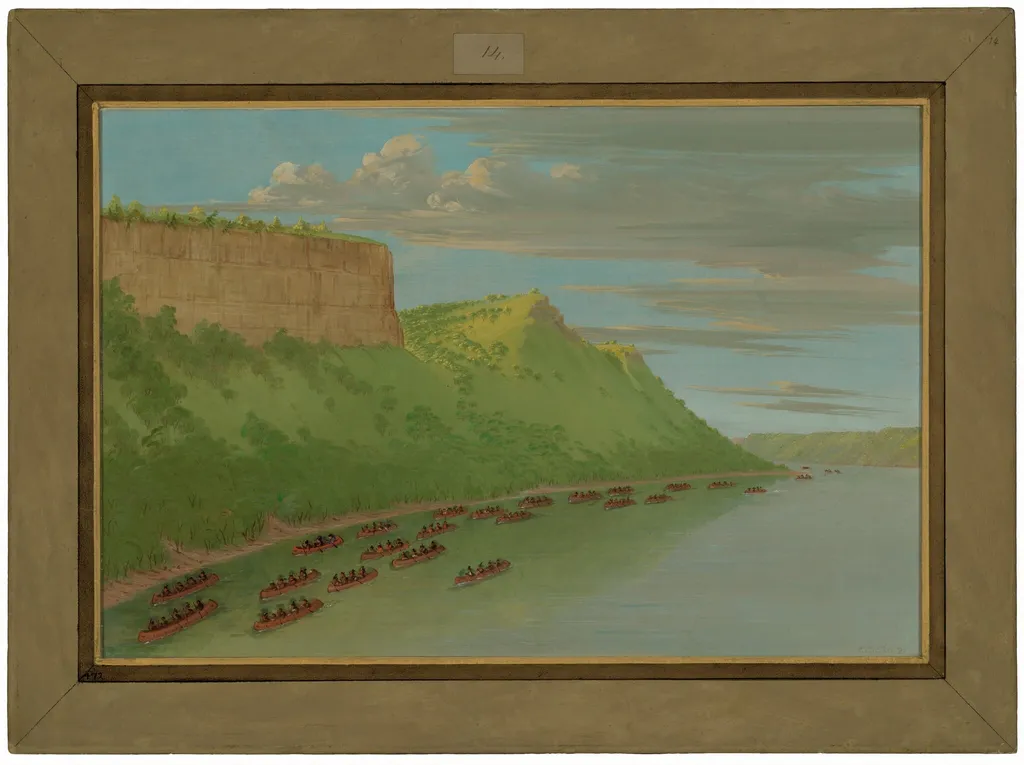
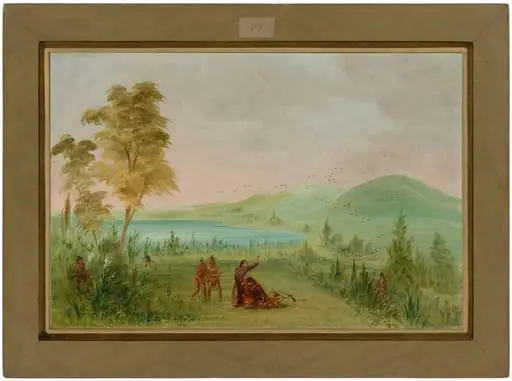
Father Hennepin and Companions Passing Lover's Leap. April 1680 is an oil painting by the Romanticist artist George Catlin. It dates from 1848 and is held in the collection of the National Gallery of Art.
- Inscription
- Inscribed:lower right: G. Catlin p.
About this work
Technique & Style
The painting is executed in oil on canvas, a medium confirmed by the catalog entry and the National Gallery of Art record.
The painting is executed in oil on canvas, a medium confirmed by the catalog entry and the National Gallery of Art record. Executed in 1847, the work portrays a house and a mountain, elements that anchor its scenic narrative. As a landscape genre piece, it reflects the formal conventions of 19th‑century American topography, emphasizing clear delineation of natural forms and a balanced spatial arrangement.
The canvas measures 37.8 cm in height by 56.2 cm in width, and the composition is part of the National Gallery of Art's collection in Washington, D.C.
History & Provenance
The painting Father Hennepin and Companions Passing Lover’s Leap. April 1680 was created by George Catlin in 1847 as an oil on canvas measuring 37.8 × 56.2 cm. It was commissioned and executed by Catlin in the mid-19th century, reflecting his broader project of documenting Indigenous life and landscapes.
The work descended by family inheritance from the artist to his daughters, Clara Gregory Catlin, Louise Catlin Kinney, and Elizabeth Wing Catlin, before being sold in 1912 to the American Museum of Natural History. It later passed through Kennedy Galleries in New York and entered the collection of Paul Mellon in Upperville, Virginia. Mellon gifted the painting to the National Gallery of Art, Washington, D.C., in 1965, where it remains.
The painting is held by the National Gallery of Art, Washington, D.C. Its accession number is 1965.1.133.
It was first owned by the artist George Catlin and descended to his daughters Clara Gregory Catlin, Louise Catlin Kinney, and Elizabeth Wing Catlin. In 1912 it was purchased from Elizabeth Wing Catlin by the American Museum of Natural History. It was sold in 1959 through Kennedy Galleries, New York, to Paul Mellon, Upperville, Virginia, and in 1965 Mellon gifted it to the National Gallery of Art.
Overview
George Catlin, an American painter, created Father Hennepin and Companions Passing Lover's Leap in 1848. This oil on canvas work portrays a group navigating a boat past a prominent rock formation within a dramatic mountain landscape. While Catlin is widely recognized for his depictions of Indigenous American life, this painting illustrates a moment in European exploration, specifically featuring Father Hennepin, an early figure in the North American frontier narrative.
Subject & Meaning
The painting captures a scene from April 1680, depicting Father Hennepin and his companions as they journey past a significant cliff known as Lover's Leap. The composition emphasizes the vastness of the American wilderness, with towering rock formations and a distant mountain framing the small boat and its occupants. This focus on a European explorer's journey offers a perspective on the frontier distinct from Catlin's more frequent portrayals of Native American communities.
Context
George Catlin, originally trained in law, dedicated much of his artistic career to documenting the American frontier. Throughout the 1830s, he extensively traveled the American West, producing numerous portraits and written accounts of Plains Indian communities. His artistic output also included early lithographs illustrating landscapes along New York State's Erie Canal.
This painting, created later in his career, reflects his enduring interest in the historical narratives and natural environments of the expanding American territories.
Own this work as a print
Artist & collection

Artist
George Catlin ( KAT-lin; July 26, 1796 – December 23, 1872) was an American lawyer, painter, author, and traveler, who specialized in portraits of Native Americans in the American frontier.

 Bulls Fighting
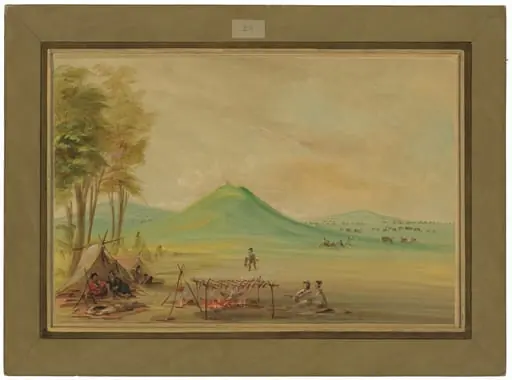 Expedition Encamped on a Texas Prairie. April 1686
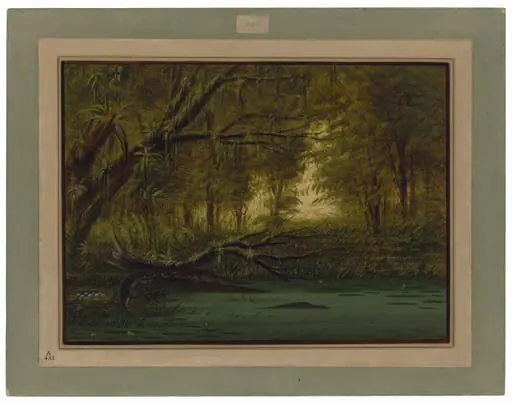 An Alligator's Nest
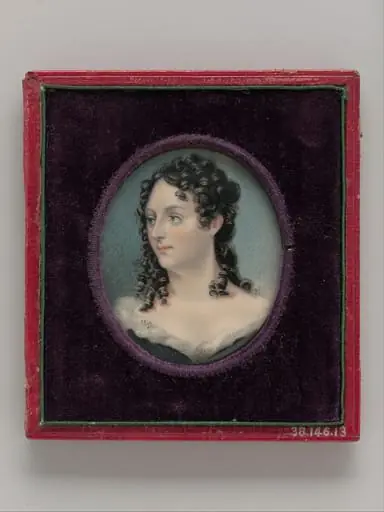 Mrs. George Catlin (Clara Bartlet Gregory)
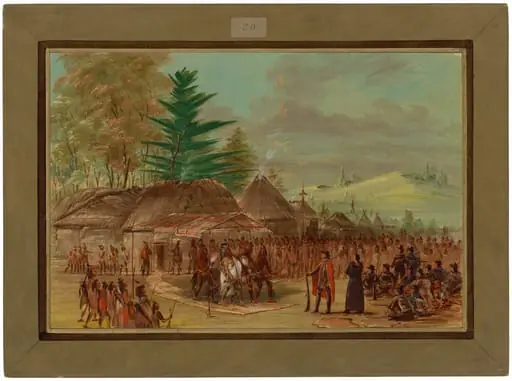 Chief of the Taensa Indians Receiving La Salle. March 20, 1682
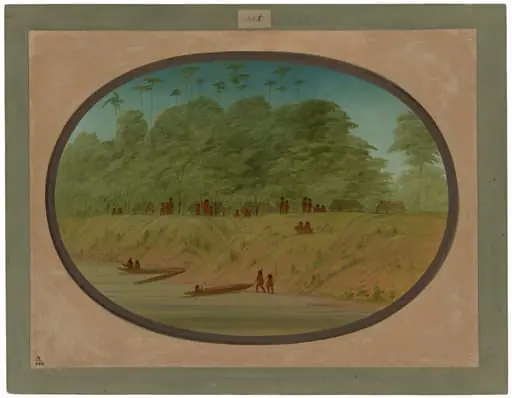 A Small Village - Payaguas Indians
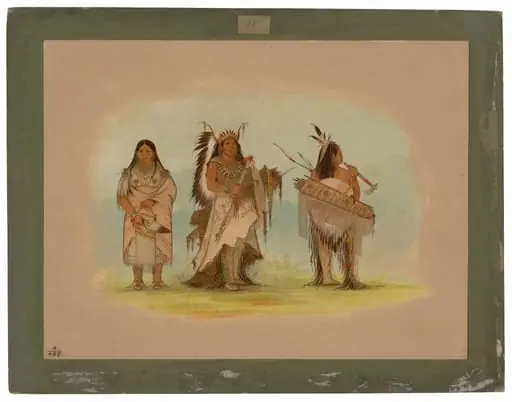 Omaha Chief, His Wife, and a Warrior
- Father Hennepin Leaving the Mississippi to Join La Salle. May 8, 1680