Artwork
Portage Around the Falls of Niagara at Table Rock
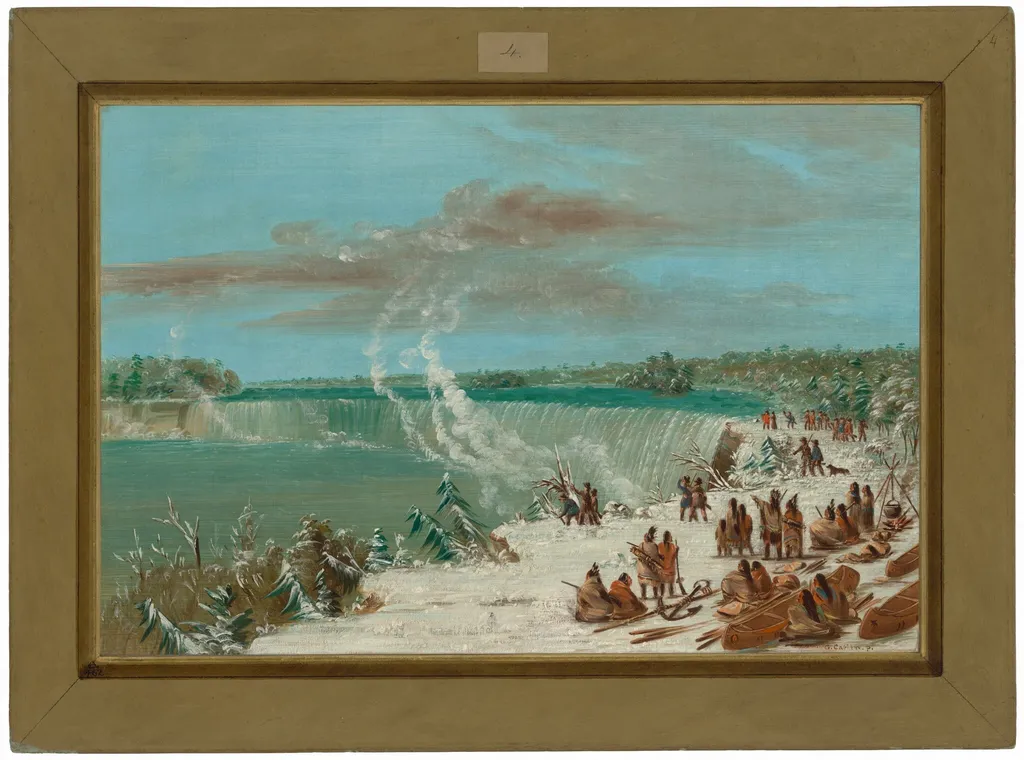
Portage Around the Falls of Niagara at Table Rock is an oil painting by the Romanticist artist George Catlin. It dates from 1848 and is held in the collection of the National Gallery of Art.
- Inscription
- Inscribed:lower right: G. Catlin. p.
About this work
Overview
Portage Around the Falls of Niagara at Table Rock is an oil on canvas landscape painted by George Catlin in 1847 or 1848.
Portage Around the Falls of Niagara at Table Rock is an oil on canvas landscape painted by George Catlin in 1847 or 1848. Measuring 37.8 by 56.2 centimeters, the work depicts Indigenous peoples navigating the landscape around a frozen Niagara Falls. The painting is part of Catlin's later Cartoon Collection, a series of over 600 works created during the 1850s and 1860s. It is currently held in the National Gallery of Art in Washington, D.C., under accession number 1965.16.318.
Subject & Meaning
The composition captures a wide, frozen Niagara Falls stretching across the middle ground, with mist rising from the cascading water. Snow blankets the foreground and banks where numerous figures gather. Clad in earth toned garments and blankets, these individuals sit on the snow, converse, and gesture toward the falls. Wooden canoes rest on the snow near seated figures, referencing the physical act of portaging around the treacherous waters. Bare trees and snow dusted evergreens frame the scene. Catlin originally titled the work Portage of Canoes, &c., around the Fall of Niagara at Table Rock. Through an ethnographic lens, he aimed to document Indigenous customs, but his portrayal is often viewed as romanticized, reflecting a common 19th century practice of depicting Indigenous peoples as existing outside of modern life and contributing to a generalized narrative about Indigenous identity.
Technique & Style
Executed in oil on canvas, the painting employs a palette dominated by turquoise, white, brown, and muted green. Catlin's brushwork varies across the composition, featuring relatively smooth application in the sky and water, contrasted by thicker texture in the rendering of snow and rising mist. Light is diffused throughout the scene, lacking strong shadows, which effectively suggests the overcast atmosphere of a winter day. The painting is signed in the lower right corner with the inscription G. Catlin. p.
History & Provenance
Created in 1847 or 1848, the painting remained with George Catlin until his death in 1872. It then descended to his three daughters, Clara Gregory Catlin, Louise Catlin Kinney, and Elizabeth Wing Catlin. In 1912, the American Museum of Natural History purchased the work from Elizabeth Wing Catlin as part of a larger acquisition of the Cartoon Collection. When the museum deaccessioned these works, Paul Mellon purchased more than 300 of them through Kennedy Galleries in New York in 1959. Mellon subsequently gifted 351 paintings from this group, including this piece, to the National Gallery of Art in 1965. The painting has an extensive exhibition history, including displays in St. Louis, Peoria, Fort Worth, Nashville, Washington D.C., Buffalo, and internationally in Bonn and Berlin for the 2013 exhibition On the Trails of the Iroquois.
Context
George Catlin was a 19th century American traveler, writer, and painter of the Romantic period who specialized in portraits and scenes of Native Americans. He created two major collections during his career. The first, known as the Indian Gallery, included more than 500 works completed during the 1830s, most of which survive at the Smithsonian American Art Museum. After financial difficulties forced him to sell his initial collection to industrialist Joseph Harrison, Catlin spent the next twenty years forming his second body of work, the Cartoon Collection, to which this painting belongs. Catlin exhibited the Cartoon Collection in New York in 1871 and published a catalog listing all the works, including this specific painting as Cart. No. 424. His broader oeuvre, including earlier views of Niagara Falls and a physical model of the falls exhibited with his Indian Gallery, sought to document the customs of tribes during a period marked by westward expansion and displacement.
Legacy
Catlin's paintings, including this portage scene, have sparked ongoing scholarly discussion regarding the complexities of representation. While the artist expressed admiration for the people he depicted, noting he uniformly found them kind and honest, modern curatorial assessment highlights how his work often generalized and essentialized diverse cultures. The painting contributes to a historical visual record while simultaneously prompting contemporary viewers to contemplate how artists can perpetuate or challenge stereotypes. The survival of the Cartoon Collection through the stewardship of the American Museum of Natural History and Paul Mellon has allowed continued public engagement and critical reevaluation of Catlin's constructed narratives about Indigenous identity.
Own this work as a print
Artist & collection

Artist
George Catlin ( KAT-lin; July 26, 1796 – December 23, 1872) was an American lawyer, painter, author, and traveler, who specialized in portraits of Native Americans in the American frontier.

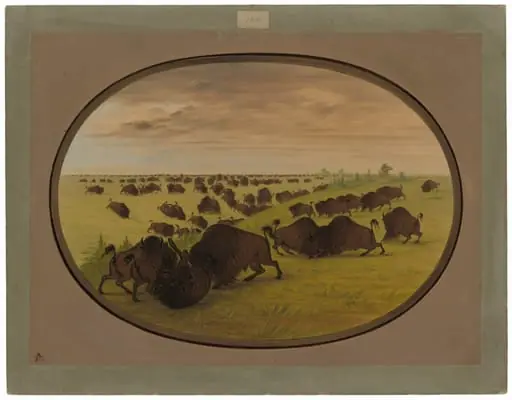 Bulls Fighting
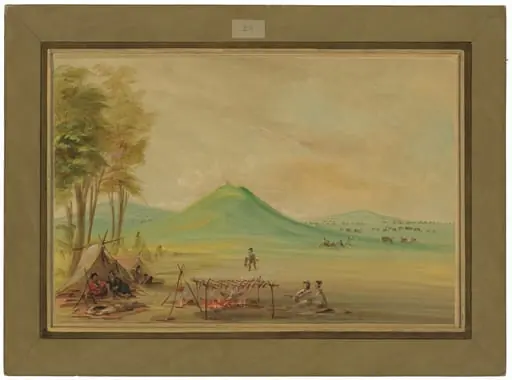 Expedition Encamped on a Texas Prairie. April 1686
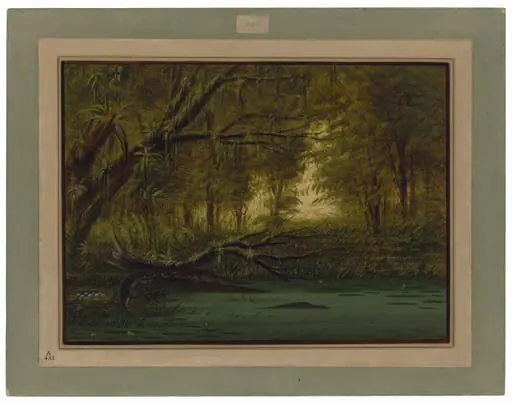 An Alligator's Nest
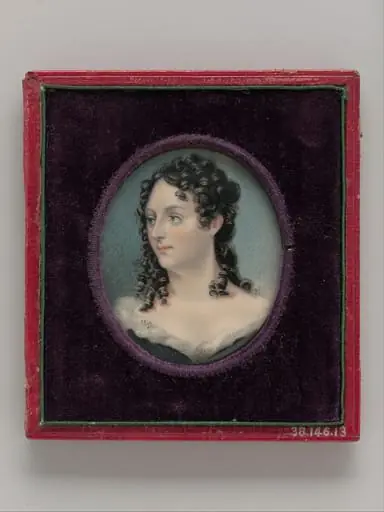 Mrs. George Catlin (Clara Bartlet Gregory)
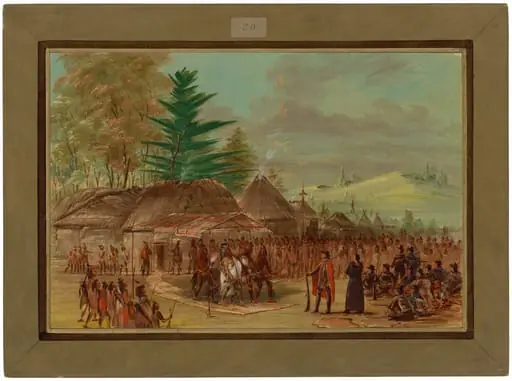 Chief of the Taensa Indians Receiving La Salle. March 20, 1682
 A Small Village - Payaguas Indians
 Omaha Chief, His Wife, and a Warrior
 Father Hennepin Leaving the Mississippi to Join La Salle. May 8, 1680