Artwork
Two Arapaho Warriors and a Woman
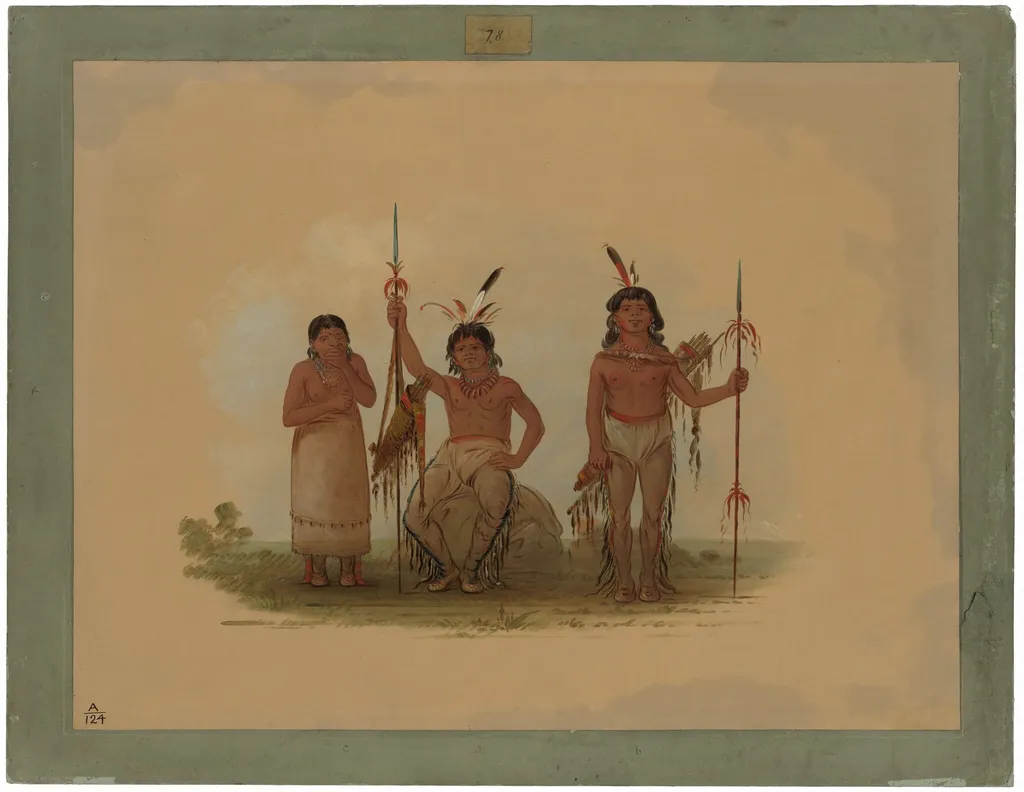
Two Arapaho Warriors and a Woman is an oil painting by the Impressionist artist George Catlin. It dates from 1865 and is held in the collection of the National Gallery of Art. Created in 1865, this oil painting on card, later mounted on paperboard, portrays three Arapaho individuals on a grassy plain.
About this work
Overview
), depicts three Arapaho figures in a horizontal arrangement against a pale sky.
Two Arapaho Warriors and a Woman is an oil painting by American artist George Catlin, dated 1861, now held in the collection of the National Gallery of Art in Washington, D.C. The work, measuring 46.7 by 62.2 cm (18 3/8 by 24 1/2 in.), depicts three Arapaho figures in a horizontal arrangement against a pale sky. It belongs to Catlin's second major body of work, the "Cartoon Collection," which he produced during the 1850s and 1860s as a reworking and expansion of themes from his earlier travels. The painting is significant as part of one of the most extensive visual records of Native American peoples created in the nineteenth century, and as a key example from the large group of works that entered the National Gallery of Art through Paul Mellon's 1965 gift.
Subject & Meaning
The painting portrays three specific Arapaho individuals arranged in a row. At center sits Ben-ó-ven, a distinguished warrior, holding a tall spear with feathered decorations and wearing a necklace of grizzly bear claws. To his right stands Hooxt-ó-ven, another celebrated warrior, equipped with lance and quiver and prepared for war. On the left stands their mother, an Arapaho woman in a long tan dress with fringed hem, one hand near her face, the other at her chest. Catlin's 1871 catalog entry for the work, when he exhibited it as part of his Cartoon Collection, identified all three figures and noted the date 1836, suggesting the subjects were based on his earlier encounters or records from that year. The composition emphasizes familial and social bonds within Arapaho society, while the warriors' regalia, including feathered headdresses, necklaces, red sashes, and fringed garments, documents specific items of material culture. The woman's multiple necklaces and red footwear, along with the men's martial equipment, serve both ethnographic and aesthetic purposes, combining portraiture with documentary intent.
Technique & Style
Catlin executed the work in oil on card mounted on paperboard, a support characteristic of his Cartoon Collection. The painting displays smooth, detailed brushwork and even, diffused light across the scene. The palette relies on muted earth tones, tan, brown, and soft green, with touches of red in the sashes and footwear providing restrained color accents. The composition is notably flat and frontal, with the three figures arranged in a horizontal row against a minimal landscape of sparse grass and a small bush at lower left, beneath a pale, warm-toned sky with soft clouds. This format, with its gray border, small label reading "78" at top center, and "A 124" at bottom left, reflects the standardized presentation Catlin developed for his Cartoon Collection. The even lighting and careful attention to costume detail prioritize clarity of observation over dramatic effect, consistent with Catlin's self-conception as a documentary recorder of Native American life.
History & Provenance
The painting remained in Catlin's possession until his death in 1872, then descended to his daughters Clara Gregory Catlin, Louise Catlin Kinney, and Elizabeth Wing Catlin. In 1912, the American Museum of Natural History purchased the work from Elizabeth Wing Catlin, acquiring it as part of a larger group of Cartoon Collection works. The museum deaccessioned the painting in 1959, selling it through Kennedy Galleries in New York to Paul Mellon of Upperville, Virginia. Mellon, a major collector of American art, gave it to the National Gallery of Art in 1965, where it entered as accession number 1965.16.147. The work has been exhibited several times since acquisition: at the Joslyn Art Museum in Omaha, Nebraska, for "Catlin, Bodmer, Miller: Artist Explorers of the 1830's" (1967-1974); on extended loan to the White House (1975-1989); on extended loan to the U.S. Embassy residence in Dublin, Ireland (1992-1993); at the Mississippi Museum of Art, Terra Museum of American Art, and Toledo Museum of Art for "The American West: Out of Myth, Into Reality" (2000); and at the Arkansas Arts Center for "Art and the Oval Office: Presidential Selections from the Nation's Museums, 1960-2000" (2004-2005).
Context
George Catlin (1796-1872) produced two major collections of paintings documenting Native American peoples. His first, the "Indian Gallery" of more than 500 works from the 1830s, was based on extensive western travels and is now largely at the Smithsonian American Art Museum. The second, the "Cartoon Collection" of more than 600 works from the 1850s and 1860s, represented a later reengagement with these subjects, often executed in a more standardized format. The surviving Cartoon Collection works were acquired by the American Museum of Natural History in 1912; Paul Mellon subsequently purchased over 300 of these when they were deaccessioned, eventually giving 351 works to the National Gallery of Art. The painting has been cataloged in the National Gallery's American painting surveys in 1970, 1980, and 1992. Scholarly attention to Catlin's work has examined the complex dynamics of his documentary project, his role as an intercultural mediator, and the tension between ethnographic accuracy and artistic convention in his paintings.
Legacy
As part of the Cartoon Collection, Two Arapaho Warriors and a Woman contributes to understanding Catlin's sustained engagement with Native American subject matter across his career, not merely as a record of 1830s travels but as a continued project of representation and preservation. The work's inclusion in the National Gallery of Art, following Paul Mellon's major gift, has ensured its place in the canon of American painting and its accessibility for scholarly and public engagement. Its exhibition history, including extended display at the White House and in diplomatic settings, indicates its function as a cultural emblem of American heritage. The painting also serves as a significant document of Arapaho individuals, Ben-ó-ven, Hooxt-ó-ven, and their mother, preserving their names and likenesses within a broader historical record that has become increasingly subject to critical reexamination regarding the ethics and politics of nineteenth-century ethnographic representation.
Own this work as a print
Artist & collection

Artist
George Catlin ( KAT-lin; July 26, 1796 – December 23, 1872) was an American lawyer, painter, author, and traveler, who specialized in portraits of Native Americans in the American frontier.

 Bulls Fighting
 Expedition Encamped on a Texas Prairie. April 1686
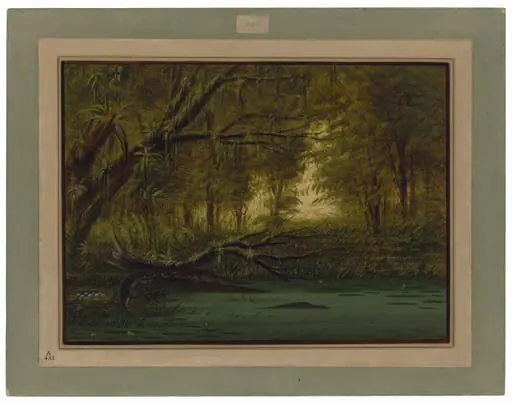 An Alligator's Nest
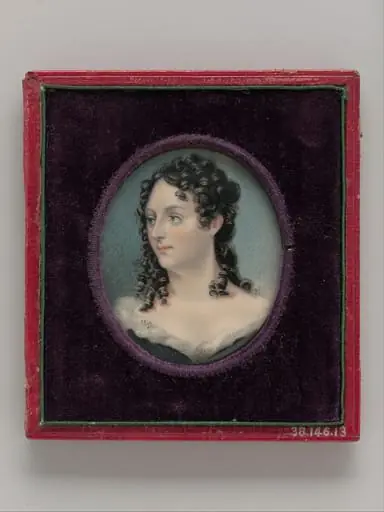 Mrs. George Catlin (Clara Bartlet Gregory)
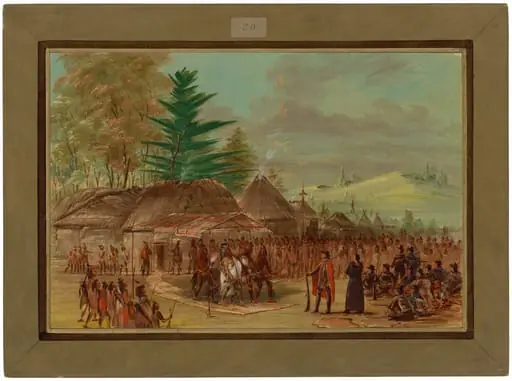 Chief of the Taensa Indians Receiving La Salle. March 20, 1682
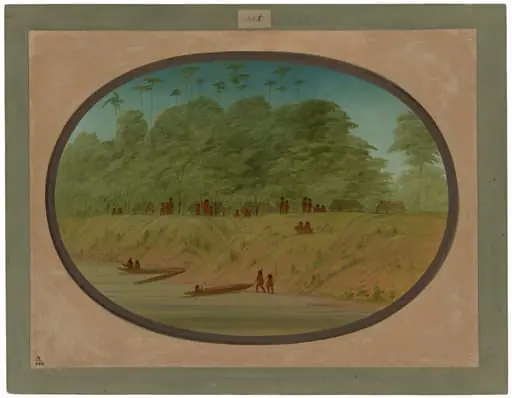 A Small Village - Payaguas Indians
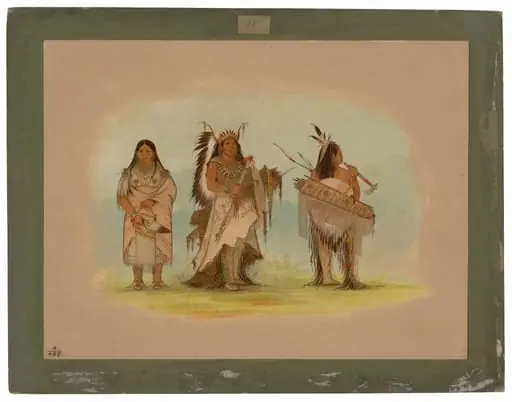 Omaha Chief, His Wife, and a Warrior
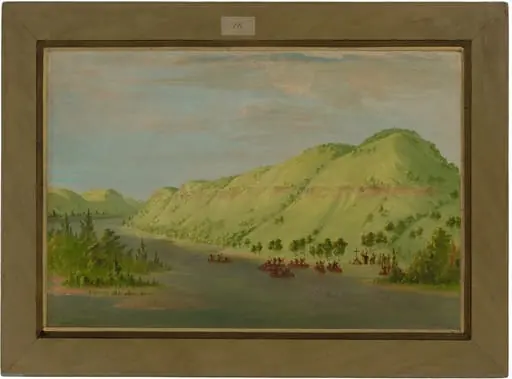 Father Hennepin Leaving the Mississippi to Join La Salle. May 8, 1680
- Alaeutian Chief and Two Warriors
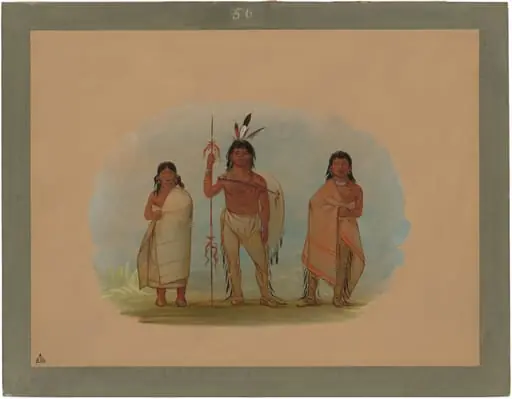 Ottowa Chief, His Wife, and a Warrior
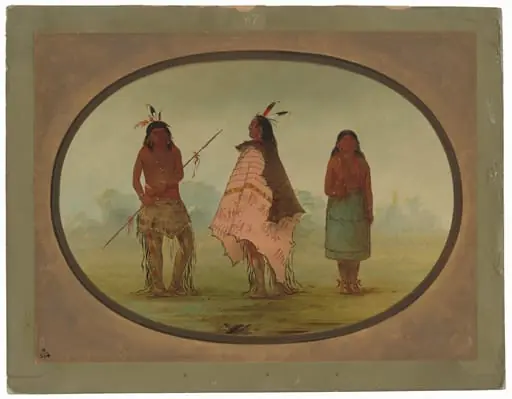 Two Apachee Warriors and a Woman
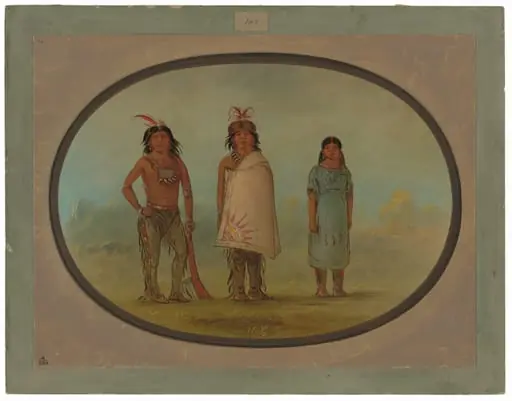 Two Chippewyan Warriors and a Woman
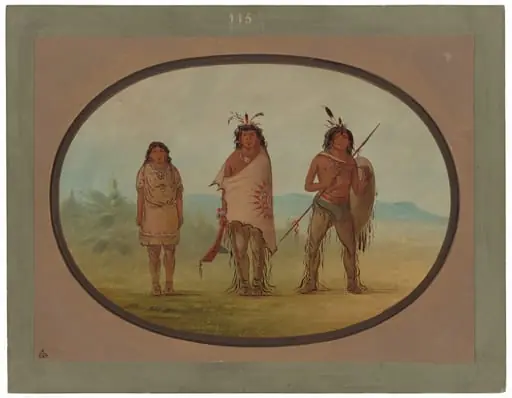 A Yuma Chief, His Daughter, and a Warrior
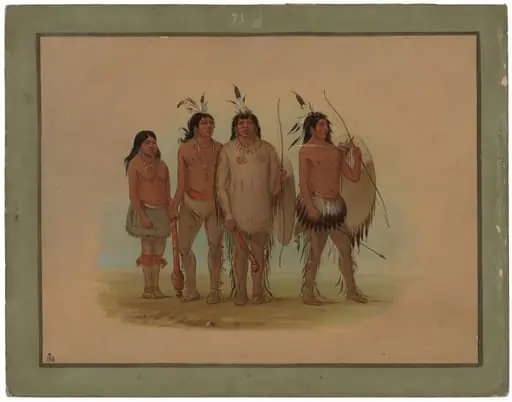 Kiowa Chief, His Wife, and Two Warriors
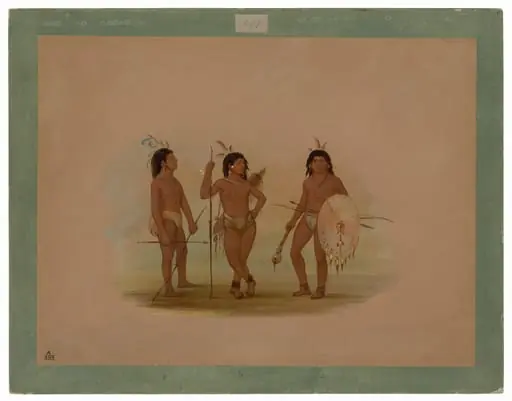 A Puelchee Chief and Two Young Warriors
 Athapasca Chief, His Wife, and a Warrior
 Mohave Chief, a Warrior, and His Wife
 Three Cheyenne Warriors