Artwork
A Puelchee Chief and Two Young Warriors
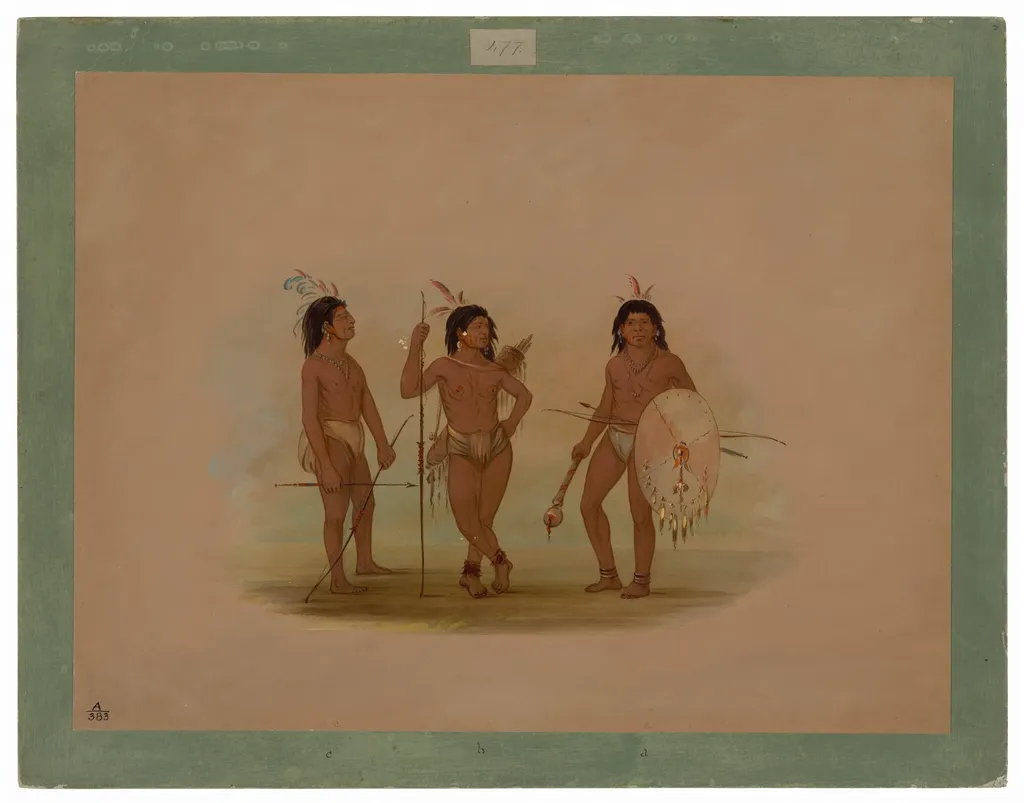
A Puelchee Chief and Two Young Warriors is an oil painting by the Impressionist artist George Catlin. It dates from 1862 and is held in the collection of the National Gallery of Art. Created in 1862, this oil painting on card, later mounted on paperboard, portrays a Puelchee chief accompanied by two youthful warriors.
About this work
Overview
A Puelchee Chief and Two Young Warriors is an oil painting on card mounted on paperboard by the American artist George Catlin, dated 1854/1869 and now held at the National Gallery of Art in Washington, D.C. The work measures 46.6 by 62.4 cm and bears the accession number 1965.16.251. It belongs to Catlin's second major collection, the "Cartoon Collection," comprising more than 600 works created during the 1850s and 1860s as the artist sought to recreate the original Indian Gallery he had painted in the 1830s. The painting is significant as one of Catlin's depictions of Indigenous peoples of South America, produced during his travels in the region between 1852 and 1857, and it exemplifies his lifelong project of documenting Native American life and leadership.
Subject & Meaning
" The figures are shown with minimal garments, feathered headdress ornaments, necklaces, earrings, and armbands or leg bands.
The painting depicts three standing male figures identified in Catlin's 1871 catalog as members of the Puelchee people, a group he described as "a small tribe, south of Buenos Ayres, reduced by small-pox and dissipation." The central figure, Bon-don-ne ("That is He"), is identified as a secondary chief, armed with shield and war club. Flanking him are two younger warriors, Yép and Yo-har-ne, whom Catlin noted were "said to be distinguished." The figures are shown with minimal garments, feathered headdress ornaments, necklaces, earrings, and armbands or leg bands. The central chief carries a tall staff and wears a quiver of arrows; one companion holds bow and arrow, while the other bears a large round shield decorated with hanging elements and also holds a bow. The composition presents the trio against a plain warm beige background with faint atmospheric haze near the horizon, emphasizing their presence and regalia rather than landscape setting. Catlin's catalog entry, published when he exhibited the Cartoon Collection in New York in 1871, provides the ethnographic framing that accompanied the work, reflecting the documentary ambitions of his practice.
Technique & Style
The work is executed in oil on card mounted on paperboard, a support characteristic of the Cartoon Collection. The surface appears smooth with careful brushwork, and the palette is dominated by earthy browns, muted greens, and touches of red and blue in the feathered ornaments. Shadows fall directly beneath the figures, indicating even, diffuse lighting from above. The horizontal composition, framed by a green border with small paper labels reading "477" at top center and "A 383" at lower left, follows the format Catlin employed for cataloged works in his second collection. The handling is precise rather than painterly, consistent with the reproductive function of the Cartoon Collection, which Catlin based on outlines drawn from his earlier works. The Smithsonian Institution's catalog lists the medium as "oil on cardboard," a slight variation in terminology that describes the same material structure.
History & Provenance
The painting descended from George Catlin through his daughters, Clara Gregory Catlin, Louise Catlin Kinney, and Elizabeth Wing Catlin. In 1912, the American Museum of Natural History purchased the work from Elizabeth Wing Catlin, acquiring the surviving works from the Cartoon Collection. The museum deaccessioned the painting in 1959, selling it through Kennedy Galleries in New York to Mr. Paul Mellon of Upperville, Virginia. Mellon, a major collector and philanthropist, gave the work to the National Gallery of Art in 1965 as part of his gift of 351 works from Catlin's Cartoon Collection. The painting has been listed in the National Gallery's catalogues of American paintings in 1970, 1980, and 1992.
Context
George Catlin (1796-1872) was an American lawyer, painter, and author who specialized in portraits of Native Americans. After practicing law briefly, he turned to art and, following a meeting with a tribal delegation from the western frontier, dedicated himself to preserving a record of Native American customs and individuals. Between 1830 and 1836, he visited fifty tribes and produced more than 500 paintings that became his first Indian Gallery. When Congress refused to purchase this collection and Catlin faced personal debts, he was forced to sell it in 1852 to the industrialist Joseph Harrison. Catlin spent the last twenty years of his life recreating his collection, producing more than 400 works known as the Cartoon Collection, based on outlines he had drawn from his earlier works. From 1852 to 1857, he traveled through South and Central America, expanding his subject matter to include Indigenous peoples beyond North America. The Puelchee painting belongs to this later period of production, when Catlin was working from memory and existing drawings rather than direct observation. The work's place in art history is complicated by this mediated relationship to its subject, as with much of the Cartoon Collection, yet it remains a significant document of Catlin's expansive, if problematic, ethnographic project.
Legacy
The painting's legacy is inseparable from the broader history of Catlin's Cartoon Collection and its acquisition by major American institutions. When Paul Mellon donated 351 works from this collection to the National Gallery of Art in 1965, he ensured the preservation of a body of work that might otherwise have been dispersed or lost. The National Gallery's repeated inclusion of the painting in its catalogues of American paintings, in 1970, 1980, and 1992, testifies to its place within the museum's permanent collection. As part of the Cartoon Collection, the work also participates in ongoing scholarly debates about the authenticity, ethnographic accuracy, and artistic value of Catlin's reproduced images compared to his original 1830s paintings. The painting's subject, the Puelchee people of the region south of Buenos Aires, has gained additional attention as contemporary interest in Indigenous histories of South America has grown, though the work itself reflects Catlin's external perspective as a traveling American artist rather than sustained engagement with the community depicted.
Own this work as a print
Artist & collection

Artist
George Catlin ( KAT-lin; July 26, 1796 – December 23, 1872) was an American lawyer, painter, author, and traveler, who specialized in portraits of Native Americans in the American frontier.

 Bulls Fighting
 Expedition Encamped on a Texas Prairie. April 1686
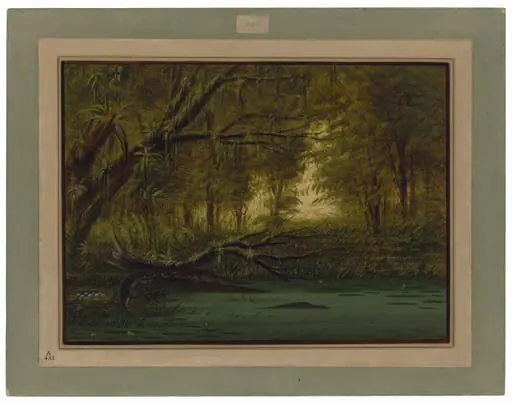 An Alligator's Nest
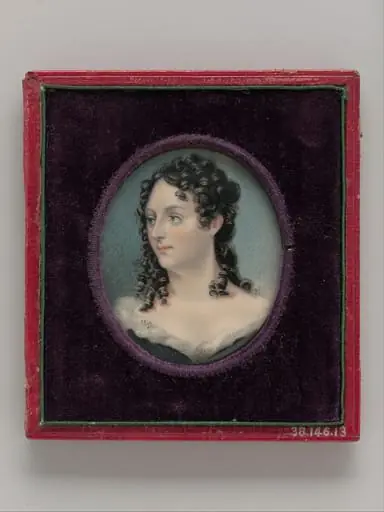 Mrs. George Catlin (Clara Bartlet Gregory)
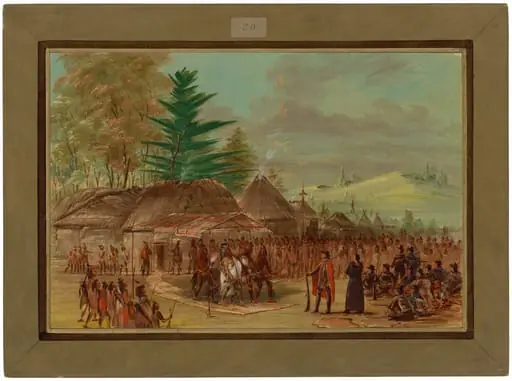 Chief of the Taensa Indians Receiving La Salle. March 20, 1682
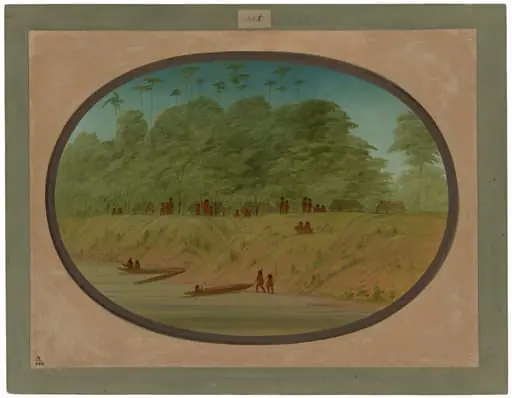 A Small Village - Payaguas Indians
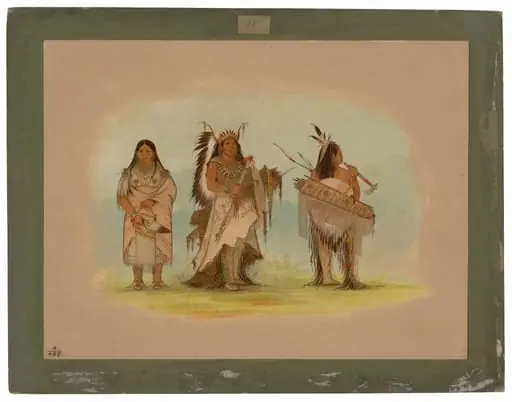 Omaha Chief, His Wife, and a Warrior
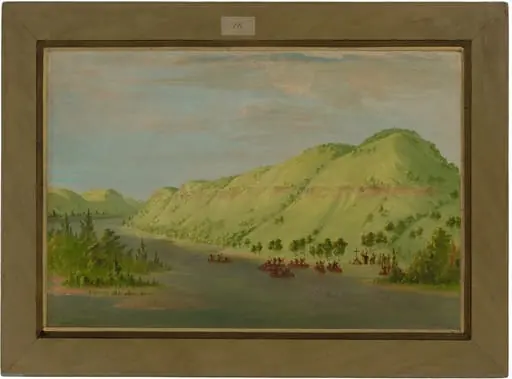 Father Hennepin Leaving the Mississippi to Join La Salle. May 8, 1680
- Alaeutian Chief and Two Warriors
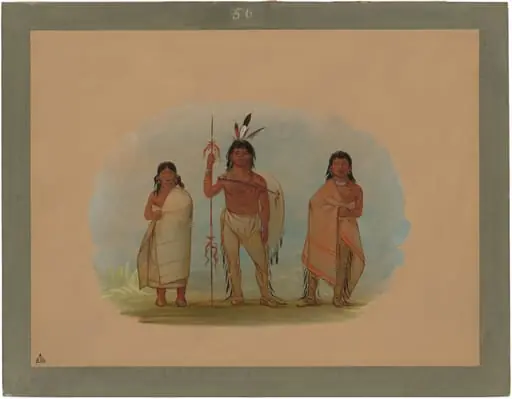 Ottowa Chief, His Wife, and a Warrior
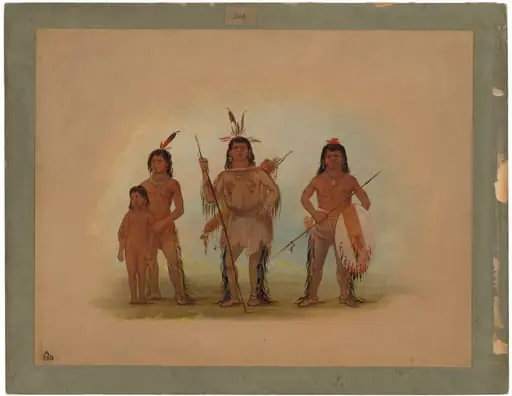 Spokan Chief, Two Warriors, and a Boy
 Chaco Chief, His Wife, and a Warrior
 Apachee Chief and Three Warriors
 Camanchee Chief, His Wife, and a Warrior
 Two Arapaho Warriors and a Woman
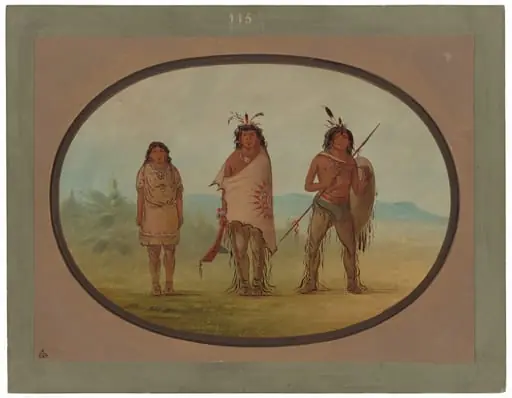 A Yuma Chief, His Daughter, and a Warrior
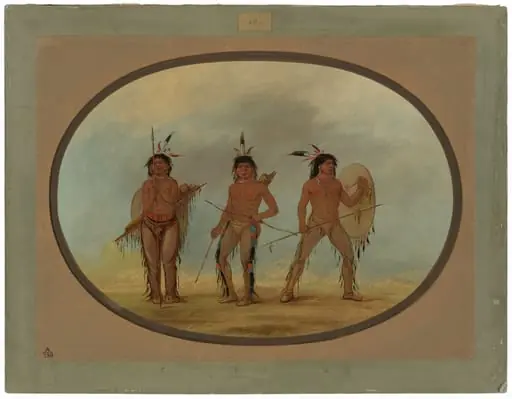 Three Cheyenne Warriors
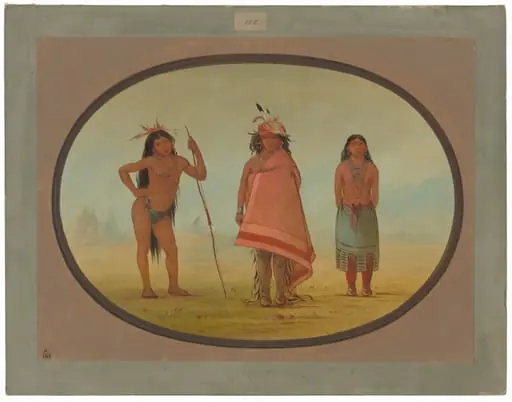 Cochimtee Chief, His Wife, and a Warrior
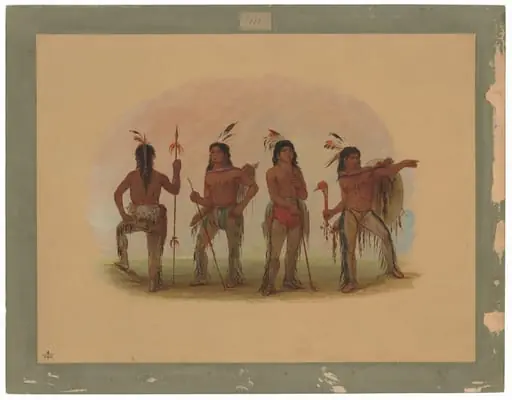 Four Navaho Warriors