Artwork
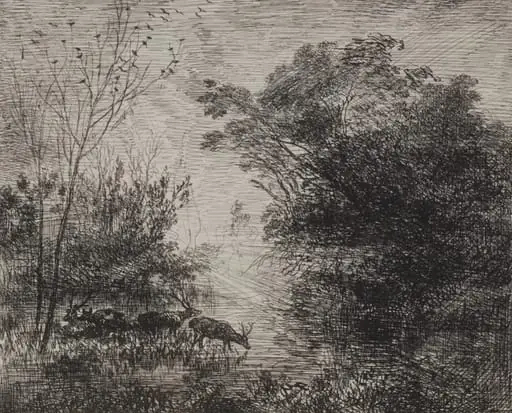
Deer
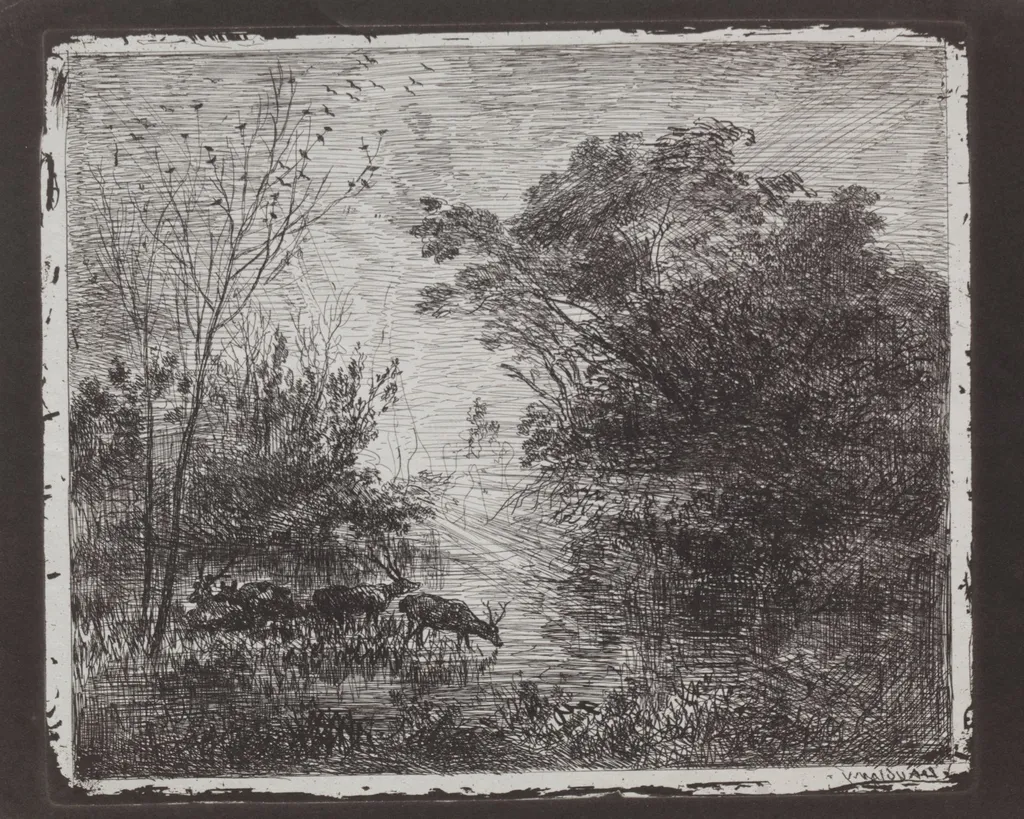
Deer is a print by the Impressionist artist Charles François Daubigny. It dates from 1862 and is held in the collection of the Cleveland Museum of Art. Around 1853, artists experimenting with alternative photographic processes developed the cliché-verre technique.
- Accession no.
- 1992.340
- Credit line
- John L. Severance Fund
About this work
Overview
Around 1853, artists experimenting with alternative photographic processes developed the cliché-verre technique. It involved drawing directly onto a coated glass plate, then using it as a negative to expose light-sensitive paper. This hybrid method blended manual drawing with photographic reproduction, offering a new way to create multiple images without traditional engraving or lithography.
Subject & Meaning
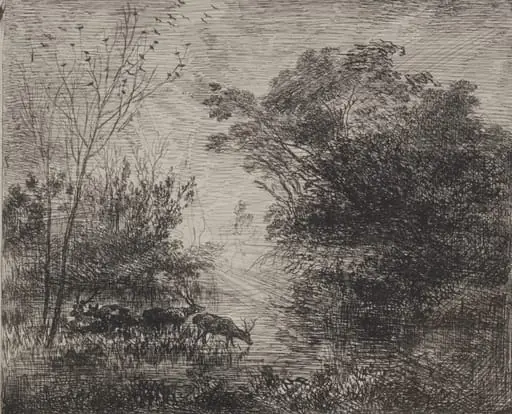
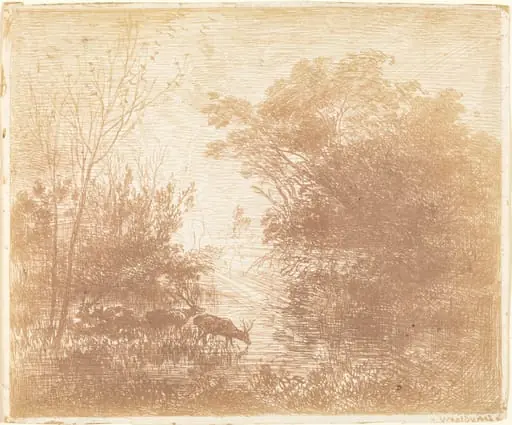
The print depicts three deer in a quiet woodland clearing, their forms softened by atmospheric haze. The largest deer, standing alert in the foreground, contrasts with the others, which dissolve into the shadowed trees. The composition evokes solitude and observation, reflecting a quiet engagement with nature rather than narrative or symbolism.
Technique & Style
The image was made by scratching lines through an opaque coating on glass, allowing light to pass selectively during exposure. This produced delicate tonal gradations and fine linear details, merging the precision of drawing with the softness of photographic halftones. The result is neither purely drawn nor fully photographic, but a unique intermediary form.
History & Provenance
Created in the early 1850s, this work emerged from a brief but active period when French artists explored cliché-verre as a means of artistic reproduction. Charles-François Daubigny, known for landscape painting, was among those who adopted the method. The print’s origin aligns with broader efforts to reconcile art and emerging photographic technologies.
Context
During the 1850s, photography was still in its experimental phase, and many painters sought ways to incorporate its qualities without abandoning drawing. Cliché-verre offered a middle ground, allowing artists to retain handcrafted composition while achieving reproducible images. Daubigny’s use of the technique reflects this transitional moment in visual culture.
Legacy
Though short-lived as a widespread practice, cliché-verre influenced later printmaking and photographic experimentation. Daubigny’s deer print exemplifies how artists navigated the boundaries between manual and mechanical image-making. The work remains a quiet testament to a moment when traditional art embraced new technical possibilities.
Own this work as a print
Artist & collection
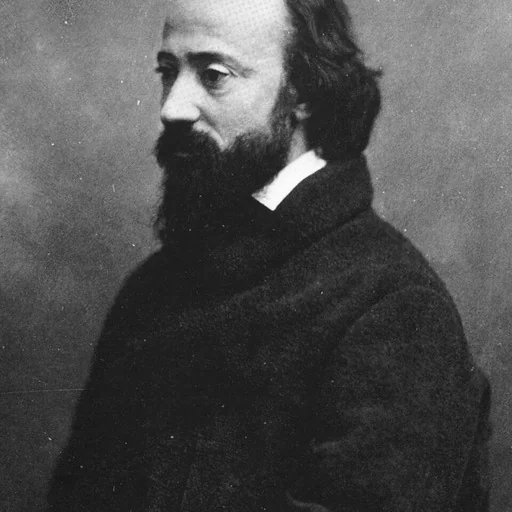
Artist
Charles-François Daubigny ( DOH-bin-yee, US: DOH-been-YEE, doh-BEEN-yee, French:; 15 February 1817 – 19 February 1878) was a French painter, one of the members of the Barbizon school, and is considered an important precursor of…

![Forest on Lago Maggiore [Foresta sul Lago Maggiore], by Giberto Borromeo](https://artifactworldgallery.com/img/giberto-borromeo--forest-on-lago-maggiore-foresta-sul-lago-maggiore--6d25270befdb299f-w320.webp)