Artwork
Rebus: "Here lies the ancient vendetta"
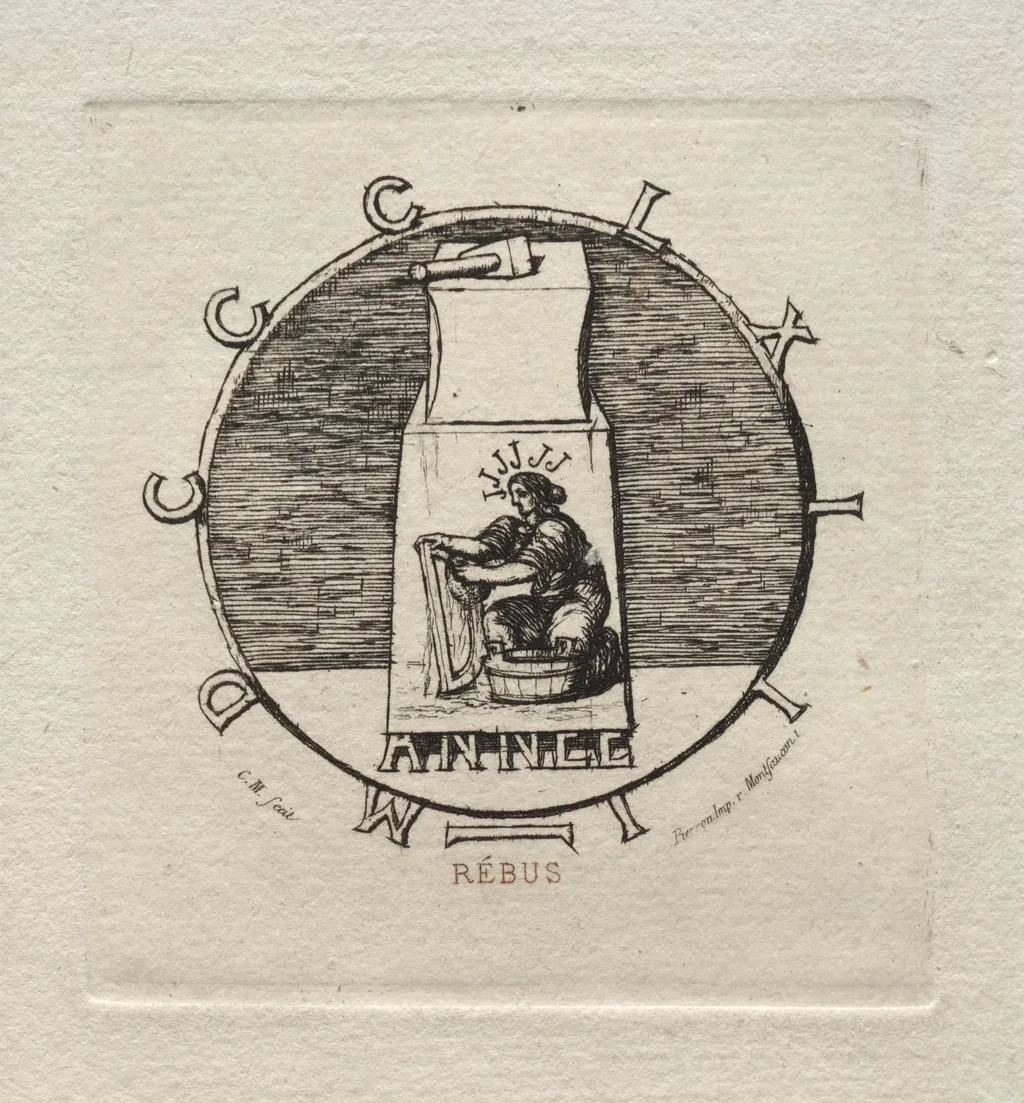
Rebus: "Here lies the ancient vendetta" is a print by the Impressionist artist Charles Meryon. It dates from 1863 and is held in the collection of the Cleveland Museum of Art.
- Accession no.
- 1954.945
- Credit line
- The Milton Curtiss Rose Collection in memory of Evelyn Curtiss Rose
About this work
Overview
Created in 1863 by French artist Charles Meryon, this etching is one of several symbolic works in his series depicting Parisian scenes. Though best known for his atmospheric urban landscapes, Meryon turned here to allegory, using visual wordplay to convey a cryptic message. His choice of etching, suited to his color blindness, allowed intricate line work that defines the piece’s enigmatic tone.
Subject & Meaning
The composition functions as a visual puzzle, suggesting a hidden phrase or name.
The image presents a woman seated on a barrel inside a circular vessel, crowned and holding a small figure, surrounded by directional letters: N, E, W, and the word 'RÉBUS' below. The composition functions as a visual puzzle, suggesting a hidden phrase or name. The trapped ruler may symbolize a buried legacy or unresolved conflict, aligning with the title’s reference to an 'ancient vendetta', a metaphor for inherited strife or silenced history.
Technique & Style
Meryon employed fine-line etching to render delicate textures and sharp contrasts, characteristic of his mature style. The ship’s circular form and the woman’s stylized posture are rendered with precise, controlled strokes, while the lettering integrates seamlessly into the composition. The absence of shading or tone emphasizes line and structure, reinforcing the work’s intellectual, puzzle-like quality over emotional expression.
History & Provenance
This print was produced during Meryon’s most productive period, shortly before his mental health deteriorated significantly. It was included in his private portfolio of symbolic etchings, distinct from his more widely circulated Parisian views. After his death in an asylum in 1868, the work remained largely obscure outside France, with few institutional records prior to late 20th-century scholarly interest.
Context
In mid-19th-century France, rebus imagery was occasionally used in literary and artistic circles as a form of intellectual play, often tied to political or personal allegory. Meryon’s work reflects this trend, but with a darker, more introspective edge. His isolation from mainstream artistic circles and his personal struggles lent his symbolic prints a unique, introspective quality absent in contemporaneous illustrative traditions.
Legacy
Though rarely exhibited outside France, this etching exemplifies Meryon’s departure from topographical accuracy toward psychological and symbolic expression. It has influenced later artists interested in visual riddles and the intersection of text and image. Today, it is studied as a rare example of 19th-century French printmaking that prioritizes metaphor over documentation.
Own this work as a print
Artist & collection
Artist
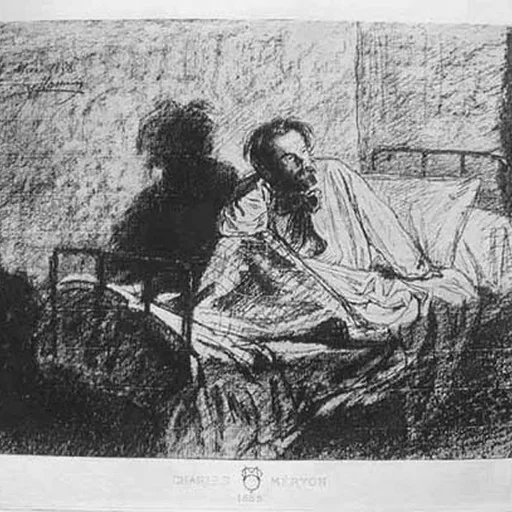
Charles Meryon (sometimes Méryon, 23 November 1821 – 14 February 1868) was a French artist who worked almost entirely in etching, as he had colour blindness.

 The Mysteries of the Passion: The Resurrection
 Judith with the Head of Holofernes
 H Beard Print Collection
 Untitled
 Thenot and Colinet Eat their Evening Meal
 Mercury with the Head of Argus
 St. Servatius; St. Boniface; St. Pachomius; St. Corona
 Saint Anthony with the Christ Child
 The Mysteries of the Passion: The Transfiguration
 The Trinity