Artwork
July Fourteenth, Rue Daunou, 1910
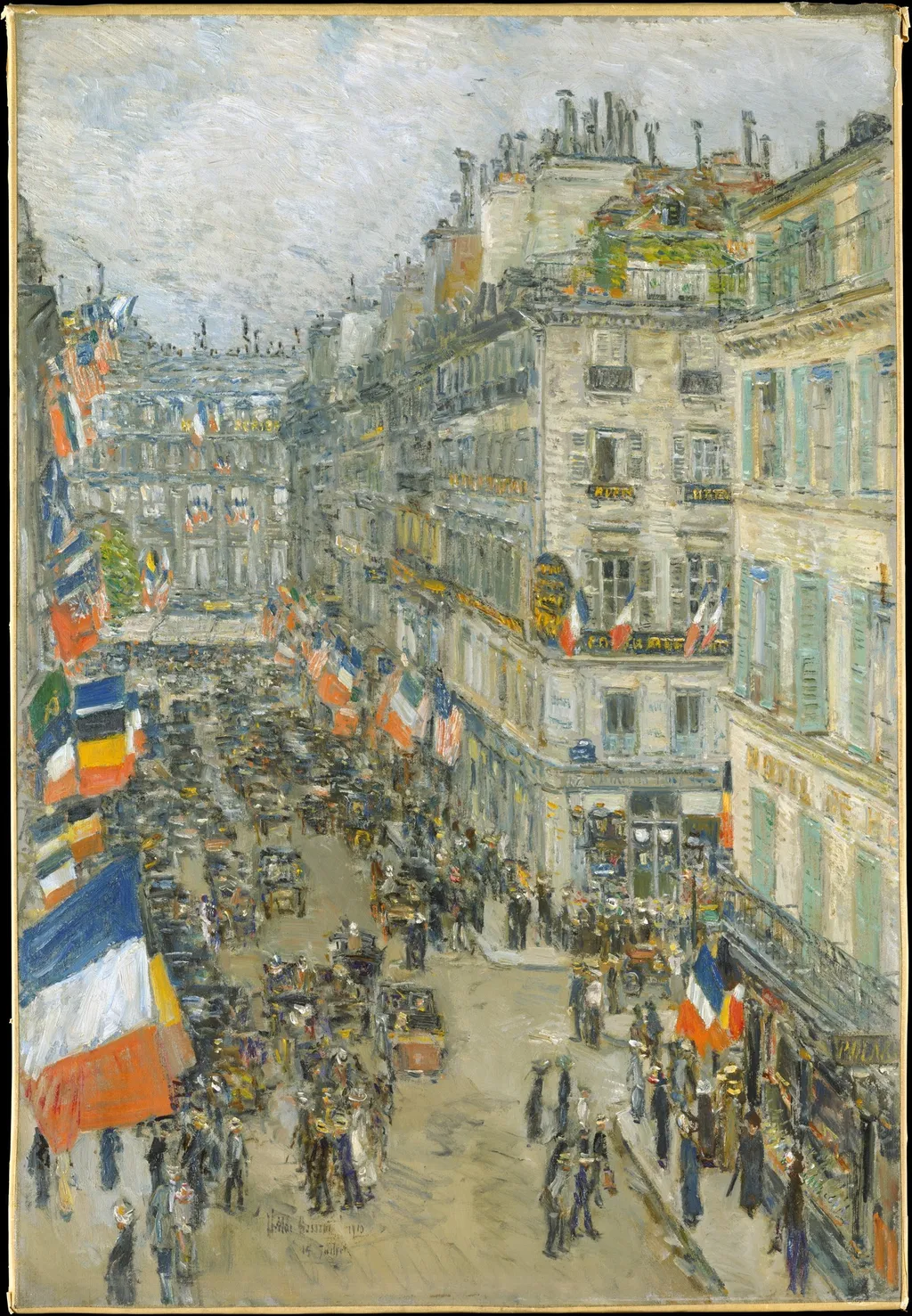
July Fourteenth, Rue Daunou, 1910 is an oil painting by the American Impressionist artist Childe Hassam. It dates from 1910 and is held in the collection of the Metropolitan Museum of Art.
About this work
Subject & Meaning
As a work of American Impressionism, the piece utilizes this urban gathering to represent the energy and collective spirit of French civic celebration.
The painting depicts a bustling street scene on Rue Daunou in Paris, capturing the atmosphere of the July 14th national holiday. The composition centers on a dense crowd gathered before a building, with flags prominently displayed to signify the festive occasion. As a work of American Impressionism, the piece utilizes this urban gathering to represent the energy and collective spirit of French civic celebration.
The inclusion of specific architectural elements alongside the throng of people and waving flags establishes the setting as a moment of public patriotism and communal joy. The visual focus on the flags and the assembled masses underscores the work's role in documenting the specific iconography of Bastille Day festivities in the early twentieth century.
Technique & Style
Created in 1910, July Fourteenth, Rue Daunou is an oil painting executed on canvas by Childe Hassam. The work measures 74 cm in height and 50.5 cm in width. Classified within the American Impressionism movement, the piece utilizes oil paint to depict a bustling street scene featuring buildings, crowds, and flags.
The handling of the medium captures the formal qualities of a festive urban atmosphere, characteristic of Hassam's style during this period. The painting is currently held in the collection of the Metropolitan Museum of Art.
History & Provenance
Childe Hassam created the oil painting July Fourteenth, Rue Daunou in 1910. The work was executed on canvas using oil paint and measures 74 cm in height by 50.5 cm in width. It depicts a street scene featuring buildings, a crowd, and flags, reflecting the artist's association with American Impressionism.
The Metropolitan Museum of Art currently holds the painting in its collection. While the specific commission details and the precise chain of ownership prior to its museum acquisition are not detailed in the available records, the work's inception is firmly dated to 1910. The piece is cataloged as a significant example of Hassam's output during this period, capturing the atmosphere of a French street celebration.
Legacy
July Fourteenth, Rue Daunou, 1910 is recognized as a representative example of American Impressionism, a classification documented in its internal record and described in external metadata. Its depiction of a Parisian street adorned with a flag aligns with the movement’s interest in urban atmosphere and transnational themes, as noted in the movement designation. The painting’s inclusion in the Metropolitan Museum of Art’s collection has elevated Hassam’s standing in art historical narratives, positioning the work as a touchstone for studies of early 20th‑century American artists abroad.
Its material composition of oil on canvas and documented dimensions further inform scholarly references to its physical presence.
Overview
Childe Hassam's July Fourteenth, Rue Daunou, completed in 1910, is an oil painting that captures a dynamic urban spectacle. This work exemplifies the artist's signature approach to American Impressionism, often focusing on cityscapes and public life. The painting is held within the collection of The Metropolitan Museum of Art, where it serves as an example of early 20th-century American art.
Own this work as a print
Artist & collection

Artist
Frederick Childe Hassam (; October 17, 1859 – August 27, 1935) was an American Impressionist painter, noted for his urban and coastal scenes.