Artwork
Winter in Union Square
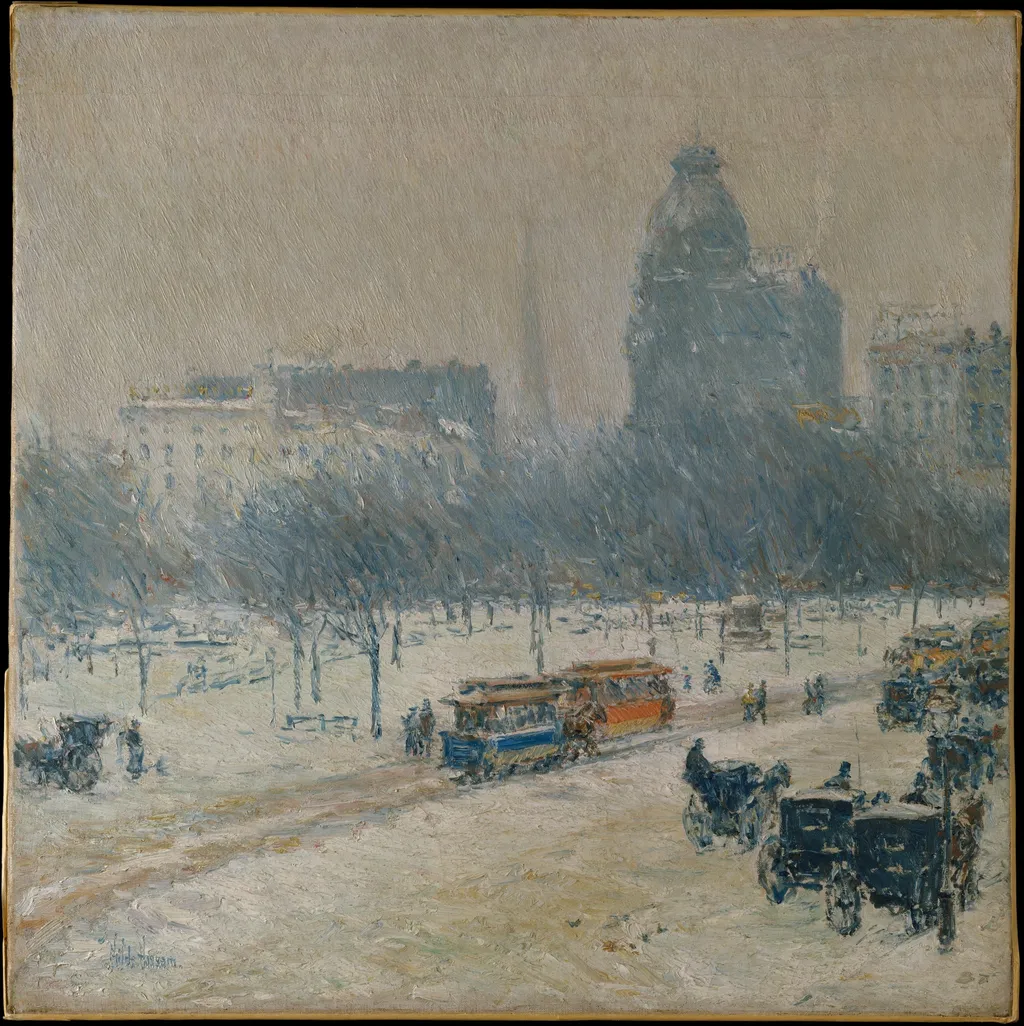
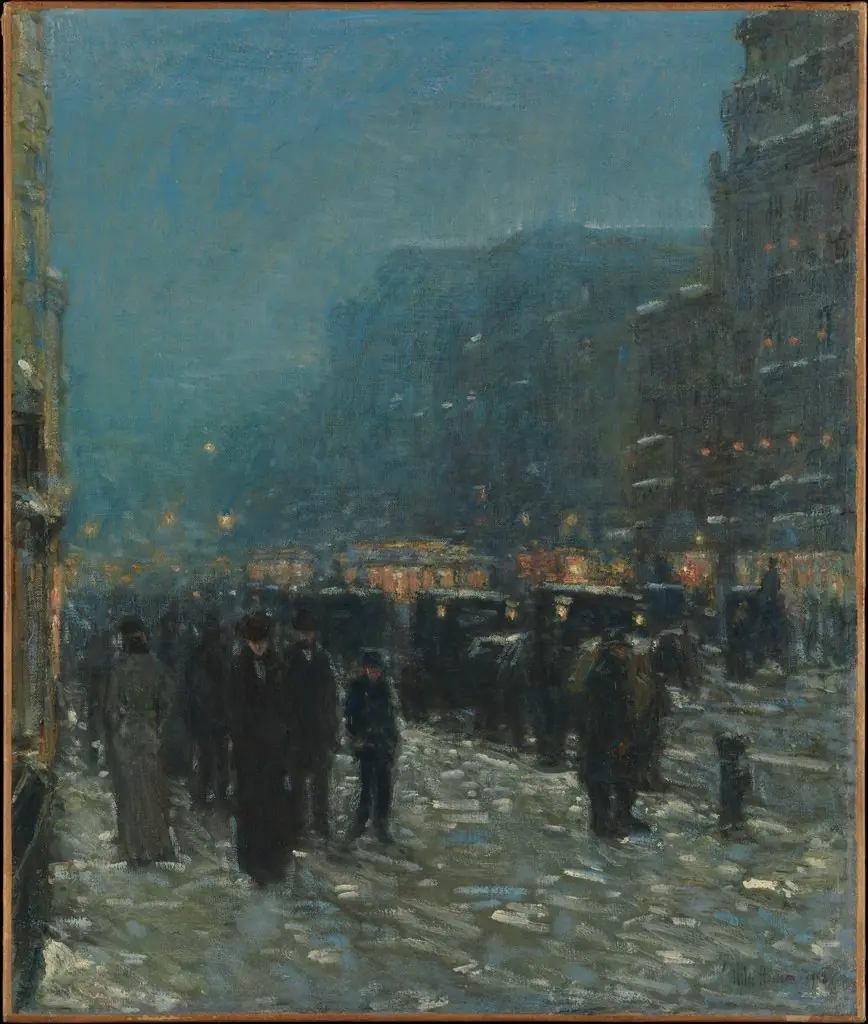
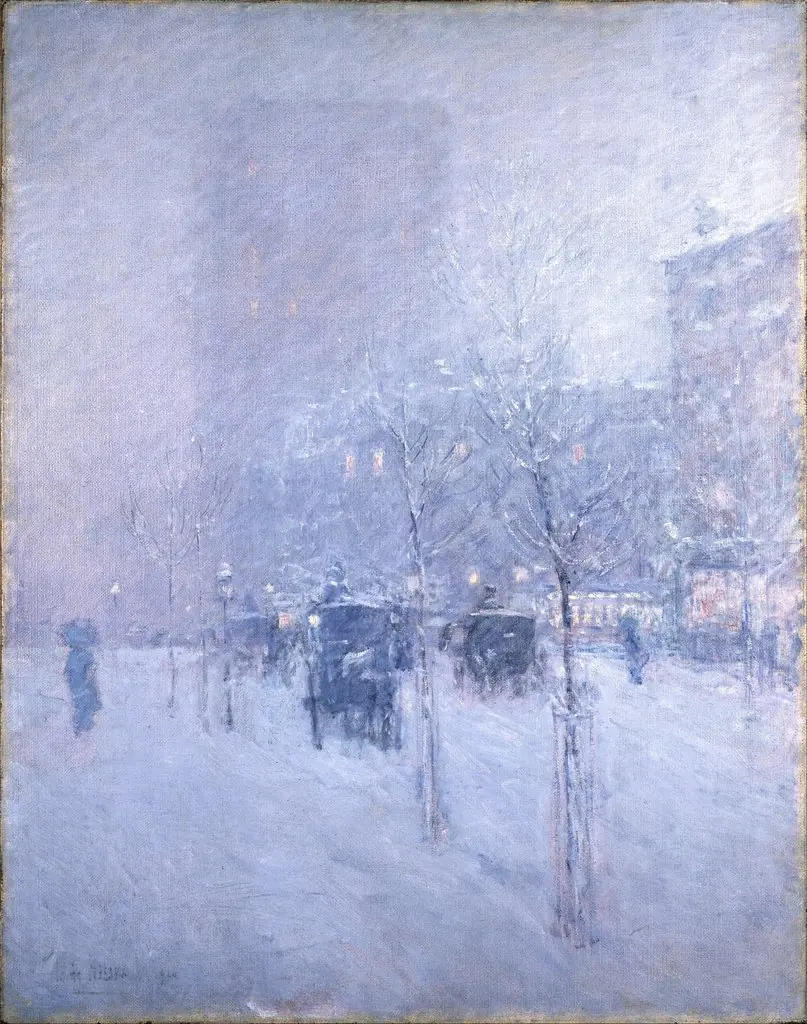
Winter in Union Square is an oil painting by the American Impressionist artist Childe Hassam. It dates from 1896 and is held in the collection of the Metropolitan Museum of Art.
About this work
Subject & Meaning
The work symbolizes the intersection of modernity and nature, capturing the city’s dynamism while highlighting the transient beauty of winter light and snow.
Childe Hassam’s Winter in Union Square (1890) depicts a snow-covered New York City intersection, rendered in an Impressionist style that emphasizes atmospheric effects over precise detail. The composition centers on Union Square, with horse-drawn trams, carriages, and pedestrians navigating the wintry conditions, conveying the bustling energy of urban life despite the weather. The painting’s iconography includes architectural landmarks such as the Morton Hotel and Grace Church, subtly rendered in the background, which situate the scene within late-19th-century New York.
The muted palette and soft brushwork evoke a fleeting moment of stillness, while the elevated vantage point from Hassam’s studio window lends a sense of detached observation. The work symbolizes the intersection of modernity and nature, capturing the city’s dynamism while highlighting the transient beauty of winter light and snow.
Technique & Style
Created between 1889 and 1890, Winter in Union Square is an oil painting executed on a canvas support measuring 46.4 by 45.7 centimeters. The work exemplifies Hassam's American Impressionist style, characterized by a fluid and vigorous handling of paint that captures the subtle, muted atmosphere of a winter day. Painted from an elevated vantage point in the artist's studio, the composition employs soft, hazy effects to depict snow-covered streets, carriages, and pedestrians in motion.
The technique translates European influences into a distinct American idiom, utilizing broad, confident brushstrokes to render the vertical forms of buildings and the dynamic movement of traffic. This approach balances the modernity of New York City with a contemplative mood, emphasizing light and weather conditions over precise detail.
History & Provenance
Winter in Union Square was painted by Childe Hassam in the winter of 1890, shortly after his return from Paris to New York in 1889. According to Dutch-language scholarship, it was the first work he produced following his repatriation, executed from the window of his studio at the corner of Seventeenth Street and Fifth Avenue, which overlooked Union Square. The painting is an oil on canvas measuring 46.4 by 45.7 centimeters.
No information in the provided sources indicates that the work was commissioned; it appears to have been an independently conceived studio production. The painting entered the collection of the Metropolitan Museum of Art in 1943, where it remains held today. Earlier ownership history prior to the 1943 Met acquisition is not documented in the available sources.
Winter in Union Square, an oil on canvas by Childe Hassam, has been in the collection of the Metropolitan Museum of Art in New York since 1943. The work, measuring 46.4 by 45.7 centimeters, was painted in 1889–1890 shortly after Hassam returned from Paris and took a studio at the corner of Seventeenth Street and Fifth Avenue overlooking Union Square. It entered the Metropolitan's holdings in 1943, where it remains today. No specific accession number or detailed exhibition history is recorded in the available sources.
Context
Executed in oil on canvas in 1889–1890, Winter in Union Square captures Union Square under a snow‑laden sky, reflecting the influence of French Impressionism on Hassam’s mature style. The Metropolitan Museum of Art records the work as part of the American Impressionist movement and notes its depiction of urban activity, including passing carriages and pedestrians. Hassam’s artistic development, shaped by Boston training, a formative period in Paris, and his 1889 relocation to a Manhattan studio overlooking the square, is documented in contemporary accounts.
Scholars have highlighted the painting’s role as an early American urban genre scene, linking it to later modernist narratives and to the broader discourse on national identity in art (see Rubin 2013).
Overview
This painting, Winter in Union Square, was created by American artist Childe Hassam in the late 19th century. Executed in oil on canvas, the work captures a bustling street scene in New York City's Union Square amidst a winter snowstorm. It is presently held in the collection of the Metropolitan Museum of Art.
Own this work as a print
Artist & collection

Artist
Frederick Childe Hassam (; October 17, 1859 – August 27, 1935) was an American Impressionist painter, noted for his urban and coastal scenes.