Artwork
El Rio de Luz (The River of Light)
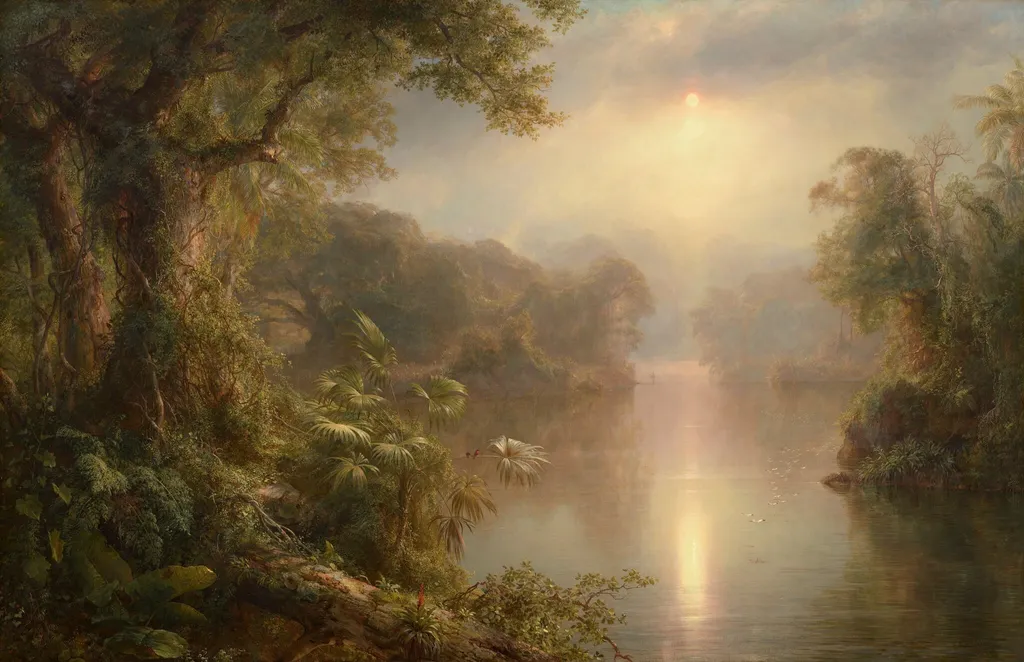
El Rio de Luz (The River of Light) is an oil painting by the American Impressionist artist Frederic Edwin Church. It dates from 1877 and is held in the collection of the National Gallery of Art.
- Inscription
- Inscribed:lower right: F. E. CHURCH / 1877
About this work
Technique & Style
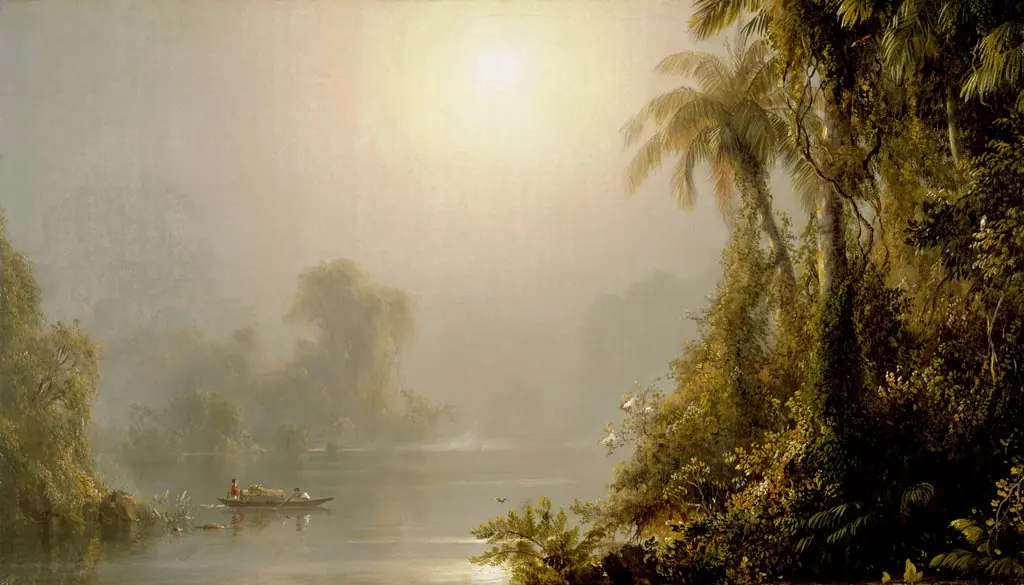
The sunlight is rendered as a diffused, vaporous glow that suffuses the foliage and atmosphere, creating an almost palpable sense of tropical morning.
Executed in 1877, El Rio de Luz is an oil painting on a canvas support measuring 138.1 × 213.7 cm. The handling emphasizes tightly focused realism, tonal harmony, and restrained coloration to produce a cohesive composition. A low vantage point draws the viewer close to the scene, integrating details such as a canoeist on the river, two hummingbirds near the foreground, and a hut on the right bank. The sunlight is rendered as a diffused, vaporous glow that suffuses the foliage and atmosphere, creating an almost palpable sense of tropical morning.
The painting was restored in 1988 while in the collection of the National Gallery of Art, Washington, where it remains.
History & Provenance
Frederic Edwin Church completed El Rio de Luz in 1877, marking his final large-scale South American landscape. Although the work was based on sketches and drawings created during the artist's travels in 1853 and 1857, the painting itself was executed two decades later, relying on memory and preliminary studies. The oil-on-canvas work was first exhibited in New York in 1877 under the title A Tropical Morning.
The initial owner was William Earl Dodge, Jr., of New York, who held the painting until his death in 1903. Ownership subsequently passed through his wife, their grandson William Earl Dodge IV, and Dodge's wife, Ella Lynch Dodge. In 1965, the work was transferred to the Preservation Society of Newport County, Rhode Island, before being purchased by the National Gallery of Art in Washington, D.C., on December 9, 1965.
The painting El Rio de Luz (The River of Light) has been part of the National Gallery of Art’s collection in Washington, D.C., since it was purchased on 9 December 1965; its acquisition is recorded in the museum’s provenance files. The work is catalogued in the Gallery’s inventory as part of its holdings of Frederic Edwin Church pieces. Its early public showing occurred in New York in 1877 at the Century Association, where it was titled “A Tropical Morning,” and later traveled to the 1878 Exposition Universelle.
These exhibition records, together with the documented chain of ownership from William Earl Dodge Jr. through his descendants to the Preservation Society of Newport County, establish the painting’s provenance and current location.
Context
El Rio de Luz (1877) marks a late shift in Frederic Edwin Church’s South American oeuvre, departing from the panoramic synthesis of multiple climates and geographies that defined earlier works such as The Andes of Ecuador (1855) and The Heart of the Andes (1859). Instead, Church adopted a more intimate, tightly focused composition, emphasizing tonal harmony and restrained coloration to create a cohesive, almost tangible atmosphere suffused with morning light. Critics of the 1870s, including William Crary Brownell, had already questioned the melodramatic excess of Church’s detail, calling such works 'magnificent drop-curtains' rather than true painting.
By the 1870s, Church’s once-celebrated reputation had softened, though he remained a prominent figure. Scholar David C. Huntington later interpreted the painting as a symbolic evocation of American renewal, framing it as a 'second dawn' and a cosmic resurrection, a 'Easter-Genesis' on the Amazon, where the viewer, as New Adam, is invited to name and redeem a pristine, unnamed world. Huntington also traced influences from Gustave Doré and J. M. W. Turner, as well as illustrated tropical travel literature.
Legacy
By the 1870s, Frederic Edwin Church's reputation had waned, with critics like William Crary Brownell dismissing his detailed style as mere "drop-curtains" lacking true painting merit. However, the work's legacy was revitalized in the 1960s when scholar David C. Huntington reinterpreted El Rio de Luz as a profound "psychic landscape." Huntington argued the painting symbolized a mystical resurrection and a "second dawn" for the American viewer, positioning the nation as a "New Adam" in a redeemed world.
This critical reassessment highlighted the work's transition from the grandiose, multi-zonal compositions of Church's earlier career to a more intimate, cohesive vision. The painting's enduring significance is further evidenced by its acquisition in 1965 by the National Gallery of Art, securing its place as Church's final major South American landscape and a key example of his late stylistic evolution.
Overview
Frederic Edwin Church's 1877 oil on canvas, El Rio de Luz (The River of Light), represents a significant late work in his career. This painting stands as the artist's final large-scale depiction of South American landscapes, a subject that had captivated him for decades. It encapsulates his enduring fascination with the continent's natural beauty, serving as a culmination of his extensive artistic explorations.
Subject & Meaning
The painting portrays a tranquil landscape under a radiant, sunlit sky. A prominent tree, positioned beside a winding river, anchors the composition and draws the viewer's eye. Church employed a palette dominated by warm hues, imbuing the scene with a profound sense of serenity and quietude. This deliberate use of color contributes to the artwork's calming atmosphere, inviting contemplation.
Own this work as a print
Artist & collection

Artist
Frederic Edwin Church was an American landscape painter born in Hartford, Connecticut.

 South American River
 Morning in the Tropics
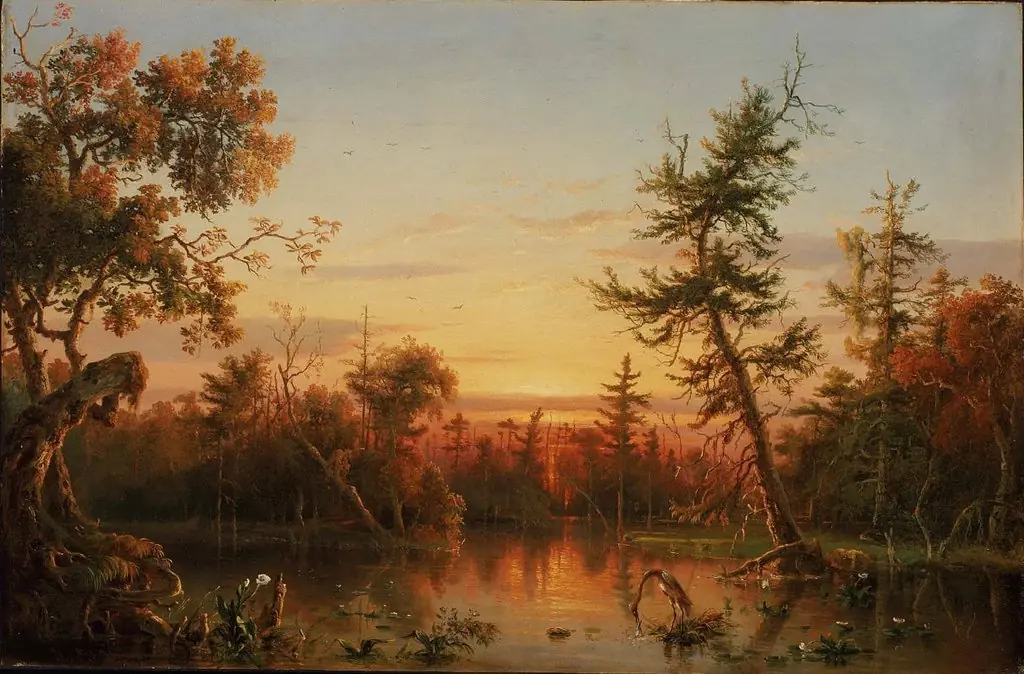 View, Dismal Swamp, North Carolina
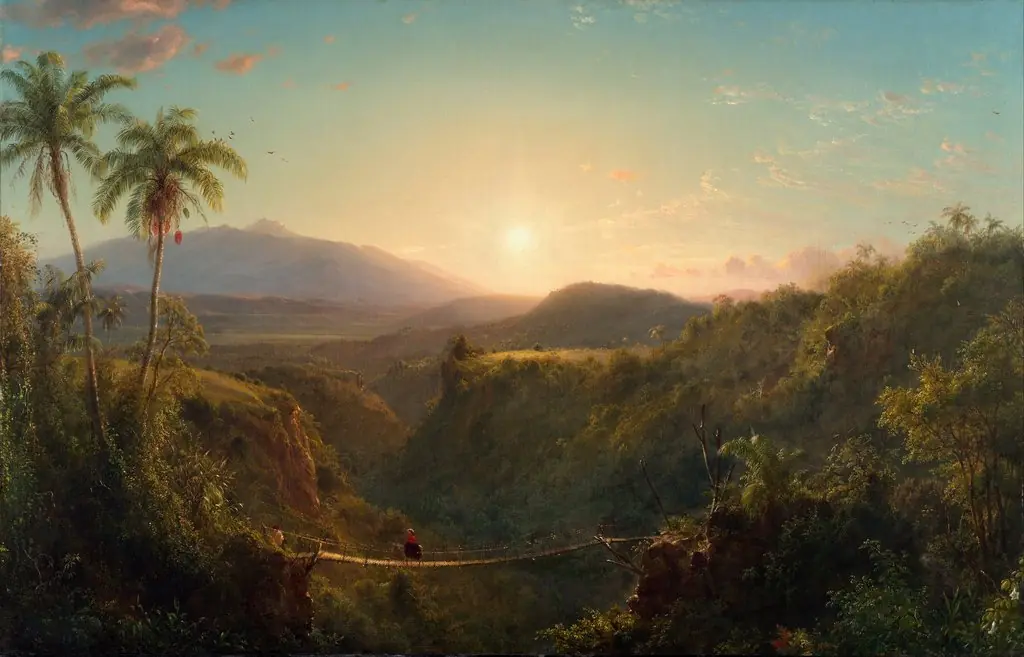 Pichincha
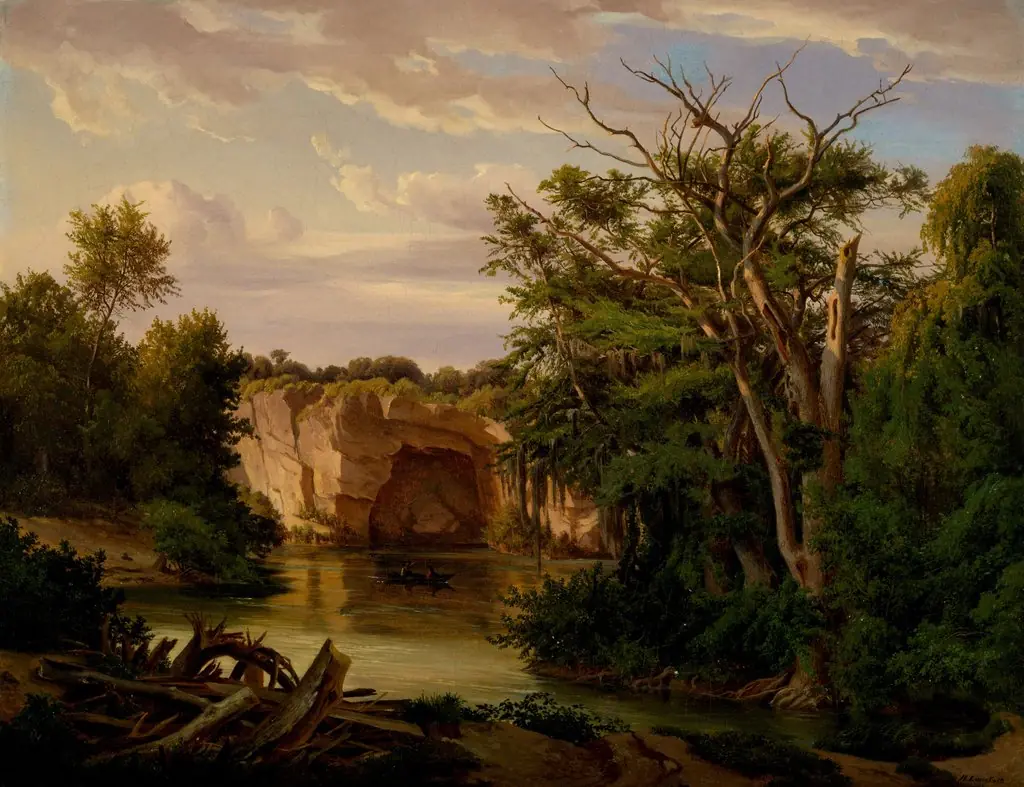 Hill Country Landscape
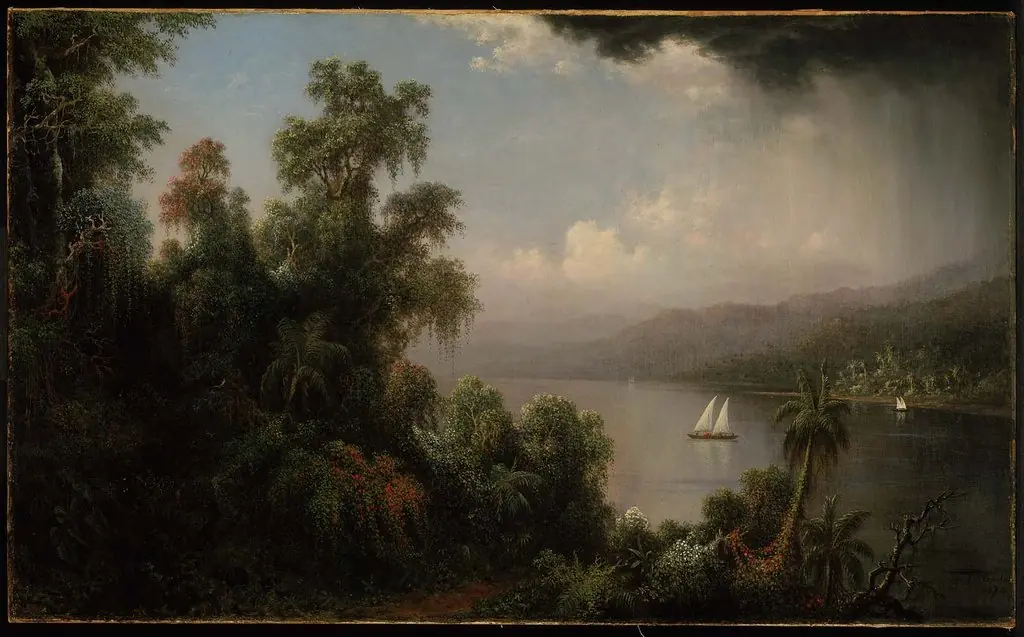 Coast of Jamaica
 Italienische Landschaft
 The Finding of Moses
 The Catskills
 The Acadians in the Achafalaya, "Evangeline"
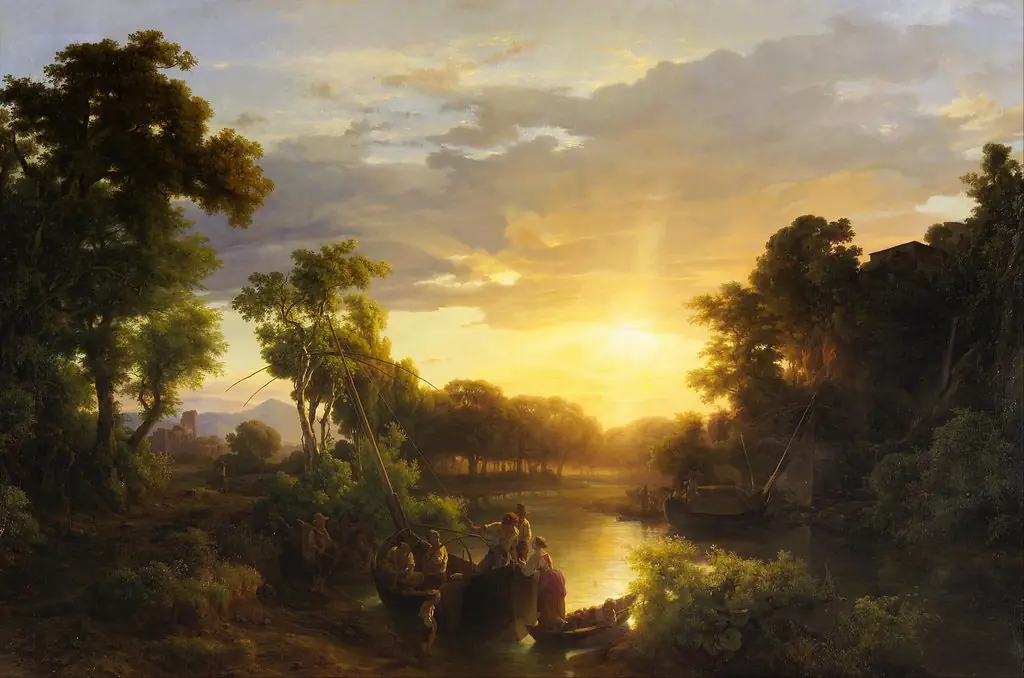 Italian Landscapes at Sunset, Fishermen
- Paisagem com rio e floresta (atribuído)