Artwork
Twilight in the Wilderness
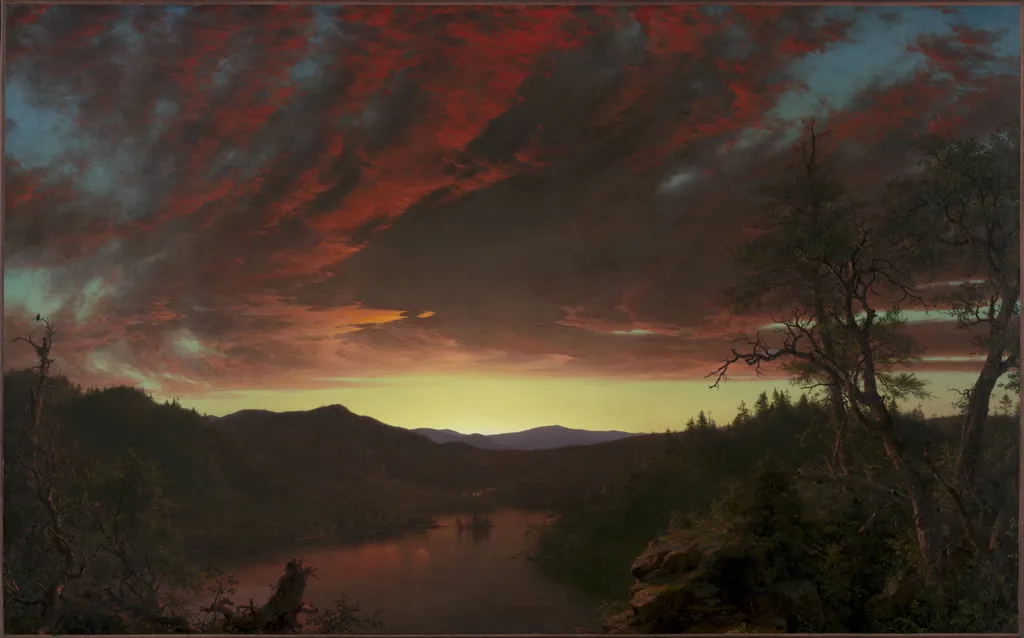
Twilight in the Wilderness is an oil painting by the Hudson River School artist Frederic Edwin Church. It dates from 1860 and is held in the collection of the Cleveland Museum of Art.
About this work
Subject & Meaning
The blood-red sky and encroaching night have also been interpreted apocalyptically, as a metaphor for a nation descending into discord.
Twilight in the Wilderness depicts a panoramic view of the northeastern United States woodlands at sunset, with no signs of human presence; the only animal is a small bird perched at left. Painted in 1860, on the eve of the Civil War, the work layers multiple meanings onto its apparently unspoiled wilderness. Contemporary viewers read the scene as spiritual, describing it as "Nature with folded hands, kneeling at her evening prayer," while later scholars have identified discrete Christian iconography: the tree stump functions as a "wilderness altar" bearing a small cross of wood splinters with an angel's outline, the three trees at right symbolize the three crosses at Calvary, and a cloud fragment aligned with the stump evokes the Holy Spirit.
The blood-red sky and encroaching night have also been interpreted apocalyptically, as a metaphor for a nation descending into discord. Scholar David C. Huntington framed the canvas as Church's "heroic representation of the New World's classic image," treating American wilderness itself as a patriotic and quasi-religious subject.
Technique & Style
Twilight in the Wilderness is an oil‑on‑canvas work measuring roughly 101.6 × 162.6 cm, painted in 1860 in Church’s New York studio and originally commissioned by William Thompson Walters. The surface is a canvas support, and the paint consists of oil pigments applied in thin, layered washes that create gradations of purple, orange and yellow across the sky. Church’s technique emphasizes careful study of natural detail, producing a luminous, almost camera‑like clarity that avoids overt brush‑stroke texture.
The composition reflects the Hudson River School’s focus on untouched wilderness, with meticulously rendered trees and rock forms that echo the precision of Luminist observation.
History & Provenance
Twilight in the Wilderness was commissioned in 1860 by William Thompson Walters and painted in New York by Frederic Edwin Church, who worked from field sketches made in Maine in 1858. The work was first exhibited at Goupil’s, New York, from June 8 to July 25, 1860. It passed to John Taylor Johnston in 1866, then to John Work Garrett in 1876.
After Garrett’s death it was inherited by his daughter Mary Garrett, who sold it to family friend Robert de Forest. Upon de Forest’s death in 1931 it descended to his brother Lockwood de Forest and thereafter through the family until the 1960s, when a descendant sold it. The Cleveland Museum of Art acquired the painting in 1965.
Twilight in the Wilderness has been held by the Cleveland Museum of Art since its acquisition in 1965, where it is registered under the accession number 1965.233. The painting's provenance begins with its commission by William Thompson Walters. Ownership subsequently passed to John Taylor Johnston in 1866, followed by a sale to John Work Garrett in 1876.
Garrett's daughter, Mary Garrett, inherited the work before selling it to family friend Robert de Forest. Upon Robert's death, his brother Lockwood de Forest inherited the canvas in 1931. It remained within the de Forest family until a descendant sold it to the Cleveland museum.
Regarding exhibition history, the work was first displayed at Goupil's gallery in New York City from June 8 to July 25, 1860.
Context
Exhibited at Goupil’s New York gallery in June–July 1860, the work was praised for its spiritual purity yet also dismissed as mere scenery; contemporary critics called it a “scene unhistoric” and “nature with folded hands.” Scholar John K. Howat later hailed it as “one of his finest ever” and the most celebrated depiction of American woodland. David C. Huntington emphasized its Luminist mastery, noting the disciplined sky and the absence of painterly excess that achieves camera‑like clarity.
As a Hudson River School painting, it reflects mid‑century American fascination with untouched nature, a theme linked to Thoreau’s Walden. The canvas, commissioned by William Thompson Walters and later acquired by the Cleveland Museum of Art in 1965, exemplifies Church’s synthesis of European influences and his role in redefining the American sublime.
Legacy
Scholars consistently rank Twilight in the Wilderness among Church’s most celebrated achievements, with Howat calling it “one of his finest ever” and Huntington noting its role as the culmination of his wilderness vision. The work exemplifies Hudson River school ideals and later Luminist concerns with light and natural detail, influencing subsequent American landscape painters. Its symbolic readings, spiritual altar, national destiny, and apocalyptic overtones, have shaped critical discourse on 19th‑century art and the cultural construction of wilderness.
Since its acquisition by the Cleveland Museum of Art in 1965, the painting has remained a touchstone in exhibitions, academic literature, and museum inventories, underscoring its enduring reputation as a benchmark of American artistic identity.
Overview
Frederic Edwin Church's 1860 oil painting, Twilight in the Wilderness, captures a dramatic natural scene. It depicts a North American woodland landscape at dusk, characterized by a vibrant, intensely colored sky. The work exemplifies Church's focus on grand, untamed environments, presenting a powerful vision of nature's beauty and majesty. This piece is a significant example of his landscape painting.
Own this work as a print
Artist & collection

Artist
Frederic Edwin Church was an American landscape painter born in Hartford, Connecticut.