Artwork
Niagara
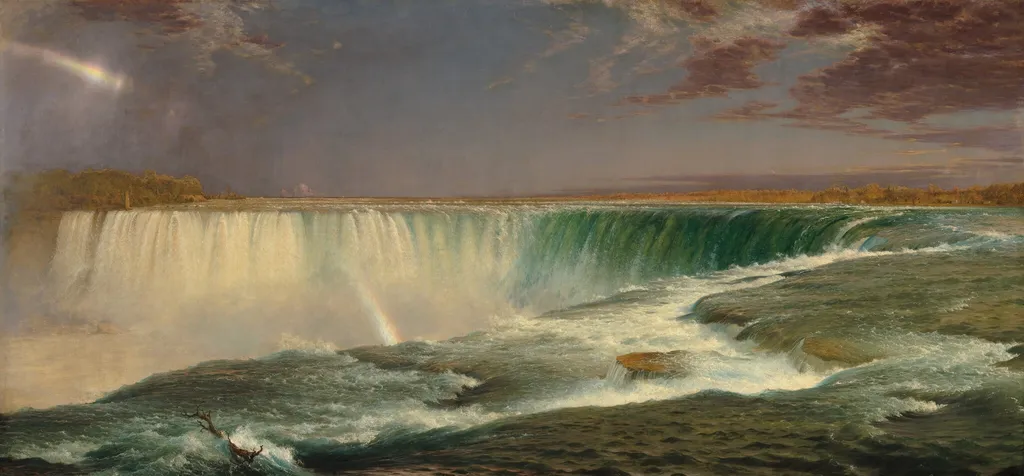
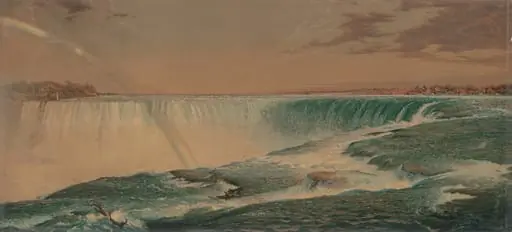
Niagara is an oil painting by the Impressionist artist Frederic Edwin Church. It dates from 1857 and is held in the collection of the National Gallery of Art.
- Inscription
- Inscribed:lower right: F.E. Church / 1857
About this work
Subject & Meaning
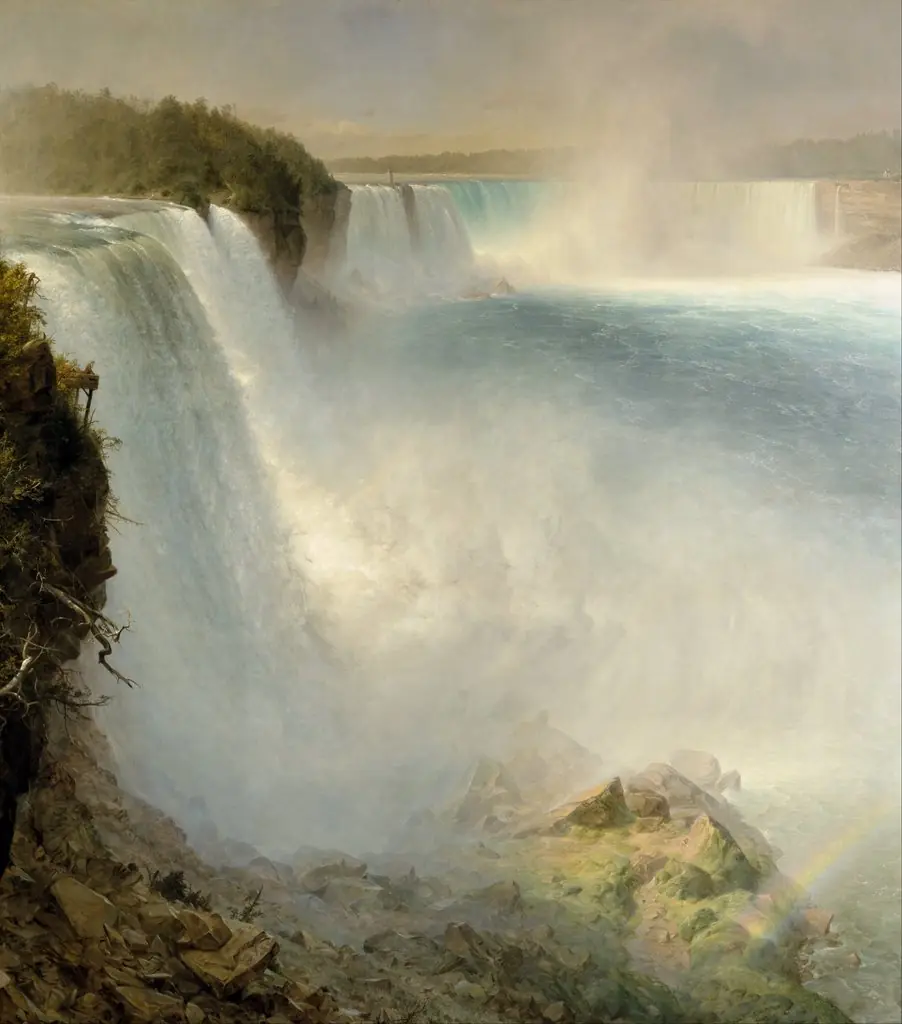
Frederic Edwin Church's Niagara (1857) depicts the Horseshoe Falls, emphasizing the waterfall's vast horizontal expanse rather than its vertical drop.
Frederic Edwin Church's Niagara (1857) depicts the Horseshoe Falls, emphasizing the waterfall's vast horizontal expanse rather than its vertical drop. The composition immerses the viewer directly at the precipice, utilizing a lone floating tree trunk for scale while minimizing human presence to a tiny figure on the distant Terrapin Tower. This arrangement underscores the indomitable power of nature.
Symbolically, the work served as a metaphor for American manifest destiny and spiritual optimism during the era. Scholars interpret the painting as a revelation of the cosmos, where the rainbow signifies a divine covenant and the cataract represents a mythical deluge that washes away the Old World to allow for a New World rebirth. By presenting the falls as an archetype of the universe, Church positioned the self-reliant American viewer as a prophetic figure discovering their identity within the New World.
Technique & Style
Niagara is an oil painting on canvas, measuring approximately 101.6 cm by 229.9 cm, a format that is more than twice as wide as high, allowing a sweeping panoramic view of the Horseshoe Falls from the Canadian side. Church prepared the work through extensive on-site studies and employed two canvases simultaneously, using a draft to test effects before transferring the favored solution to the final support. The composition lacks a repoussoir, immerses the viewer at the lip of the falls, and renders mist, turbulent water, and a partial rainbow with unprecedented naturalism, while a floating tree trunk provides scale.
Over time the surface accumulated damage; Church repainted parts of the sky in 1886, though he felt constrained by the numerous reproductive prints.
History & Provenance
Frederic Edwin Church completed the oil painting Niagara in 1857, following extensive preparatory work that included dozens of pencil and oil studies made during multiple visits to the falls, most notably in 1856. The artist reportedly executed the final canvas in approximately six weeks, utilizing a draft canvas to test ideas before transferring satisfactory results to the final surface. In 1857, Church sold the work to the New York firm Williams, Stevens & Williams.
The painting subsequently passed to Brown Brothers Bankers, New York, before being shown in December 1861 at a charity exhibition at Tiffany & Co. benefiting the Association for Improving the Condition of the Poor. It was purchased by John Taylor Johnston of New York, who held it until 1876, when the Corcoran Gallery of Art in Washington acquired it. The National Gallery of Art in Washington acquired the work in 2014, following the dissolution of the Corcoran’s collection.
Context
Completed in 1857, Niagara stands as Frederic Edwin Church's most significant work at the time, cementing his status as the era's premier American landscape painter. A central figure of the Hudson River School, Church transformed a subject previously deemed a "trite" cliché into a profound national metaphor. Contemporary scholar David C. Huntington later characterized the painting as an American prophecy, interpreting the cataract as a symbol of Manifest Destiny and spiritual rebirth for the New World.
The work's unprecedented realism and panoramic format, which eliminates traditional foreground elements to immerse the viewer, marked a technical and aesthetic breakthrough. Pierre Berton subsequently described it as the greatest of all Niagara paintings. Church's approach reflected the influence of John Ruskin's aesthetics while advancing the sublime tradition, positioning the artist as an interpreter of nature's transcendent truths for a democratic audience.
Legacy
Church’s Niagara became a touchstone for American landscape painting and cultural identity in the decades after 1857. Contemporary critics and later scholars repeatedly cited it as the definitive image of the Falls, eclipsing hundreds of earlier and later treatments; Pierre Berton’s mid-twentieth-century assessment that it is “by common consent the greatest” crystallized this view across anglophone and francophone sources. The work’s panoramic format, immersive vantage, and rainbow motif were widely reproduced in prints and decorative arts within years of its debut, embedding its iconography in popular visual culture.
By the 1960s, art historians such as David C. Huntington framed the painting as a visual articulation of Manifest Destiny and spiritual optimism, reinforcing its status as a national emblem. Acquired by the Corcoran Gallery in 1876 and transferred to the National Gallery of Art in 2014, its canonical place in American art was secured through institutional permanence and repeated scholarly revival.
Overview
Frederic Edwin Church's 1857 oil painting, Niagara, captures the immense power of the Horseshoe Falls. This monumental canvas quickly became a pivotal work in the artist's career, solidifying his standing as the foremost American landscape painter of his generation. Through its detailed depiction of one of North America's most iconic natural wonders, the painting served as a significant statement on the grandeur of the American wilderness.
Artist & collection

Artist
Frederic Edwin Church was an American landscape painter born in Hartford, Connecticut.