Artwork
Agony in the Garden with donor Louis I of Orléans
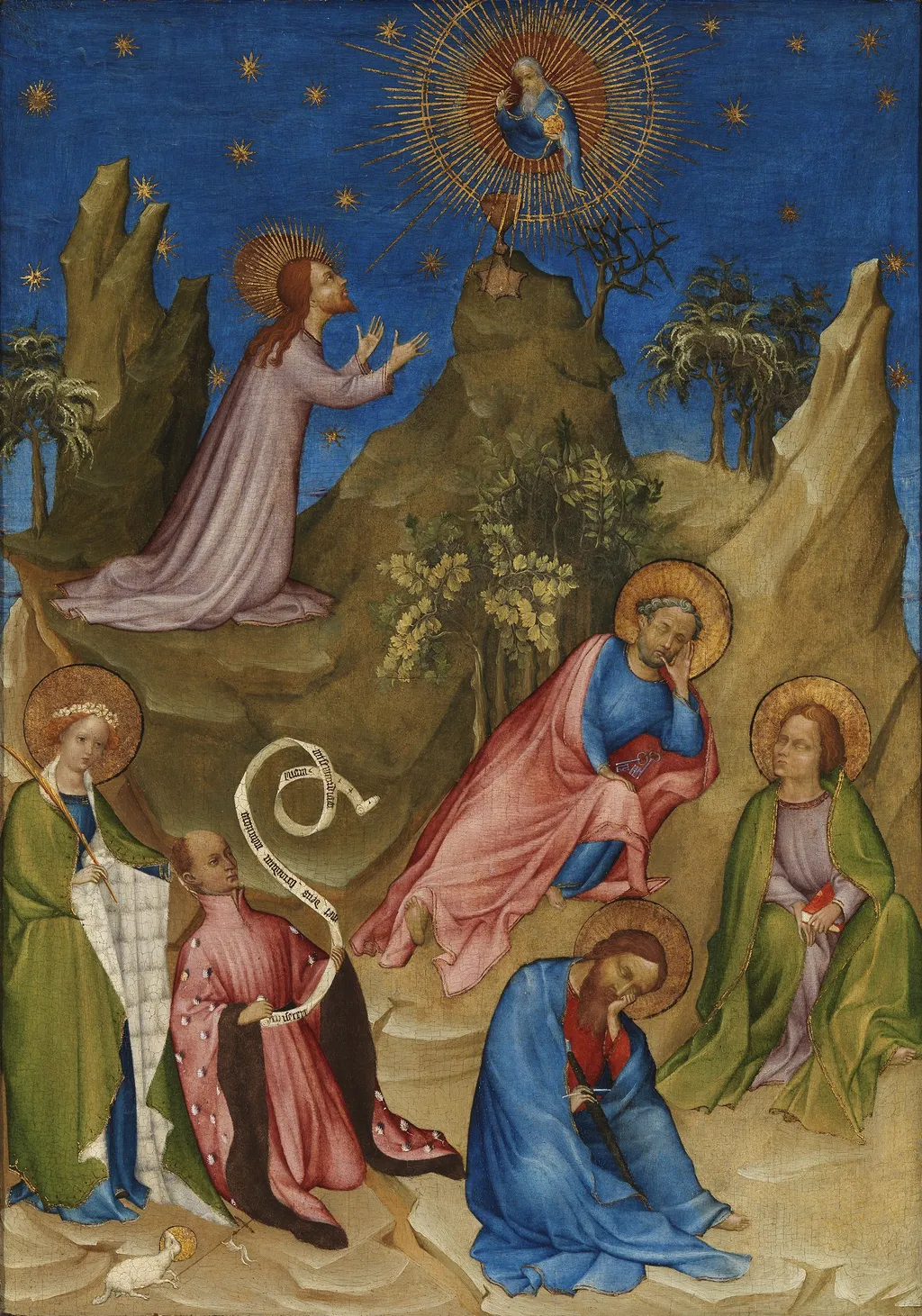
Agony in the Garden with donor Louis I of Orléans is a tempera painting by the Northern Renaissance artist Colart de Laon. It dates from 1405 and is held in the collection of the Museo del Prado.
About this work
Subject & Meaning
Its rare survival, excellent condition, and the discovery of original figures beneath later overpaint reveal a masterwork of the International Gothic style.
The work portrays the Agony in the Garden, the moment of Christ's final prayer before his arrest, and is interpreted as a funerary image commissioned not by Louis I himself but by his widow and son after his 1407 assassination. The donor, Louis I, Duke of Orléans, is identified by golden nettle leaves on his fur‑lined coat, a heraldic emblem he used from 1399, and is shown alongside Saint Agnes, whose lamb alludes to his father's birthdate and to the Visconti family of his wife. The inclusion of the biblical phrase 'Miserere mei, Deus' on a filacteria held by the duke further reinforces the penitential tone, while the absence of his wife and children suggests a memorial context.
The panel, painted on Baltic oak with abundant ultramarine pigment, reflects the high cost of materials such as lapis lazuli, underscoring its luxury. Its rare survival, excellent condition, and the discovery of original figures beneath later overpaint reveal a masterwork of the International Gothic style.
Technique & Style
The work is executed in tempera on a Baltic oak panel measuring 47 cm in height by 33.5 cm in width. The international Gothic style combines delicate linear drawing with a vivid ultramarine blue derived from ground lapis lazuli, a costly pigment that was often contracted separately in medieval commissions. The panel retains its original Gothic frame with side‑mounted hinges, suggesting it once formed the central leaf of a small triptych.
The composition depicts the Agony in the Garden, with donor Louis I of Orléans identified by golden nettle‑leaf motifs on his fur‑lined surcoat and Saint Agnes recognized by her lamb. Infrared reflectography and ultraviolet fluorescence revealed earlier overpaints that concealed the donor and saint, allowing careful dry‑clean removal and revealing the original colour scheme and remarkably preserved surface. The painting’s rarity lies in its status as one of only about a dozen surviving French panel works from 1380–1420, noted for its excellent condition and high‑quality materials.
History & Provenance
The painting was created in Paris around 1405-1408 on a Baltic oak panel, likely by Colart de Laon, who served as valet de chambre to Louis I, Duke of Orléans, and may have acted as commissioner. It remained in a private French collection until it was acquired by the Museo del Prado in May 2012 through Sotheby's Spain, purchased for 850,000 euros after the Royal Board of Trustees approved the offer on 22 May 2012. The work was presented to the public in February 2013 following restoration.
Prior to acquisition, the painting had been overpainted; ultraviolet fluorescence and radiography revealed hidden figures of the Duke and Saint Agnes beneath later oil repaints, which were carefully removed using a microscope and scalpel over the course of a year. The original tempera work was preserved beneath, with the overpaint acting as a protective layer, resulting in exceptional survival of the original surface. The composition includes a donor portrait of Louis I, Duke of Orléans, identifiable by golden nettle leaves on his fur-lined surcoat, and Saint Agnes, marked by a lamb, both linked to his family's heraldry and patronage.
The work is held in the Museo del Prado in Madrid. Its inventory number is P00968. It entered the museum after being acquired in May 2012 through Sotheby's Spain, with the purchase finalized on May 22, 2012, and publicly announced in February 2013.
The acquisition followed restoration work that revealed earlier overpainted figures of the Duke of Orléans and Saint Agnes. The painting was previously in a private French collection, whose family had settled in Spain during the time of Joseph Bonaparte. The museum purchased it at a fixed price of €850,000, a sum considered below market value, especially when compared to recent acquisitions of similar works such as Le Christ de pitié soutenu par saint Jean l'Évangéliste en présence de la Vierge et de deux anges, bought by a Paris museum for €7.8 million.
Context
The Agony in the Garden with donor Louis I of Orléans is recognized as a rare survival of French panel painting from the early 15th century, a period when few such works remain due to destruction during the French Revolution and later religious upheavals. Its emergence as an almost unknown masterpiece was marked by its acquisition by the Museo del Prado in 2012 after a discreet purchase from a private French-origin collector via Sotheby's Spain for €850,000, a price described by Louvre curator Guillaume Kientz as significantly below market value for a work of its rarity and quality. The painting, dated between 1405 and 1408 and executed in tempera on Baltic oak panel, is attributed to an anonymous artist possibly Colart de Laon, a court painter and valet de chambre to Louis I, Duke of Orléans, who may have commissioned the work.
It depicts the Garden of Gethsemane scene with Louis I kneeling in prayer, accompanied by Saint Agnes, whose inclusion reflects both dynastic patronage and possible funerary intent following the duke's assassination in 1407. The work's original frame with side hinges suggests it may have been the central panel of a small triptych, with heraldic elements potentially placed on wings. The use of costly ultramarine blue, derived from lapislazuli, underscores the painting's luxurious commissioning, with pigment application documented in contractual terms.
Restoration between 2011 and 2012, involving meticulous removal of later overpaints using microscopic techniques, revealed the original figures of the duke and saint, confirming their distinct pigmentation and validating historical iconographic interpretations. The Prado's acquisition was hailed as a landmark event in French medieval art, filling a critical gap in the museum's collection and representing one of the most significant discoveries in the field in recent decades.
Legacy
The painting's rediscovery in 2012–2013 was hailed as one of the most important finds in French medieval painting in recent times. Its acquisition by the Museo del Prado for €850,000, well below market value, was noted by Louvre curator Guillaume Kientz, who stated that the Louvre or an American museum would have paid far more. The Louvre itself had recently paid €7.78 million for a comparable though larger and worse-preserved work by Jean Malouel.
The painting's arrival at the Prado represented an absolute novelty for the collection, as the museum previously held no works of this type. Its exceptional quality and rarity are underscored by the scarcity of surviving French panel paintings from 1380 to 1420, with only about a dozen extant due to destruction during the French Revolution and religious conflicts.
Overview
Created between 1405 and 1408, this tempera panel depicts the Agony in the Garden and belongs to the international Gothic tradition of early 15th‑century France. Executed on a Baltic oak board, the work entered the Museo del Prado’s collection in May 2012, where it remains on display.
Own this work as a print
Artist & collection
Artist
Colart de Laon painted delicate scenes of faith in the early 1400s. His only known work shows Christ kneeling in a moonlit garden while a kneeling nobleman, Louis I of Orléans, watches. The colors are soft but the lines…

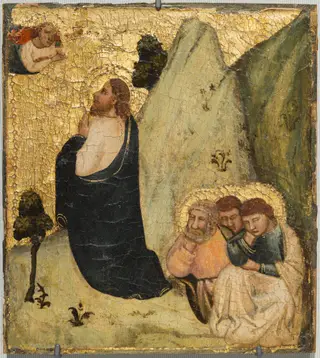
- The Agony in the Garden
![Scenes from the Passion of Christ: The Agony in the Garden [left panel], by Andrea Vanni](https://artifactworldgallery.com/img/andrea-vanni--scenes-from-the-passion-of-christ-the-agony-in-the-garden-le--2bad16de75eee8eb-w320.webp) Scenes from the Passion of Christ: The Agony in the Garden [left panel]
Scenes from the Passion of Christ: The Agony in the Garden [left panel]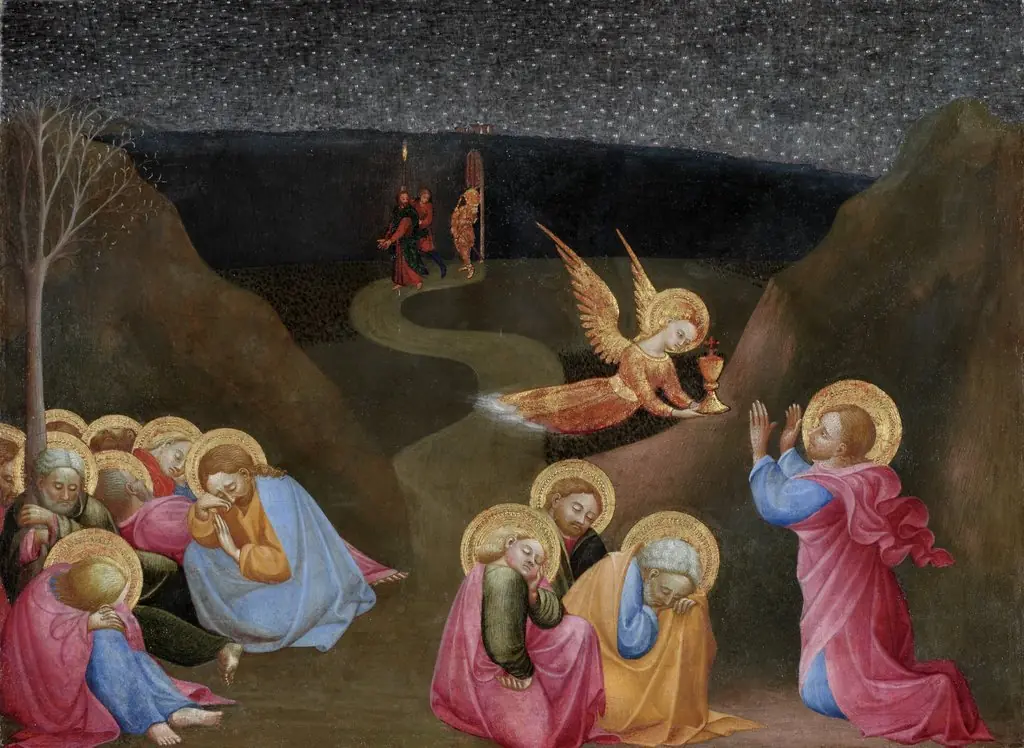 The Agony in the Garden
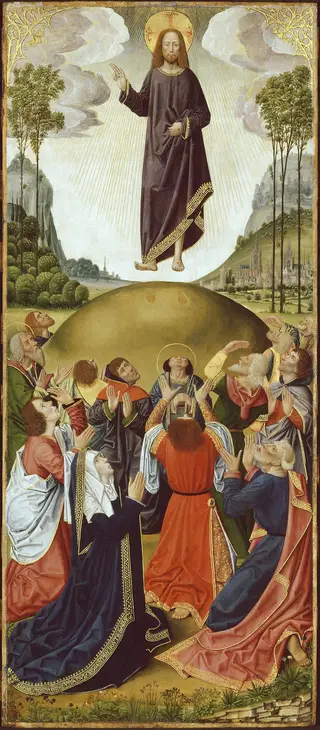 Altarpiece from Thuison-les-Abbeville: The Ascension
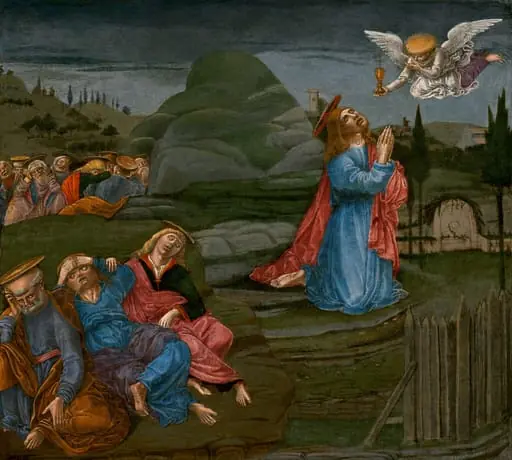 The Agony in the Garden
 The Ascension
 Saint John the Evangelist's Dream at Patmos
 Nativity of Christ
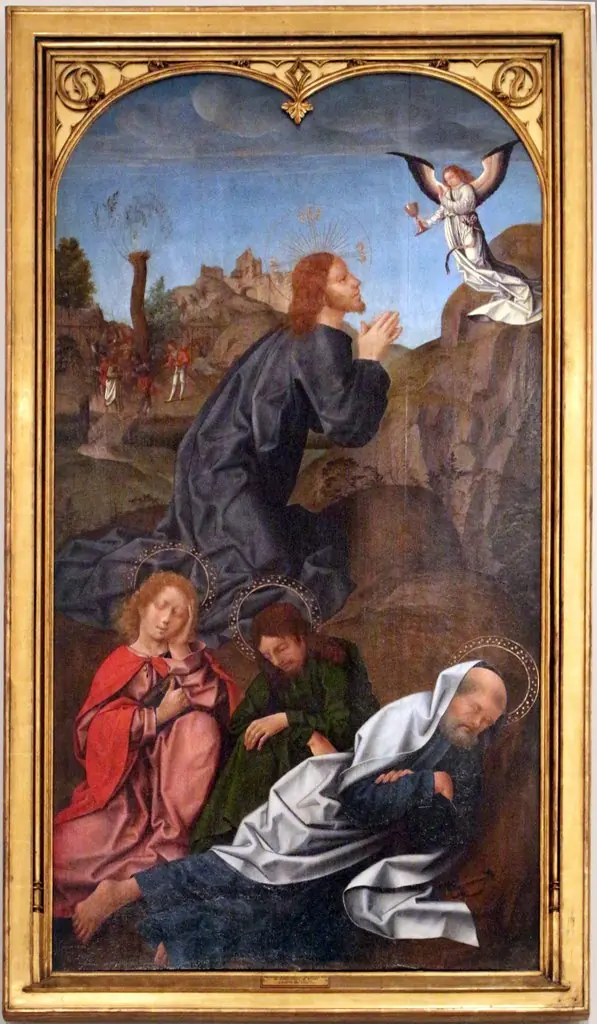 Cristo no Horto
 Ecce Agnus Dei
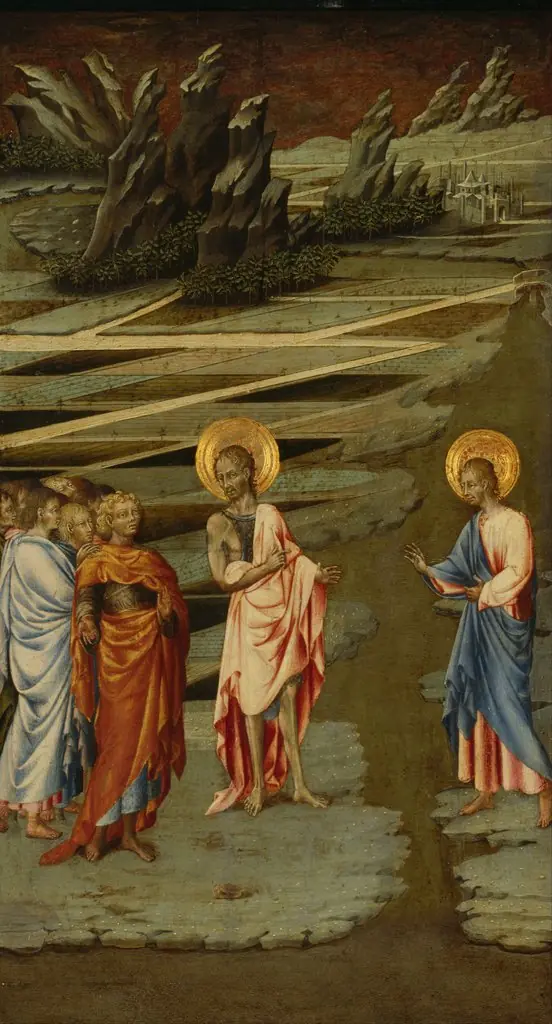 Ecce Agnus Dei
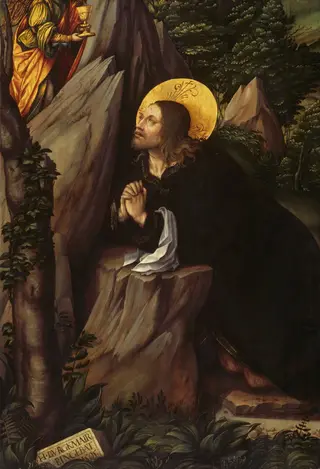 Agony in the Garden