Artwork
The Agony in the Garden
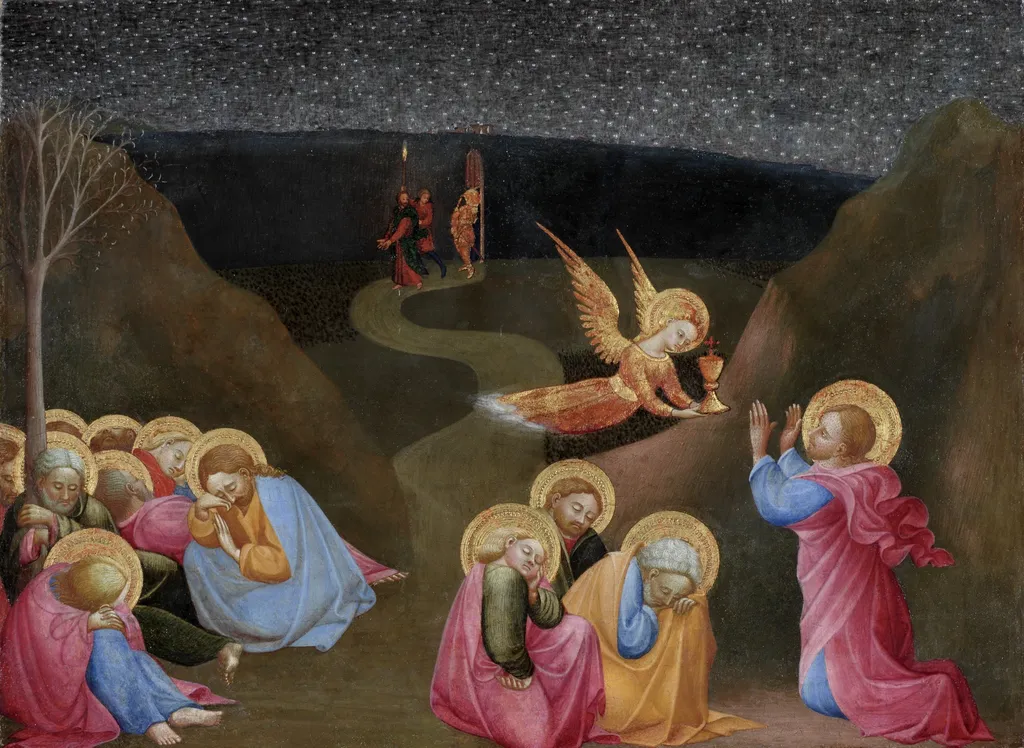
The Agony in the Garden is an unspecified painting by the Sienese School artist Sassetta. It dates from 1437 and is held in the collection of the Detroit Institute of Arts.
About this work
Overview
Painted in 1437 by Stefano di Giovanni, known as Sassetta, this work is one of several panels from a larger altarpiece commissioned for a Sienese church.
Painted in 1437 by Stefano di Giovanni, known as Sassetta, this work is one of several panels from a larger altarpiece commissioned for a Sienese church. Created during the early Renaissance in Tuscany, it reflects the transition from medieval stylization to naturalistic representation. The painting is now part of the Detroit Institute of Arts collection, where it remains a key example of Sienese devotional art from the period.
Subject & Meaning
The scene depicts Christ in the Garden of Gethsemane, moments before his arrest, kneeling in prayer as he accepts his fate. Three apostles sleep nearby, their bodies slumped in exhaustion, contrasting with Christ’s intense spiritual focus. The presence of halos identifies sacred figures, reinforcing the theological gravity of the moment. The quiet night setting underscores solitude and divine surrender, central themes in Passion narratives of the time.
Technique & Style
Sassetta combines the intricate linearity and gold detailing characteristic of Gothic art with the spatial awareness and softer modeling influenced by Florentine pioneers like Masaccio. Figures are rendered with delicate drapery and subtle gradations of light, while the landscape recedes with atmospheric perspective. The use of muted tones and controlled composition creates a contemplative mood, balancing decorative elegance with emerging naturalism.
History & Provenance
The painting originally formed part of a polyptych commissioned for the Church of San Francesco in Siena. After the altarpiece was dismantled in the 18th century, individual panels entered private and institutional collections across Europe and America. The Detroit Institute of Arts acquired this panel in the 20th century, where it has since been studied as a representative work of Sienese painting during the early Renaissance.
Context
In mid-15th-century Siena, artists maintained a distinct regional style even as Florence advanced in perspective and anatomy. Sassetta’s work bridges the ornamental traditions of the past with the human-centered realism gaining ground elsewhere in Italy. This painting reflects a Sienese preference for spiritual intimacy over dramatic action, aligning with local devotional practices that emphasized quiet contemplation over theatricality.
Legacy
Sassetta’s approach influenced later Sienese painters who continued to favor lyrical composition and spiritual nuance over Florentine dynamism. While less widely known than his contemporaries, his integration of Gothic and Renaissance elements helped sustain a regional artistic identity. Today, this panel stands as a quiet testament to the enduring power of devotional imagery in a time of artistic transformation.
Own this work as a print
Artist & collection

Artist
Stefano di Giovanni di Consolo, known as il Sassetta (c. 1392–1450) was a Tuscan painter of the Renaissance, and a significant figure of the Sienese School. While working within the Sienese tradition, he innovated the…