Artwork
Rocks in the Forest of Fontainebleau
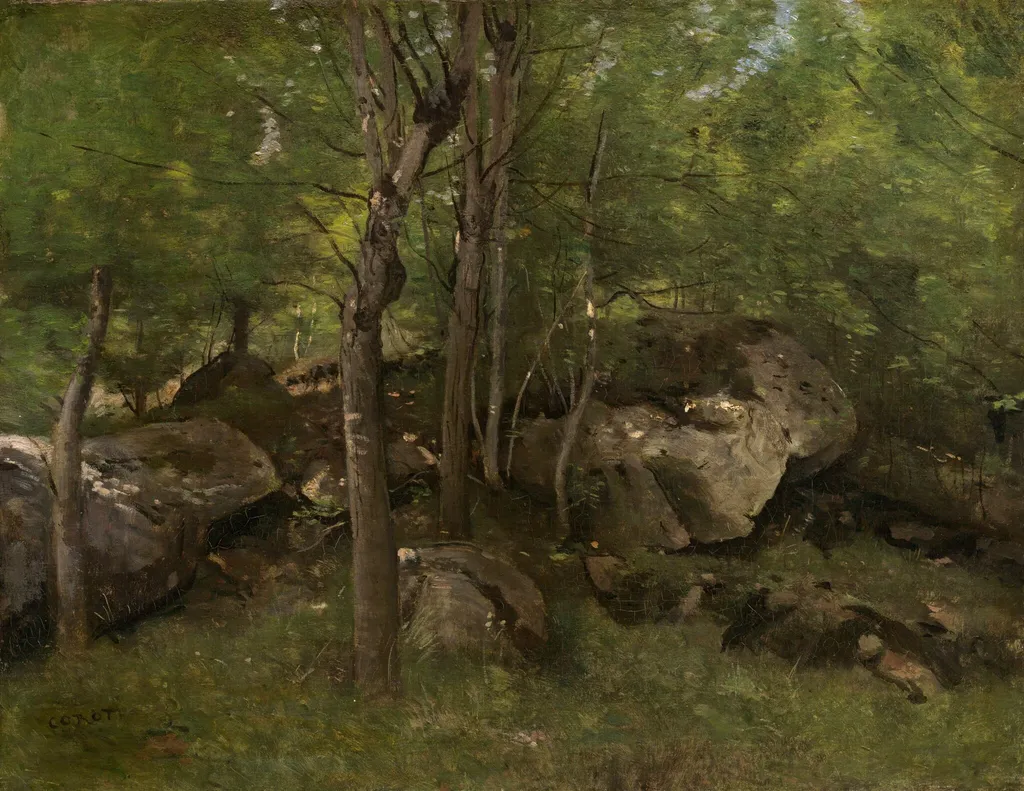
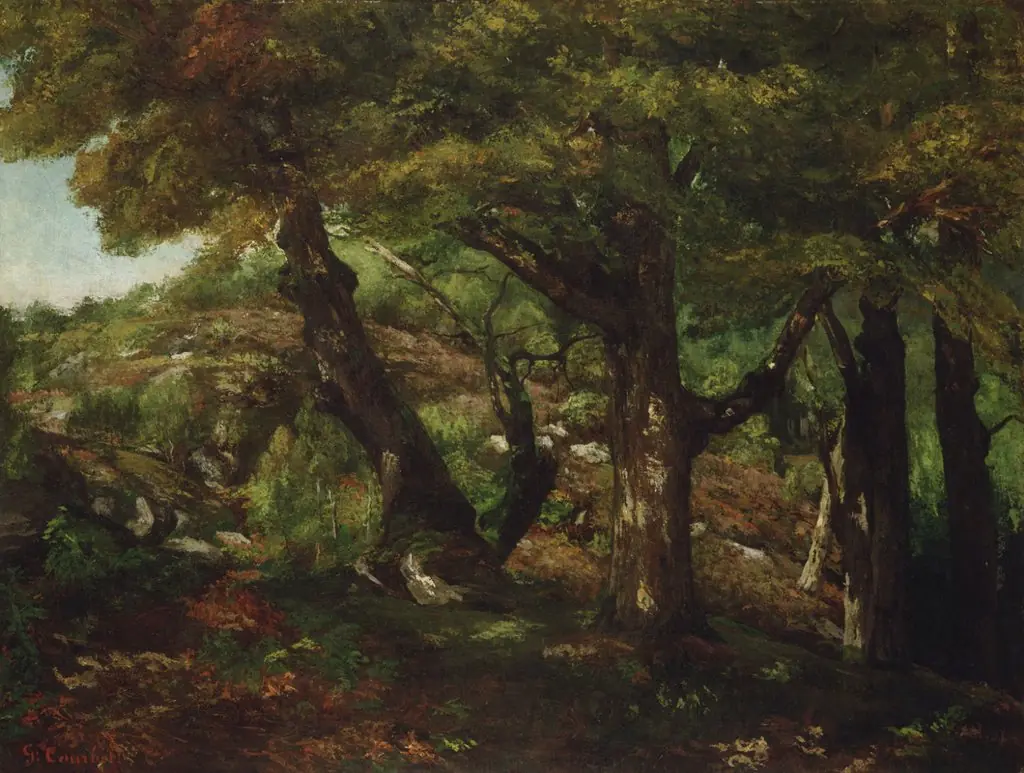
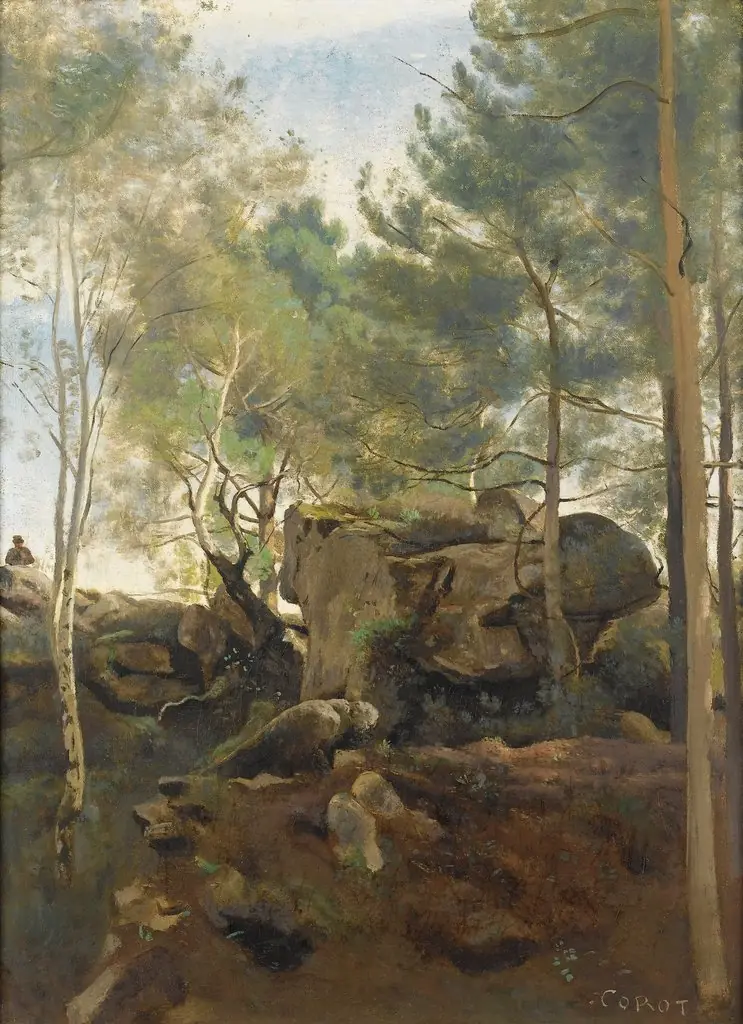
Rocks in the Forest of Fontainebleau is an oil painting by the Barbizon school artist Jean Baptiste Camille Corot. It dates from 1862 and is held in the collection of the National Gallery of Art.
- Inscription
- Inscribed:lower left: COROT
About this work
Technique & Style
The work is executed in oil paint on a canvas support, a medium Corot frequently employed for his forest landscapes.
The work is executed in oil paint on a canvas support, a medium Corot frequently employed for his forest landscapes. The canvas measures 46 cm in height and 59 cm in width, providing a modestly scaled view of the rocky undergrowth. As an oil painting, the medium allows for layered glazes and subtle tonal variations, though specific brush handling or surface condition details are not recorded in the available sources. The painting belongs to the landscape genre, depicting trees and rocks within the Fontainebleau forest.
History & Provenance
The painting was created in 1862. Corot gave the work to the Parisian miniaturist Mme Camille Cornelie Isbert, who owned it until it passed to Paul Tesse; by 1881 Tesse lent the canvas to an exhibition in Lille. Subsequently it entered the collection of Alfred Robaut before 1905, though it was not included in his 1919 estate sale.
On 12 June 1930 the work appeared at Hôtel Drouot (lot 28), where it was bought by dealer Etienne Bignou for American collector Chester Dale. Dale bequeathed the painting to the National Gallery of Art in 1963.
Rocks in the Forest of Fontainebleau is held by the National Gallery of Art in Washington, D.C., where it entered the collection as a bequest from Chester Dale in 1963. Dale originally acquired the painting at a sale at Hôtel Drouot in Paris on June 12, 1930. Prior to its acquisition by Dale, the work passed through the hands of Etienne Bignou, Alfred Robaut, Paul Tesse, and was initially given by the artist to Mme. Camille Cornelie Isbert. The painting was lent by Paul Tesse to an exhibition in Lille in 1881.
Legacy
After leaving the artist's studio, the canvas entered a series of private collections before being shown at the 1881 Lille exhibition, a rare public exposure that signaled early appreciation of Corot's landscape innovations. The work later passed to Chester Dale, who purchased it at the 1930 Hôtel Drouot sale, and in 1963 it was bequeathed to the National Gallery of Art, where it remains on view. Its presence in a major national museum has contributed to ongoing scholarly focus on Corot's role in shaping French plein-air painting.
Overview
Jean-Baptiste-Camille Corot's Rocks in the Forest of Fontainebleau, an oil on canvas from 1862, captures a specific moment within the rugged French woodland. This painting exemplifies Corot's approach to landscape, depicting a sunlit glade with twisted oak roots and prominent rocks. It reflects his interest in naturalistic observation, a characteristic of the Barbizon School, and showcases his distinctive brushwork that would influence later generations of artists.
Subject & Meaning
The painting presents a focused view of the Fontainebleau Forest, emphasizing its untamed character. Rather than an idealized vista, Corot renders a dense, almost intimate scene of gnarled oak roots and rough stones bathed in sunlight. This naturalistic portrayal aims to convey the sensory experience of the forest, suggesting the texture of bark and soil, and evoking the feeling of a vibrant, living environment rather than a static, picturesque view.
Context
Created during the height of the Barbizon School movement, this painting aligns with the group's commitment to depicting landscapes with unvarnished realism. Corot, a pivotal figure in 19th-century French art, is recognized for bridging the formal traditions of Neo-Classicism with the emerging practices of plein-air painting. His detailed studies of natural light and form, as seen in this work, laid foundational groundwork for the Impressionist movement that followed.
Own this work as a print
Artist & collection
Artist
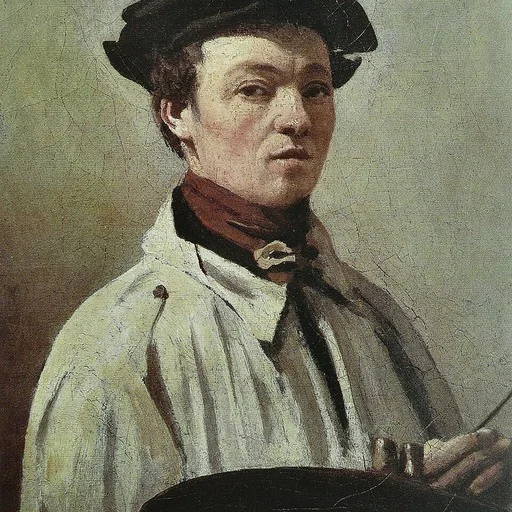
Jean-Baptiste-Camille Corot (UK: KORR-oh, US: kə-ROH, kor-OH; French:; 16 July 1796 – 22 February 1875), or simply Camille Corot, was a French landscape and portrait painter as well as a printmaker in etching.