Artwork
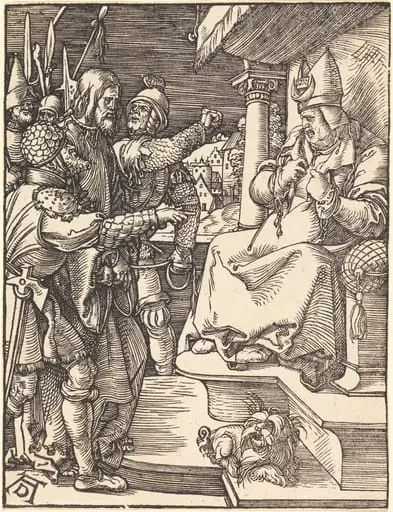
Christ before Caiaphas
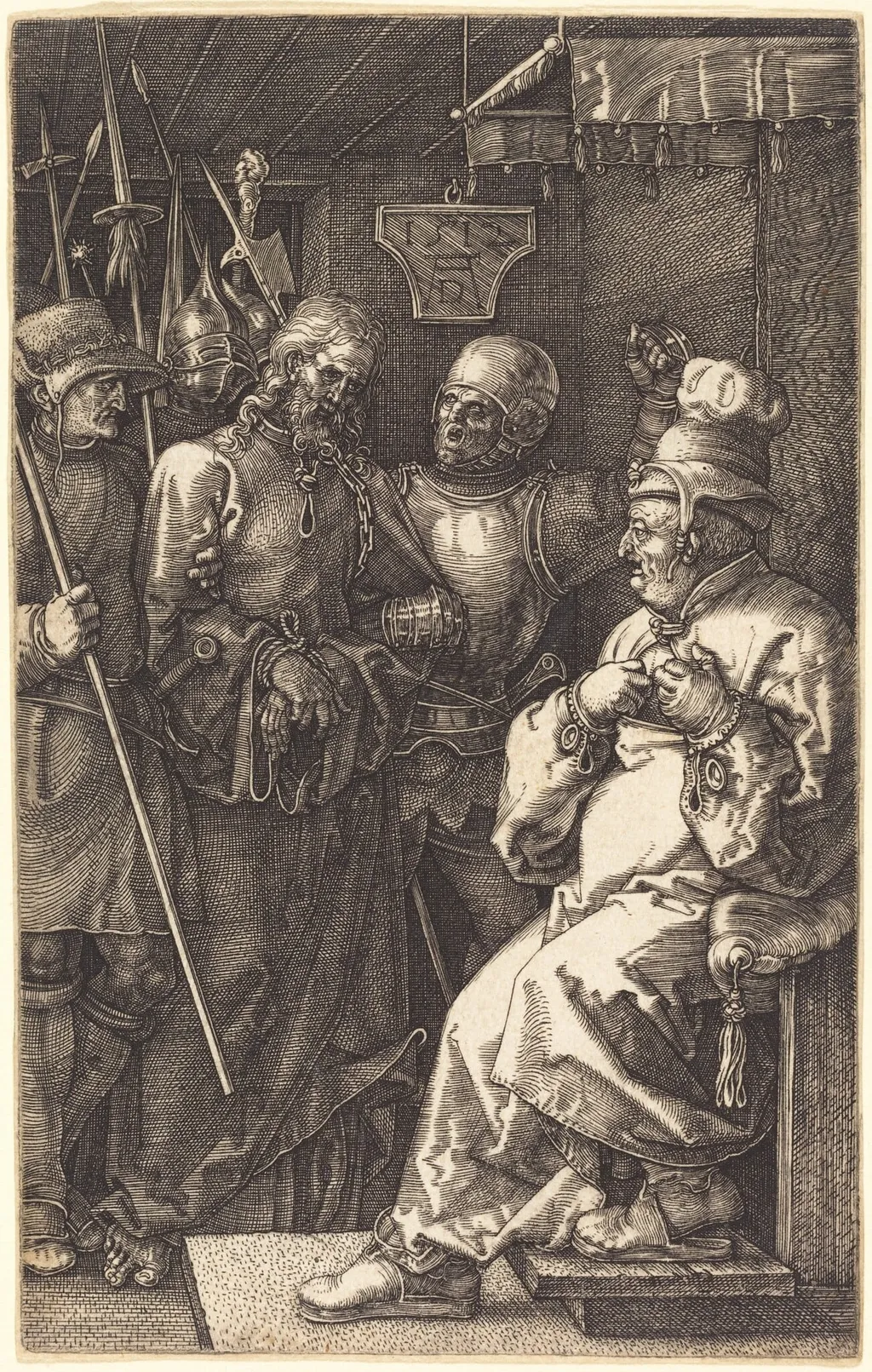
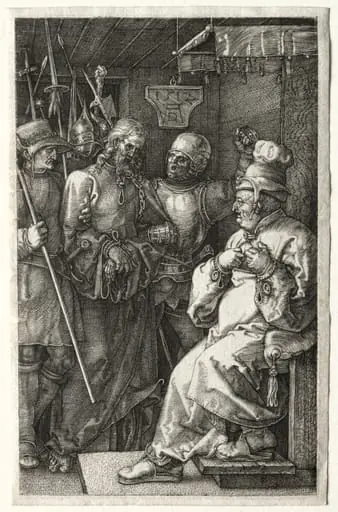
Christ before Caiaphas is an ink print by the Northern Renaissance artist Albrecht Dürer. It dates from 1512 and is held in the collection of the Metropolitan Museum of Art.
- Inscription
- Inscribed:in plate at upper center on hanging tablet: 1512 / AD [artist's monogram]; verso, lower center, in graphite by a later hand: 18 [upside down]; verso, bottom center, in graphite by a later hand: B.5; verso, bottom center, in graphite by a later hand: NR [?] 25146
- Markings
- Marked:none
About this work
Subject & Meaning
The engraving depicts the moment when Jesus is brought before Caiaphas, the Jewish high priest, during the Sanhedrin trial as recounted in the New Testament.
The engraving depicts the moment when Jesus is brought before Caiaphas, the Jewish high priest, during the Sanhedrin trial as recounted in the New Testament. Dürer’s composition focuses on the confrontation between Jesus and Caiaphas, emphasizing the tension of the religious and legal proceedings. The scene is drawn from the Gospel accounts of Jesus’s trial, particularly the denial and questioning that precede his condemnation.
Symbolically, the work underscores themes of authority, betrayal, and the confrontation between spiritual and temporal power. Jesus’s calm demeanor amid the gathering of accusers contrasts with the charged atmosphere, reflecting the theological significance of his trial in Christian narrative.
Technique & Style
The engraving employs fine, controlled burin lines to build dense cross-hatching and modulated tonal contrasts, typical of Dürer’s mature print technique. The composition relies on crisp contours and volumetric modeling to render Christ’s draped figure and Caiaphas’s seated presence with sculptural clarity. Handling emphasizes linear precision and subtle gradations, from deep blacks in the shadows to delicate reserve in the highlights, creating a restrained yet dramatic spatial illusion.
The laid paper support, consistent with northern European printmaking practice, bears faint chain lines and a watermark associated with Nuremberg production. The print’s condition is generally good, with minor marginal foxing and a faint central crease, but no significant tears or abrasions are recorded.
History & Provenance
Created in 1512 in Nuremberg, Albrecht Dürer's engraving Christ before Caiaphas is part of his series on the Passion. The work was executed on laid paper and depicts the Sanhedrin trial of Jesus. Its known ownership history begins with the Brentano-Birckenstock Collection in Vienna and Frankfurt, followed by the Stuttgart collection of Arthur Friederich Theodor Bohnenberger.
In 1928, the print was purchased by Lessing J. Rosenwald in Jenkintown, Pennsylvania, who subsequently gifted it to the National Gallery of Art in Washington, D.C., in 1943.
Context
Printed in 1512, this engraving illustrates the Sanhedrin trial of Jesus as recounted in the New Testament, capturing the pivotal moment when Christ stands before the high priest Caiaphas. Dürer’s meticulous rendering reflects the theological intensity characteristic of German Renaissance art and underscores his engagement with contemporary religious discourse.
The work belongs to Dürer’s broader ‘Passion’ series, a cohesive exploration of Christ’s suffering that demonstrates his innovative approach to narrative depth within printmaking. Its provenance traces a clear path from the Brentano‑Birckenstock Collection in Vienna and Frankfurt through private ownership in Stuttgart to acquisition by Lessing J. Rosenwald, culminating in its donation to the National Gallery of Art in 1943.
Scholarly attention has highlighted the piece as a key example of Dürer’s mastery of engraving technique and his integration of humanist themes, positioning it within the evolution of Northern Renaissance visual storytelling.
Overview
Christ before Caiaphas is a 1512 engraving by the German Renaissance master Albrecht Dürer, depicting the biblical trial of Jesus before the high priest. The composition centers on Christ, bound in chains, standing with a composed demeanor amidst a crowded, agitated group of figures in contemporary robes. A central figure, likely Caiaphas or a council member, gestures sharply toward the accused, driving the narrative tension.
Dürer executes the scene with his signature precision, utilizing intricate cross-hatching to model volume and create dramatic chiaroscuro effects on the laid paper. The dense network of lines defines the textures of the garments, the metallic sheen of the chains, and the architectural setting. Created during the height of Dürer's printmaking career, this work exemplifies his ability to synthesize Northern European detail with Italianate compositional balance and psychological depth.
It forms part of a series of Passion prints that solidified his reputation across Europe for technical mastery and theological gravity.
Own this work as a print
Artist & collection
Artist
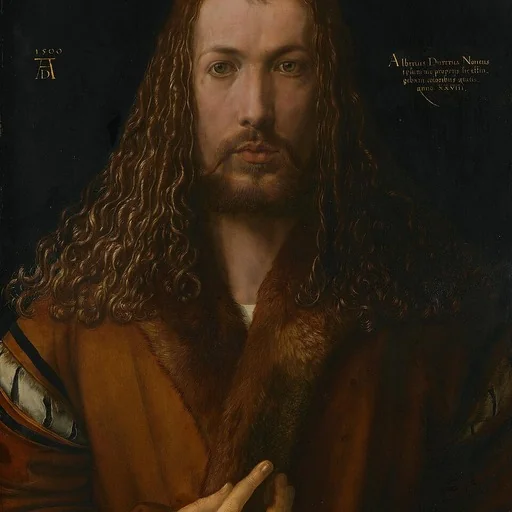
Albrecht Dürer spent his life in Nuremberg, a busy German city where artists traded prints like currency.

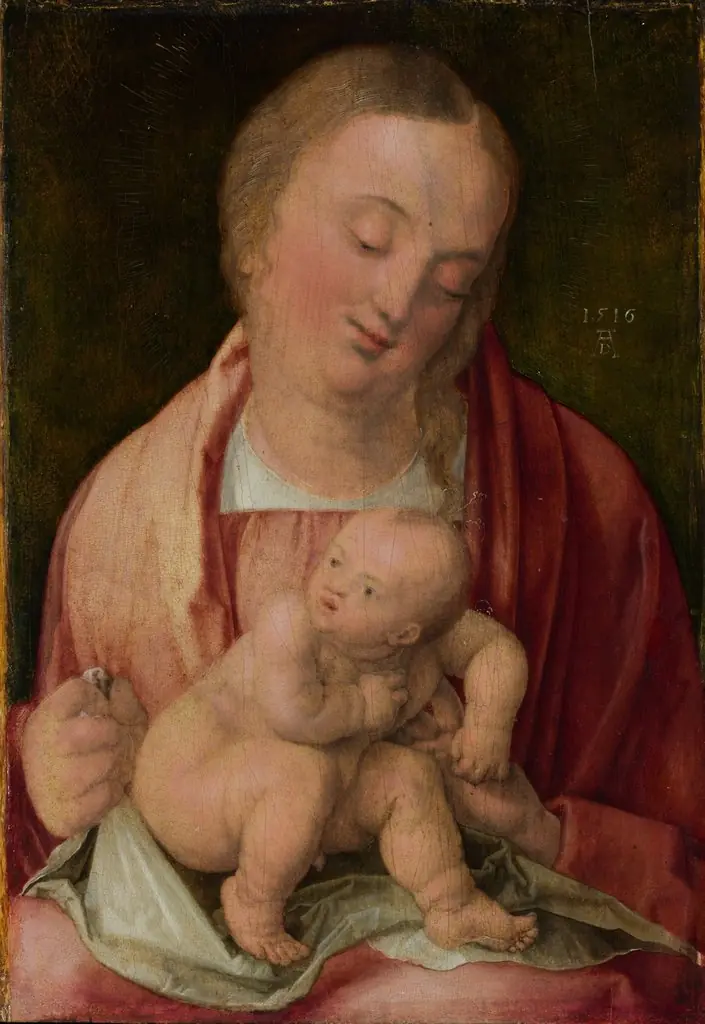
![Madonna and Child [obverse], by Albrecht Dürer](https://artifactworldgallery.com/img/albrecht-durer--madonna-and-child-obverse--d7b8ebf05d22ebe5-w320.webp)
![Lot and His Daughters [reverse], by Albrecht Dürer](https://artifactworldgallery.com/img/albrecht-durer--lot-and-his-daughters-reverse--b4ebf9b282faa17a-w320.webp)