Artwork
Christ on the Mount of Olives
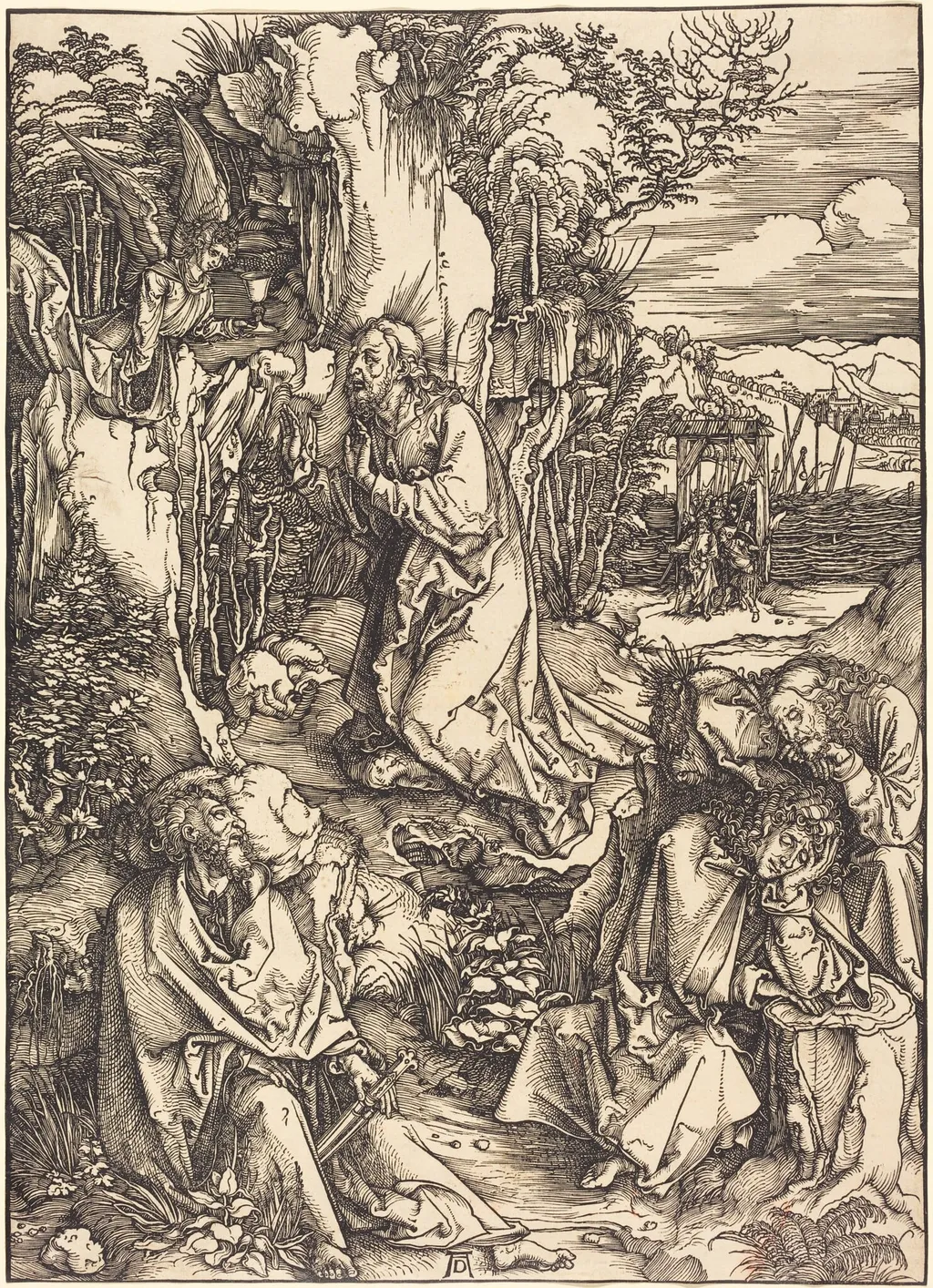
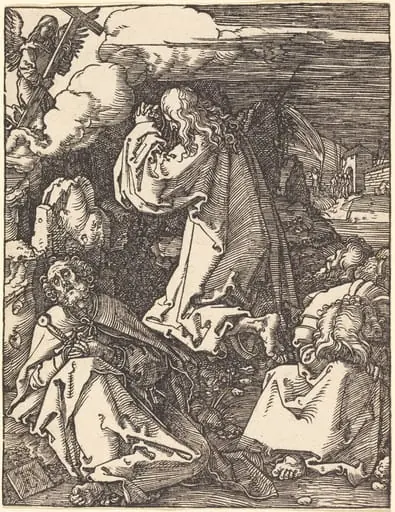
Christ on the Mount of Olives is an ink print by the Northern Renaissance artist Albrecht Dürer. It dates from 1498 and is held in the collection of the National Gallery of Art.
- Inscription
- Inscribed:in block, bottom center: AD [artist's monogram]; verso, lower left, in graphite by a later hand: 140 [underlined]; verso, lower center, in graphite by a later hand: C.16896; verso, lower center, in graphite by a later hand: B.6.: 213: Reichsapfel
About this work
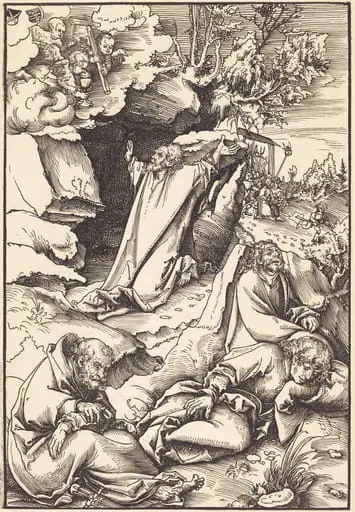
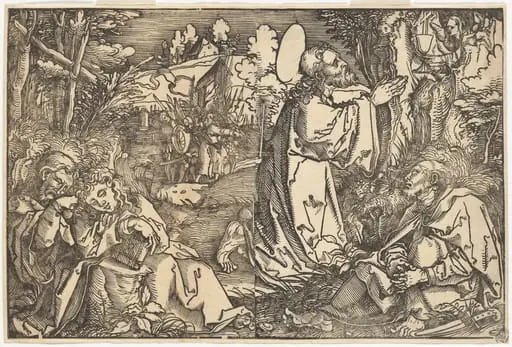
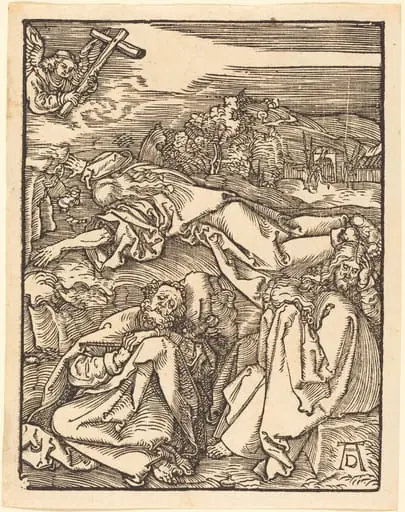
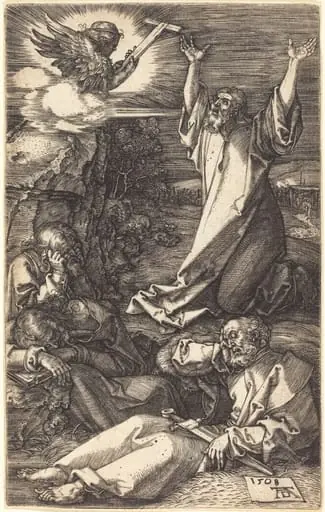
This woodcut shows Christ kneeling alone on a rocky hill, his hands raised in prayer. His robe glows white in the dark night. Three apostles sleep below, curled under their cloaks.
Dürer made this print in 1497. It’s part of a series on Christ’s life. The lines are so sharp they look like real light.
Look up the next woodcut by Dürer, Albrecht.
Subject & Meaning
Christ on the Mount of Olives depicts the Agony in the Garden, the New Testament episode in which Jesus Christ prays on the Mount of Olives before his arrest.
Christ on the Mount of Olives depicts the Agony in the Garden, the New Testament episode in which Jesus Christ prays on the Mount of Olives before his arrest. The work belongs to the religious genre of the German Renaissance, presenting this Passion narrative as its main subject.
As part of Dürer's Great Passion series, the woodcut translates a moment of solitary spiritual struggle into a devotional image. The Mount of Olives setting frames Christ in a moment of human vulnerability and divine submission, inviting viewers to contemplate the meaning of his sacrifice and to meditate on the suffering that initiates the Passion cycle.
Technique & Style
The print is executed in ink on paper, a woodcut technique characteristic of the German Renaissance. Its composition shows the Agony in the Garden, a religious scene drawn from the New Testament, rendered with precise line work and tonal contrast typical of Dürer's approach to printmaking. The work measures 39.6 cm in height and 28.7 cm in width, reflecting the standard dimensions of early German woodcuts.
The handling of light and shadow emphasizes the emotional intensity of Christ's moment of solitude on the Mount of Olives, aligning with the formal stylistic qualities observed in Dürer's mature print period.
History & Provenance
The print was created in Nuremberg around 1497 as part of Albrecht Dürer’s Great Passion series, depicting Jesus Christ in the Agony in the Garden. It entered the collection of Lessing J. Rosenwald, who gifted it to the National Gallery of Art in 1943. The work is held in several major institutions, including the National Gallery of Art, the Chester Beatty Library, and the Cleveland Museum of Art.
Dürer produced this woodcut on paper using ink, measuring 39.6 cm by 28.7 cm. Its creation falls within the early German Renaissance, and it is based on the New Testament narrative of Christ’s suffering on the Mount of Olives.
Impressions of Albrecht Dürer's 1497 woodcut are held in numerous major institutions, including the National Gallery of Art in Washington, D.C., the Metropolitan Museum of Art, the Museum of Fine Arts, Houston, the Cleveland Museum of Art, the British Museum, the Chester Beatty Library, and the Cooper Hewitt, Smithsonian Design Museum. The specific impression at the National Gallery of Art originates from the collection of Lessing J. Rosenwald of Jenkintown, Pennsylvania, who gifted the work to the museum in 1943.
While the print is part of the Great Passion series and widely distributed across these collections, the provided records confirm its presence in these specific holdings without detailing a chronological exhibition history for individual impressions.
Overview
Albrecht Dürer’s woodcut titled Christ on the Mount of Olives dates from the late 1490s and belongs to a series illustrating episodes from the life of Jesus. Executed on laid paper, the print presents a nocturnal scene in which the central figure kneels in prayer on a barren hilltop.
Context
The work reflects the devotional climate of late‑15th‑century Germany, where printed images of biblical narratives were increasingly used for private meditation. Dürer’s integration of detailed line work and dramatic chiaroscuro aligns with contemporary trends in Northern Renaissance art.
Own this work as a print
Artist & collection
Artist
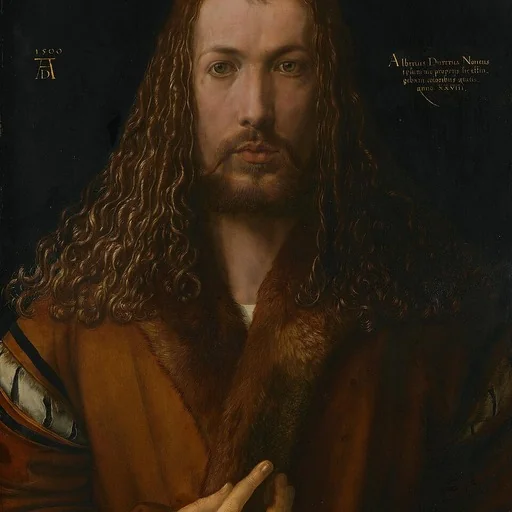
Albrecht Dürer spent his life in Nuremberg, a busy German city where artists traded prints like currency.

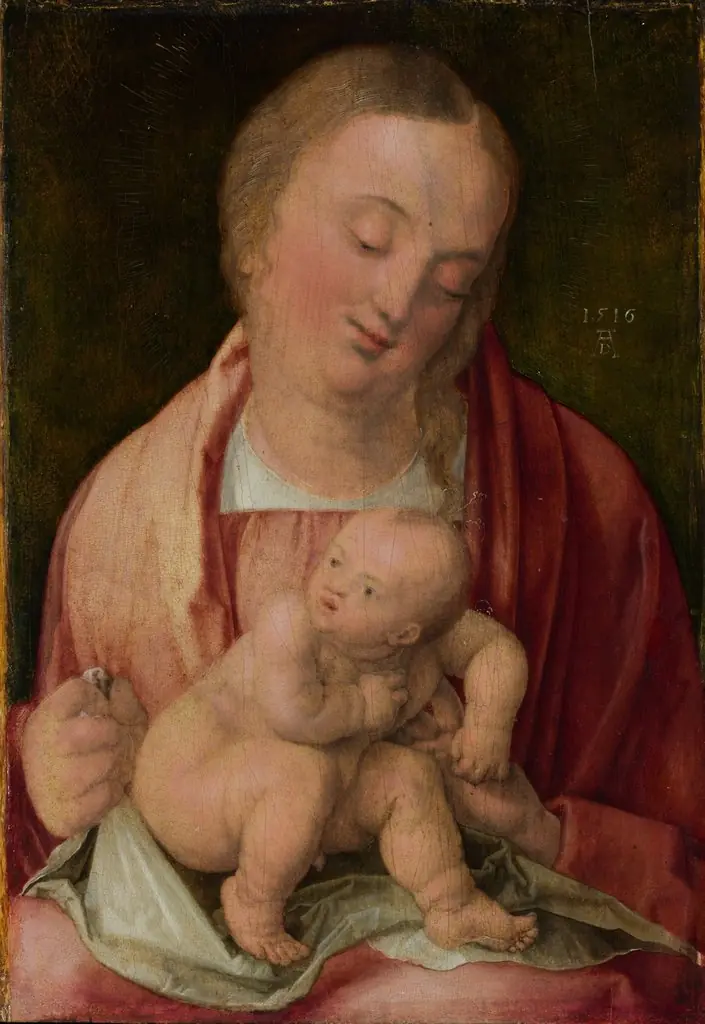
![Madonna and Child [obverse], by Albrecht Dürer](https://artifactworldgallery.com/img/albrecht-durer--madonna-and-child-obverse--d7b8ebf05d22ebe5-w320.webp)
![Lot and His Daughters [reverse], by Albrecht Dürer](https://artifactworldgallery.com/img/albrecht-durer--lot-and-his-daughters-reverse--b4ebf9b282faa17a-w320.webp)