Artwork
Christ Washing the Feet of the Disciples
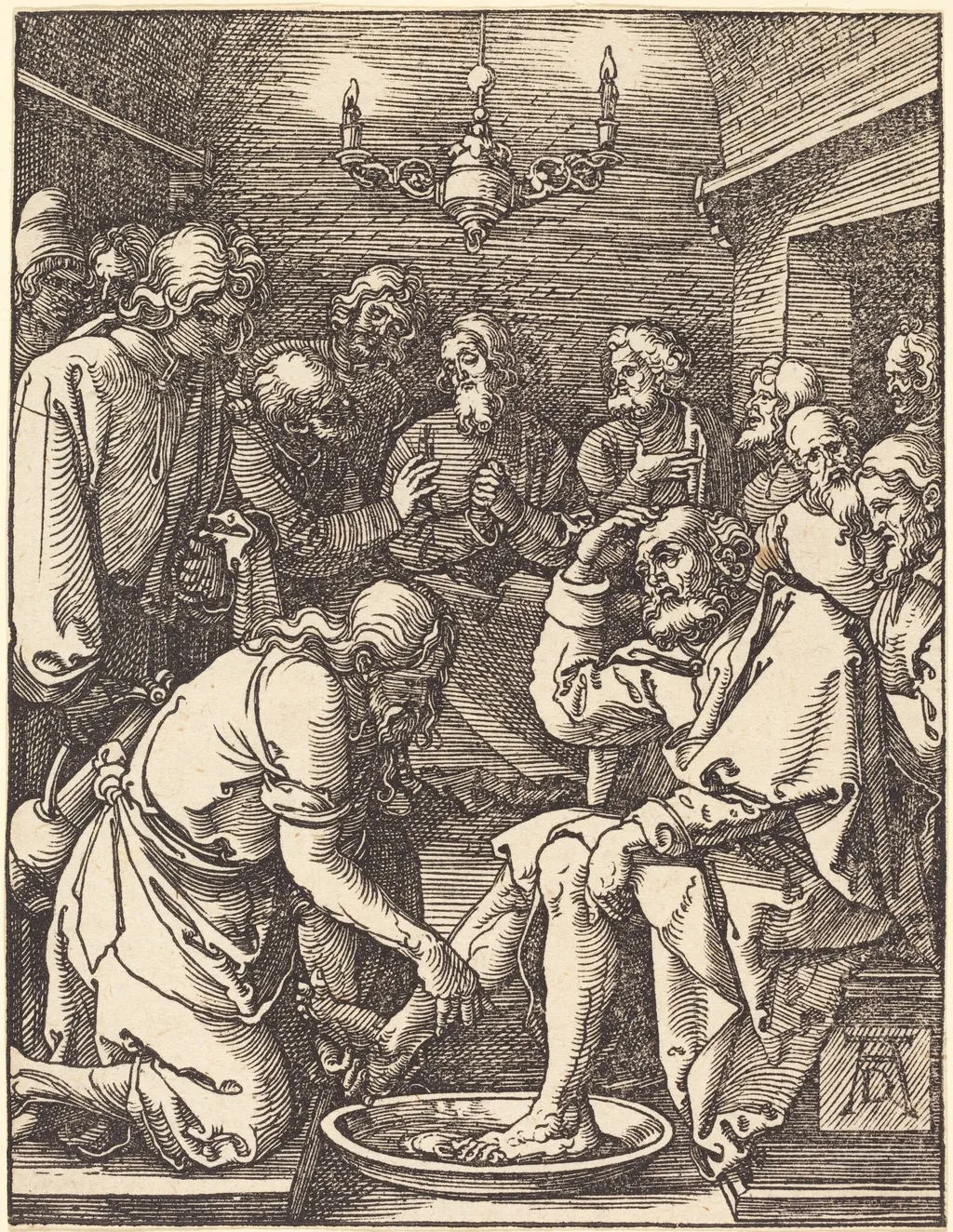
Christ Washing the Feet of the Disciples is an ink print by the Northern Renaissance artist Albrecht Dürer. It dates from 1510 and is held in the collection of the British Museum.
- Inscription
- Inscribed:in block, bottom right, on bench: AD [artist's monogram]; verso, lower center, in graphite by a later hand: 627; verso, lower left, in graphite by a later hand: B 25; verso, bottom center, in graphite by a later hand: 10
About this work
Subject & Meaning
The subject is drawn from the Gospel accounts and forms part of Albrecht Dürer's Little Passion series, a devotional cycle intended for prayerful contemplation.
Christ Washing the Feet of the Disciples depicts the New Testament episode in which Jesus Christ washes the feet of his disciples, an act of humility performed before the Last Supper. The print shows Jesus and Saint Peter as the principal figures engaged in this gesture of service. The subject is drawn from the Gospel accounts and forms part of Albrecht Dürer's Little Passion series, a devotional cycle intended for prayerful contemplation.
The act of foot-washing carries layered symbolic meaning: it expresses Christ's humility and self-emptying love, serves as a model for disciples to follow, and prefigures the Eucharistic sacrifice he is about to offer. By taking the role of a servant, Christ inverts expectations of messianic power, presenting leadership as compassionate service rather than dominance.
Technique & Style
Albrecht Dürer’s Christ Washing the Feet of the Disciples (1509) is a woodcut executed on laid paper, a technique central to the artist’s printmaking practice during the German Renaissance. The medium relies on the precise carving of a wooden block to create high-contrast lines and textures, characteristic of Dürer’s mastery of the form. Measuring 12.7 × 9.8 cm, the composition employs fine, controlled hatching and cross-hatching to model figures and drapery, achieving volumetric depth within the constraints of the medium.
Stylistically, the work reflects Dürer’s engagement with both Northern European detail and Italianate principles of proportion and spatial organization. The figures of Christ and Saint Peter are rendered with anatomical precision, while the interplay of light and shadow enhances the narrative’s emotional gravity. The print’s condition, as preserved in collections like the National Gallery of Art, remains dependent on the quality of impressions and subsequent handling, though specific conservation details are not uniformly documented across holdings.
History & Provenance
Albrecht Dürer created this woodcut in 1509 as part of his Little Passion series. The work's documented ownership history begins with Joseph Daniel Böhm of Vienna, followed by Robert Scholtz of Budapest. It subsequently passed through the hands of William Schab in New York before being acquired by Lessing J. Rosenwald in 1940.
Rosenwald donated the print to the National Gallery of Art in Washington, D.C., in 1943, where it remains part of the institution's collection.
Legacy
The woodcut's focus on humble service shaped subsequent religious imagery and printmaking practice. Printmakers from the early 17th century onward turned to Dürer's compositional treatment of Christ's gesture and the disciples' varied reactions as a model for depicting divine humility. The work remained in continuous circulation through reproductive engravings and American museum holdings, notably within the Rosenwald Collection that formed the core of the National Gallery of Art's print department.
Its inclusion in major institutional inventories cemented its status as a benchmark for narrative printmaking in the German Renaissance tradition.
Overview
Christ Washing the Feet of the Disciples is a woodcut print on laid paper created by Albrecht Dürer around 1510.
Context
The work is a representation of a biblical scene, showcasing Dürer's ability to convey complex emotions and narratives through his art.
Own this work as a print
Artist & collection
Artist
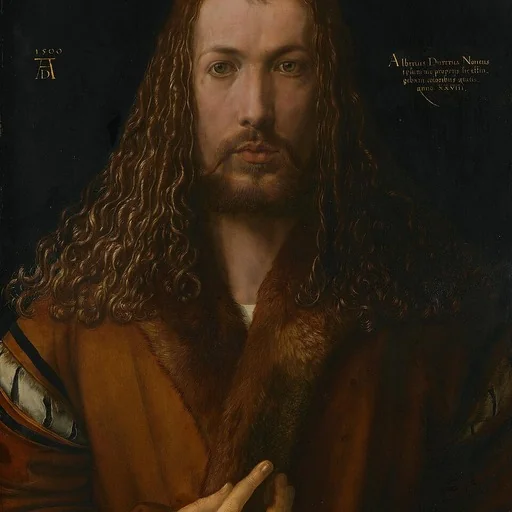
Albrecht Dürer spent his life in Nuremberg, a busy German city where artists traded prints like currency.

![Madonna and Child [obverse], by Albrecht Dürer](https://artifactworldgallery.com/img/albrecht-durer--madonna-and-child-obverse--d7b8ebf05d22ebe5-w320.webp)
![Lot and His Daughters [reverse], by Albrecht Dürer](https://artifactworldgallery.com/img/albrecht-durer--lot-and-his-daughters-reverse--b4ebf9b282faa17a-w320.webp)
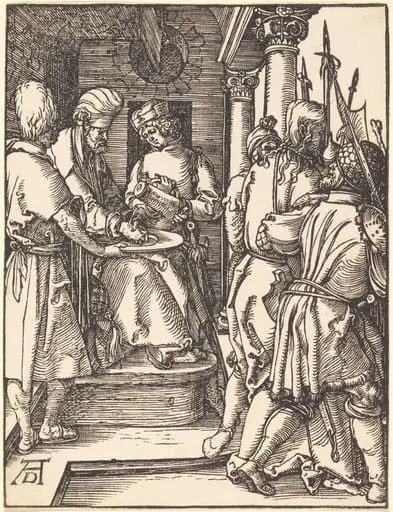 Pilate Washing His Hands
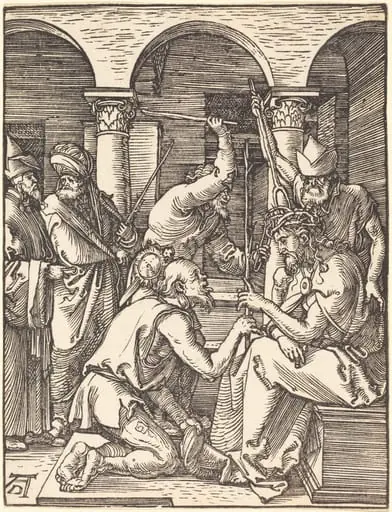 Christ Crowned with Thorns
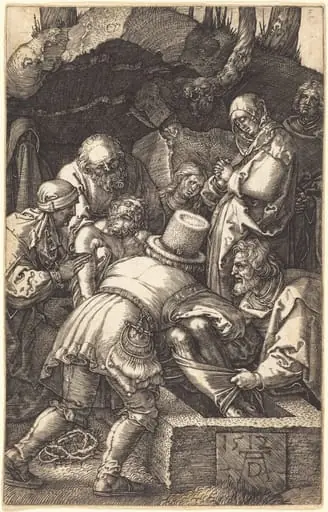 The Entombment
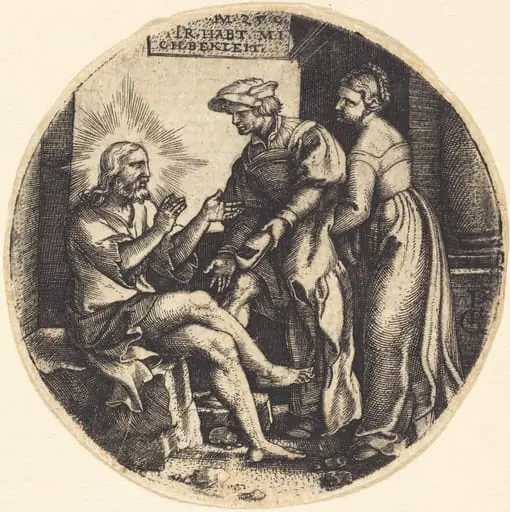 To Clothe the Naked
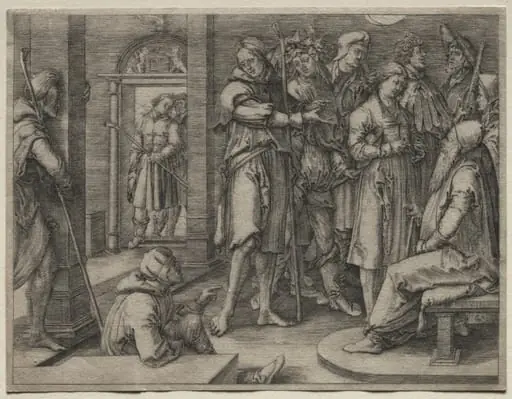 The Story of Joseph: Joseph Interprets his Dream to Jacob
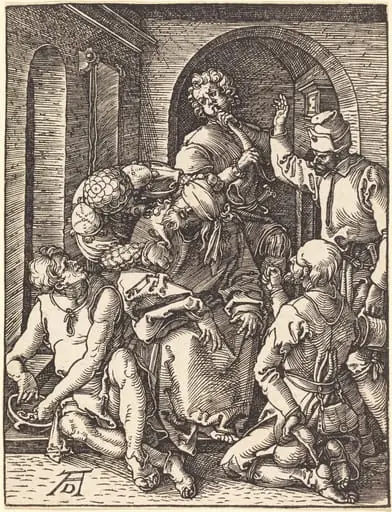 The Mocking of Christ
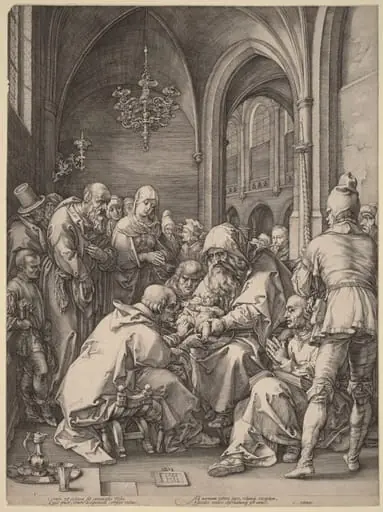 The Circumcision
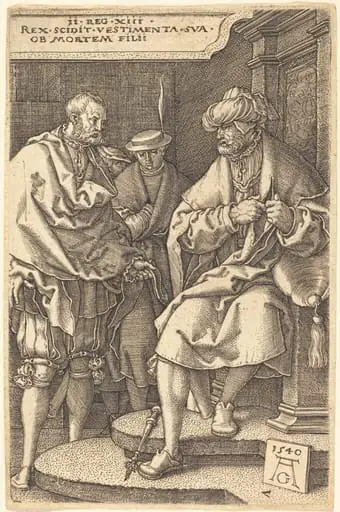 David Casting Off His Robes at the News of the Death of His Son
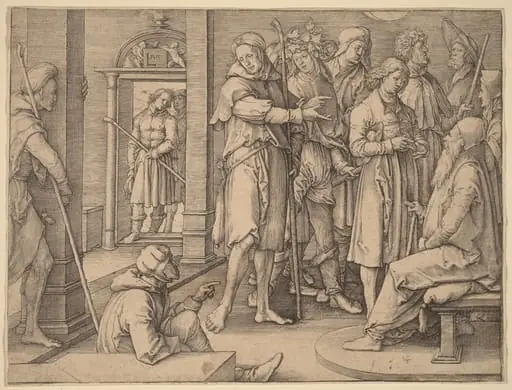 Joseph Interprets His Dream to Jacob
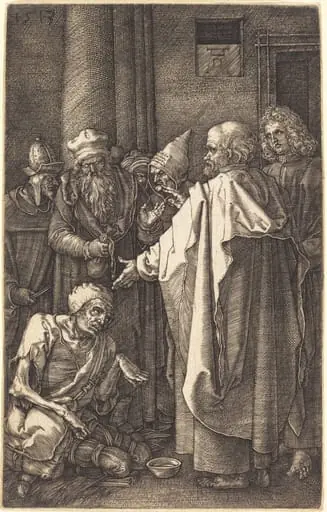 Saint Peter and Saint John Healing a Cripple at the Gate of the Temple
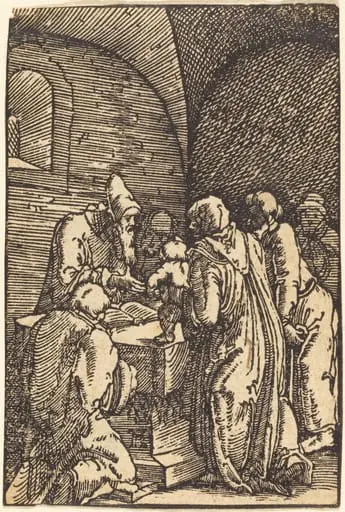 The Presentation of Christ in the Temple
- The Small Passion: Christ Washing St. Peter's Feet