Artwork
Saint Jerome in His Study
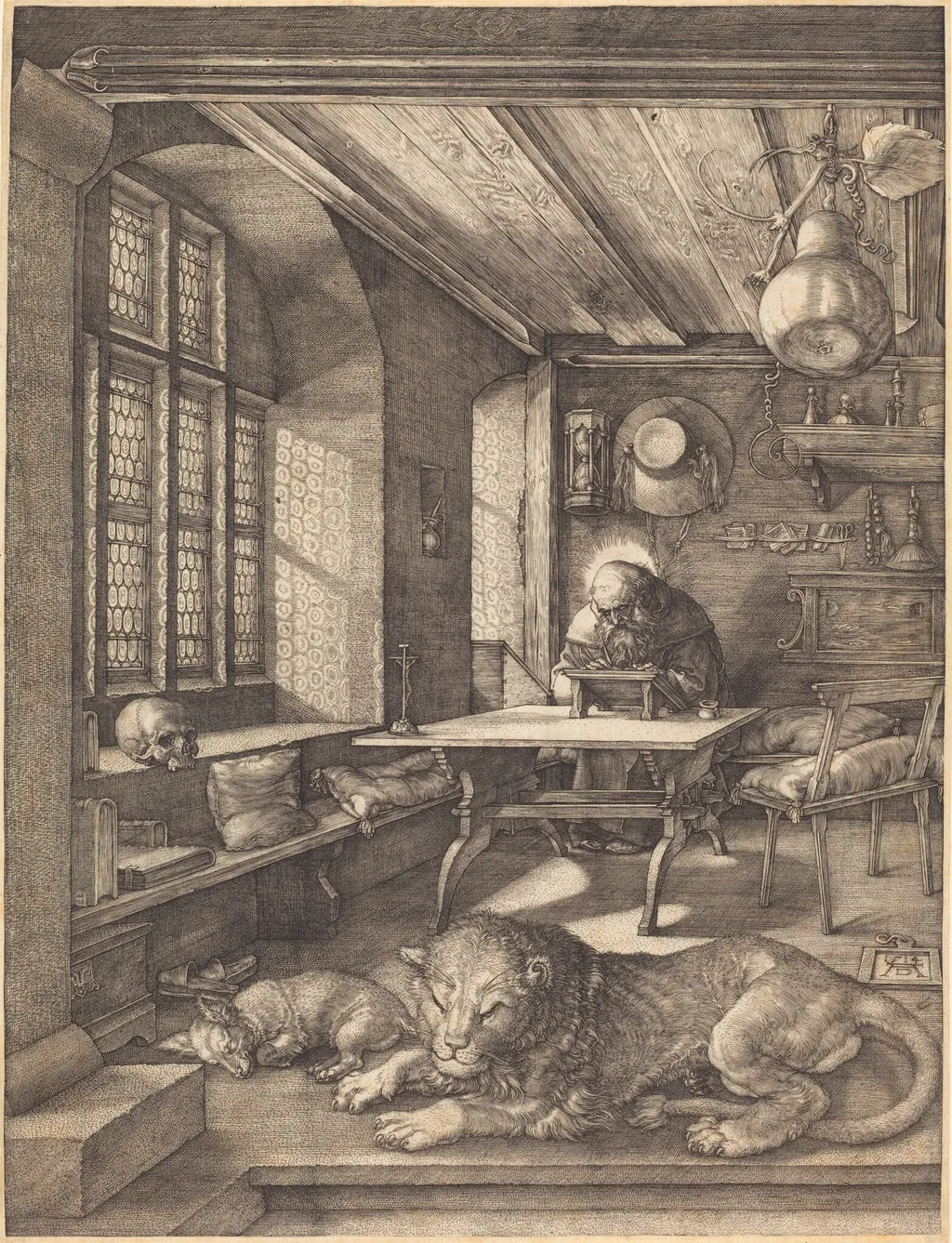
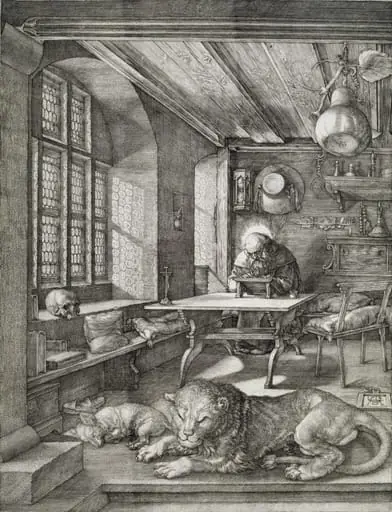
Saint Jerome in His Study is an ink print by the Northern Renaissance artist Albrecht Dürer. It dates from 1514 and is held in the collection of the National Gallery of Art.
- Inscription
- Inscribed:in plate, lower right, on tablet on floor: 1514 / AD [artist's monogram]; verso, top right, in graphite by a later hand: 1; verso, upper right, in graphite by a later hand: B.60
About this work
Subject & Meaning
The engraving depicts Saint Jerome absorbed in study and writing within a cozy, sunlit study or monastic cell.
The engraving depicts Saint Jerome absorbed in study and writing within a cozy, sunlit study or monastic cell. An imaginary line connecting Jerome's head, the crucifix on his desk, and the skull on the window ledge links death and the Resurrection, while an hourglass and a burned-out candle serve as memento mori symbols of life's transience. The foreground features a lion and a sleeping dog, creatures rooted in Jerome's hagiography in the Golden Legend; the dog symbolizes loyalty, while the lion's half-open eyes suggest vigilance.
A highly detailed pumpkin hanging from the ceiling references a philological dispute between Jerome and Augustine over the translation of the Hebrew plant name in Jonah 4. An anachronistic cardinal's hat hangs on the wall behind him.
As one of Dürer's three Meisterstiche, the work represents the theological and contemplative life, contrasting the peaceful contentment of theological study with the unrest of the creative intellect seen in Melencolia I.
Technique & Style
Executed in 1514, the engraving is cut into a copper plate with fine, controlled burin work, producing a precise matrix for ink on laid paper. The composition is organized through an eccentric single-point perspective that opens the shallow room toward the back wall; tiny objects in the distance and the hatching vary in weight to articulate textures, wood grain, fur, glass, velvet, while the saint appears absorbed in stillness. The intimate space is defined by a low threshold on which a resting lion and sleeping dog lie in the foreground, framing the scene's contemplative mood.
Symbolic objects, a crucifix, skull, hourglass, and suspended gourd, are arranged along a sight-line from Jerome's head to emphasize mortality, resurrection, and scholarly labor.
History & Provenance
The engraving Saint Jerome in His Study (1514) by Albrecht Dürer is held by the National Gallery of Art in Washington, D.C. Its provenance records that it was purchased by Lessing J. Rosenwald in 1928 and gifted to the museum in 1943. No exhibition history is documented in the provided references.
Context
Created in 1514, this engraving is universally recognized as one of Albrecht Dürer's three Meisterstiche (Master Engravings), alongside Knight, Death and the Devil (1513) and Melencolia I (1514). Scholarship frequently interprets this triad as representing the three spheres of medieval activity: the moral or active life, the intellectual, and the theological or contemplative life, respectively. Art historian Erwin Panofsky described the work's atmosphere as gemütlich (cozy) and noted its perspective creates a subjective viewpoint for an observer just entering the room, enhancing its intimate effect.
Thomas Puttfarken further argues that while the scene is close, the intimacy belongs solely to the saint, who remains engrossed in meditation rather than engaging the viewer. The print exemplifies the Northern Renaissance through its meticulous detail and complex iconography, such as the gourd referencing a philological dispute between Jerome and Augustine, solidifying Dürer's reputation for combining technical perfection with deep humanist scholarship.
Legacy
Saint Jerome in His Study is recognized as one of Albrecht Dürer's three Meisterstiche, a group that art historians use to illustrate the medieval division of intellectual activity into moral, theological, and contemplative spheres. The engraving's dense symbolism, crucifix, skull, hourglass, lion, and dog, has been repeatedly analyzed for its theological import, with Erwin Panofsky and Thomas Puttfarken emphasizing its intimate perspective and the way it isolates the saint's contemplative focus. Contemporary scholarship notes the work's lasting impact on the reception of Dürer's printmaking and its role as a visual model for the ideal scholar.
The image is held in several major collections, reinforcing its canonical status in the history of Northern Renaissance art.
Overview
Albrecht Dürer's 1514 engraving, Saint Jerome in His Study, depicts the revered scholar-saint immersed in his work. This print, executed on laid paper, offers an intimate glimpse into Jerome's contemplative world. The detailed composition showcases Dürer's mastery of the engraving technique, presenting a scene rich with symbolic elements and a sense of quiet scholarly devotion.
Own this work as a print
Artist & collection
Artist
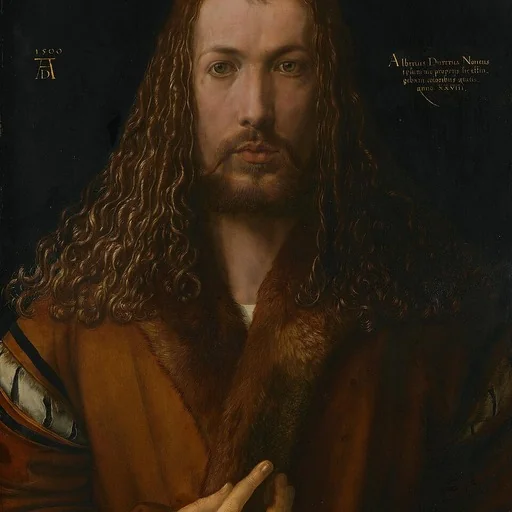
Albrecht Dürer spent his life in Nuremberg, a busy German city where artists traded prints like currency.

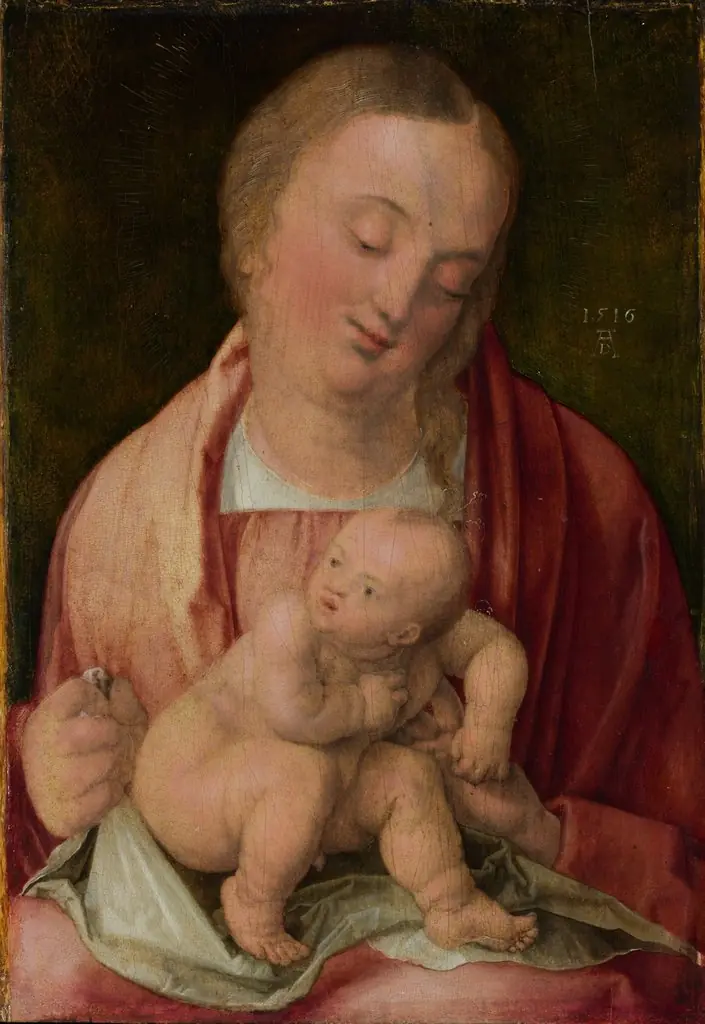
![Madonna and Child [obverse], by Albrecht Dürer](https://artifactworldgallery.com/img/albrecht-durer--madonna-and-child-obverse--d7b8ebf05d22ebe5-w320.webp)
![Lot and His Daughters [reverse], by Albrecht Dürer](https://artifactworldgallery.com/img/albrecht-durer--lot-and-his-daughters-reverse--b4ebf9b282faa17a-w320.webp)