Artwork
Saints Stephen, Sixtus, and Lawrence
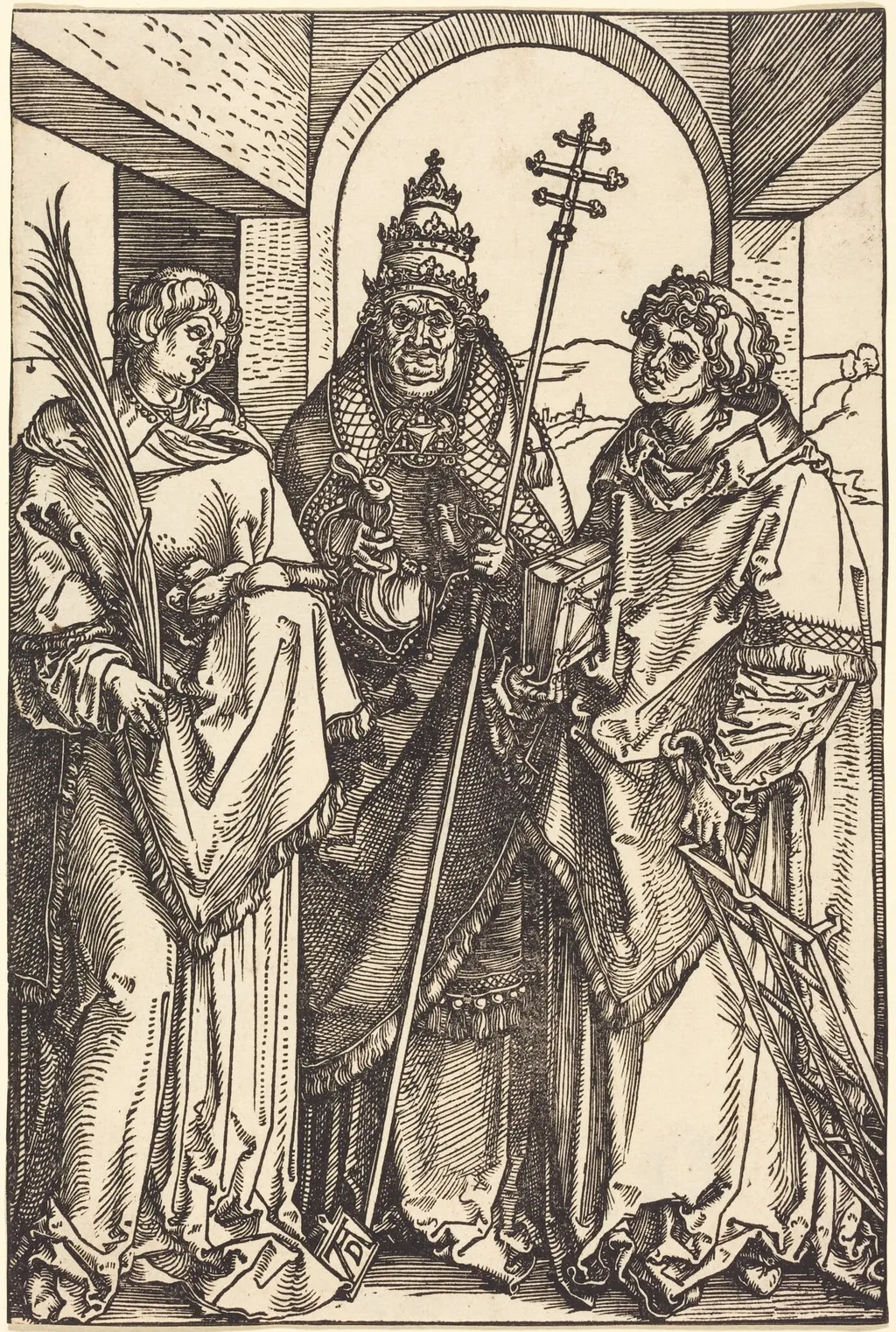
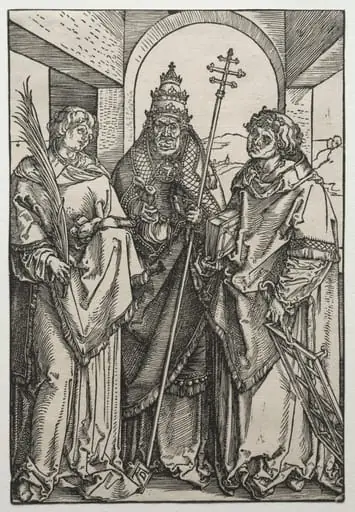
Saints Stephen, Sixtus, and Lawrence is an ink print by the Northern Renaissance artist Albrecht Dürer. It dates from 1504 and is held in the collection of the National Gallery of Art.
- Inscription
- Inscribed:in block, bottom center, on tablet: AD [artist's monogram]; verso, lower left, in graphite by a later hand: 9 [?] [obscured by old hinge]; verso, bottom left, in graphite by a later hand: B-19798; verso, bottom left, in graphite by a later hand: B.5887-85
- Markings
- Marked:Budapest Duplicate, NGA (not Rosenwald)
About this work
Subject & Meaning
The print portrays three early Christian martyrs, Saint Stephen, Saint Sixtus, and Saint Lawrence, identified by their traditional attributes of martyrdom.
The print portrays three early Christian martyrs, Saint Stephen, Saint Sixtus, and Saint Lawrence, identified by their traditional attributes of martyrdom. Their presence reflects the shared theme of steadfast faith under persecution, a common subject in German Renaissance religious imagery. The composition emphasizes their individual sanctity while uniting them in a collective witness to Christian witness.
Technique & Style
Albrecht Dürer created this 1504 woodcut on paper using ink. The work measures 21.1 cm in height and 14.2 cm in width and originates from Nuremberg. It depicts the saints Lawrence of Rome, Sixtus II, and Stephen, rendered with precise line work characteristic of German Renaissance printmaking.
The print is held in the National Gallery of Art’s collection and has been documented in several museum holdings.
The composition balances the figures within a tightly framed space, employing stark contrasts of black ink on white paper to emphasize the texture of the woodcut medium. This technique highlights the formal qualities of the print, showcasing Dürer’s mastery of line and detail in depicting religious subjects.
History & Provenance
Albrecht Dürer created the woodcut Saints Stephen, Sixtus, and Lawrence in 1504 in Nuremberg. While some records suggest a potential inception range extending into 1505, the primary dating remains 1504. A specific ownership trajectory is documented for one impression of this print, which belonged to Addie Burr Clark of New York by the mid-20th century.
Upon Clark's death in 1946, the work passed by descent to Jane C. Carey. In 1951, Carey gifted the print to the National Gallery of Art in Washington, D.C., where it entered the permanent collection. Other impressions are held by institutions such as the Cleveland Museum of Art and the Metropolitan Museum of Art.
The woodcut is held by the National Gallery of Art in Washington, D.C., which received it as a gift from Jane C. Carey in 1951. Carey had acquired the work by descent from Addie Burr Clark. Prior to entering the National Gallery of Art, the print belonged to the Museum of Fine Arts, Budapest, which held it as a duplicate.
Additional impressions of the print reside in the collections of the Cleveland Museum of Art and the Metropolitan Museum of Art.
Overview
Albrecht Dürer’s woodcut, dated around 1504, presents three early Christian martyrs, Saint Stephen, Saint Sixtus, and Saint Lawrence, arranged in a solemn, linear composition. Executed on laid paper, the print exemplifies Dürer’s precise handling of line and his interest in rendering fabric and form with a delicate, almost tactile quality.
Context
The work reflects the period’s renewed interest in hagiographic subjects, aligning with the Catholic Church’s emphasis on martyr narratives. Dürer’s approach combines the detailed observation of his drawings with the reproducibility of print, allowing the image to reach a wider audience than a painted altarpiece.
Legacy
Dürer’s treatment of the three saints influenced subsequent German printmakers, who adopted his careful line work and compositional balance. The print continues to be studied for its technical mastery and its role in the dissemination of religious iconography in the early modern era.
Own this work as a print
Artist & collection
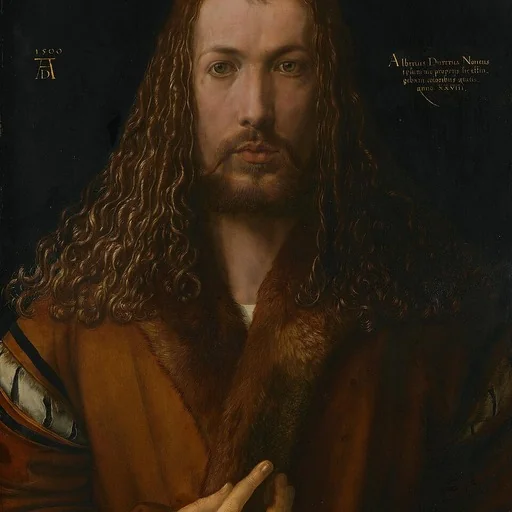
Artist
Albrecht Dürer spent his life in Nuremberg, a busy German city where artists traded prints like currency.

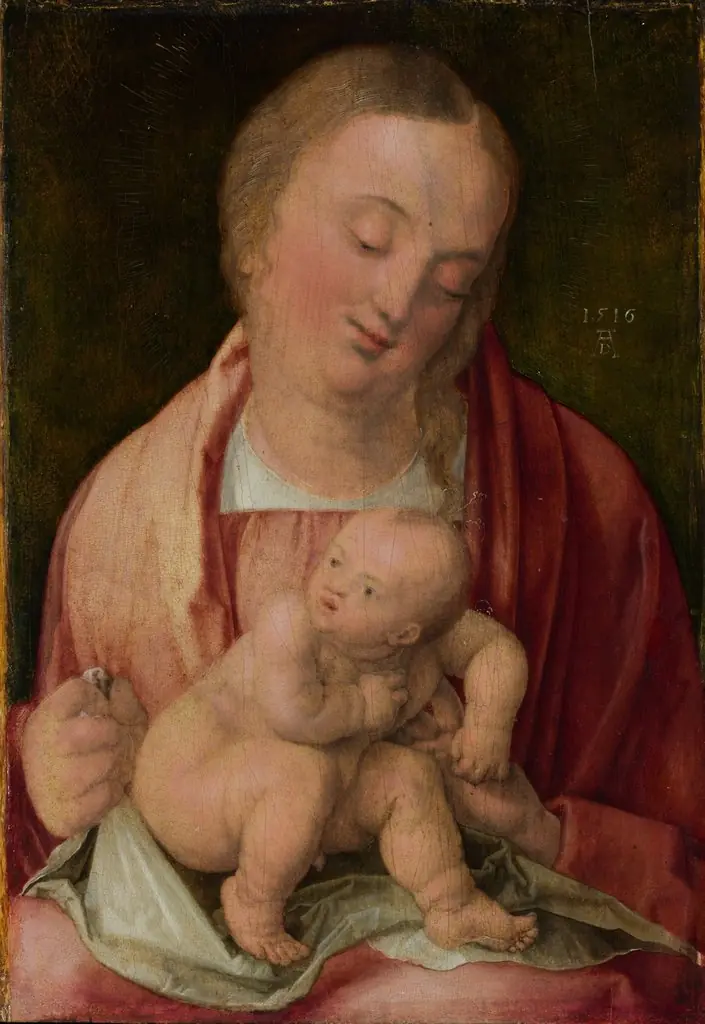
![Madonna and Child [obverse], by Albrecht Dürer](https://artifactworldgallery.com/img/albrecht-durer--madonna-and-child-obverse--d7b8ebf05d22ebe5-w320.webp)
![Lot and His Daughters [reverse], by Albrecht Dürer](https://artifactworldgallery.com/img/albrecht-durer--lot-and-his-daughters-reverse--b4ebf9b282faa17a-w320.webp)