Artwork
The Fall of Man
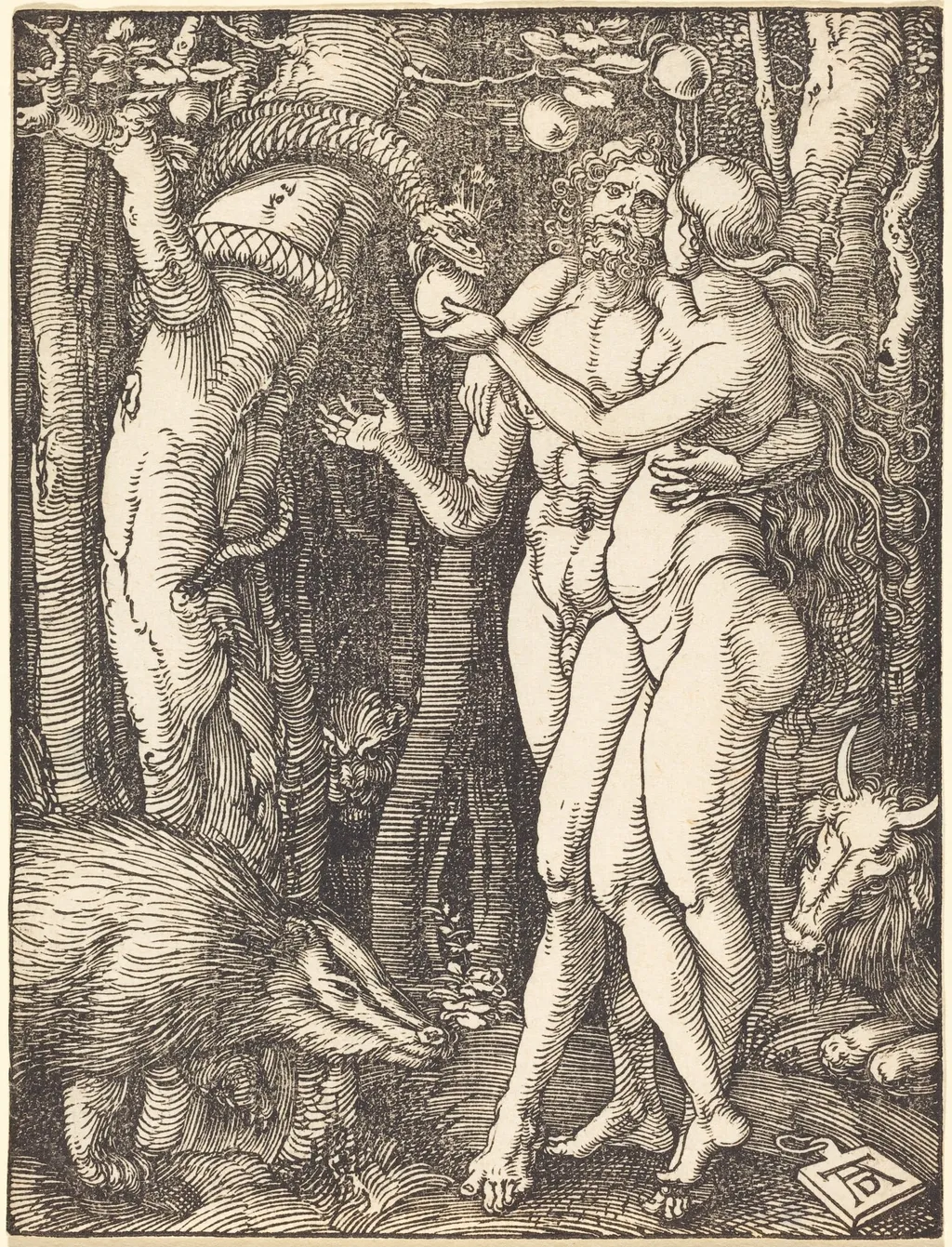
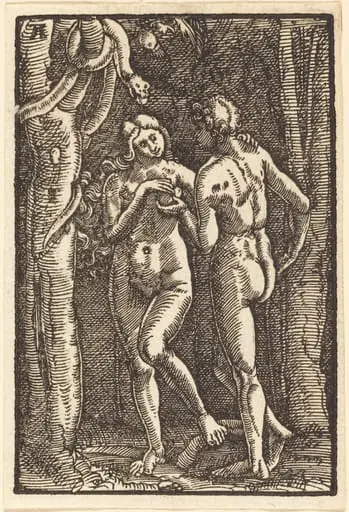
The Fall of Man is an ink print by the Northern Renaissance artist Albrecht Dürer. It dates from 1510 and is held in the collection of the British Museum.
- Inscription
- Inscribed:in block, bottom right: AD [on tablet]; verso, bottom left, in graphite by a later hand: 17
About this work
Subject & Meaning
Albrecht Dürer's 1509 woodcut The Fall of Man illustrates the biblical narrative of original sin derived from the Old Testament.
Albrecht Dürer's 1509 woodcut The Fall of Man illustrates the biblical narrative of original sin derived from the Old Testament. The composition features Adam and Eve as the central figures, capturing the moment of humanity's disobedience. As a work of religious art within the German Renaissance, the print serves as a visual representation of the theological concept of the fall, emphasizing the loss of innocence.
This specific sheet belongs to Dürer's series known as the Little Passion, where it functions as a devotional image reflecting on the origins of human sinfulness.
Technique & Style
Albrecht Dürer created The Fall of Man in 1509 as a woodcut on laid paper, a technique characteristic of the German Renaissance. The print measures 12.9 cm in height and 9.8 cm in width. As a religious work depicting Adam and Eve, the piece utilizes the woodcut medium to render the narrative of original sin with the precise line work typical of Dürer's printmaking style. The work is part of the series known as the Little Passion.
History & Provenance
Albrecht Dürer created the woodcut The Fall of Man in 1509 as part of his Little Passion series. The work depicts Adam and Eve in the context of the original sin, drawing on Old Testament narratives. Its provenance begins with Joseph Daniel Böhm of Vienna, followed by Robert Scholtz of Budapest.
The print later passed through the collection of William Schab in New York before being purchased by Lessing J. Rosenwald in Jenkintown, Pennsylvania, in 1940. Rosenwald subsequently gifted the artwork to the National Gallery of Art in Washington, D.C., in 1943, where it remains part of the Rosenwald Collection.
The Fall of Man is held in the National Gallery of Art, Washington, D.C., where it is catalogued under accession number 1943.1.1. It entered the collection through the gift of Lessing J. Rosenwald in 1943, following his purchase in 1940 from William Schab in New York. Its earlier provenance includes Joseph Daniel Böhm of Vienna and Robert Scholtz of Budapest.
The work has been exhibited as part of the Rosenwald Collection and has appeared in exhibitions at the National Gallery of Art and the Metropolitan Museum of Art.
Context
The work is recognized as a seminal example of the Little Passion series, reflecting Dürer's mastery of printmaking and his engagement with the German Renaissance movement. Scholars highlight its theological precision and compositional innovation in depicting original sin, situating it within the broader trajectory of his religious imagery. The print's provenance traces from Böhm to Rosenwald, underscoring its significance in European collections before its acquisition by the National Gallery of Art in 1943.
Its enduring scholarly attention stems from its technical brilliance and thematic depth in the visual interpretation of biblical narratives.
Overview
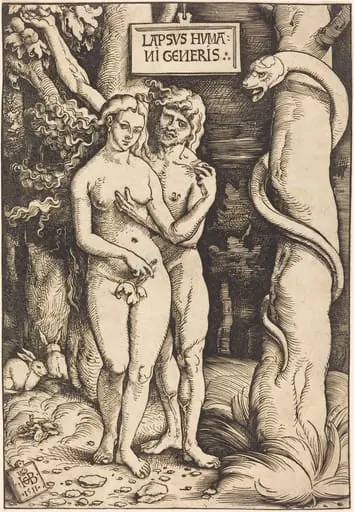
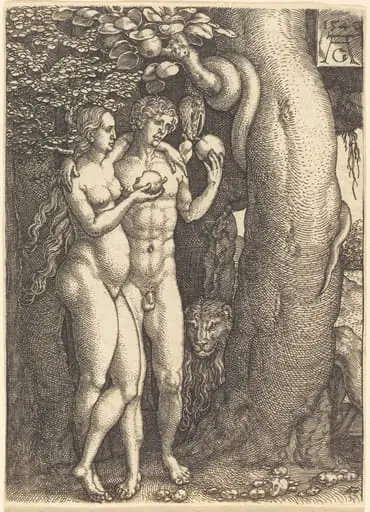
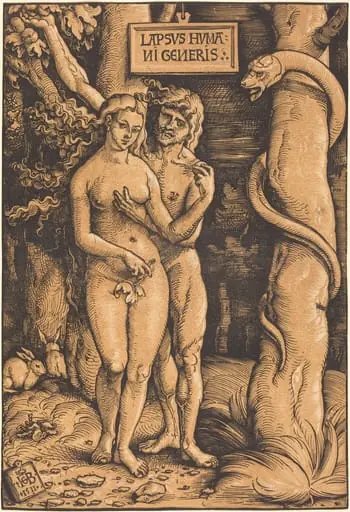
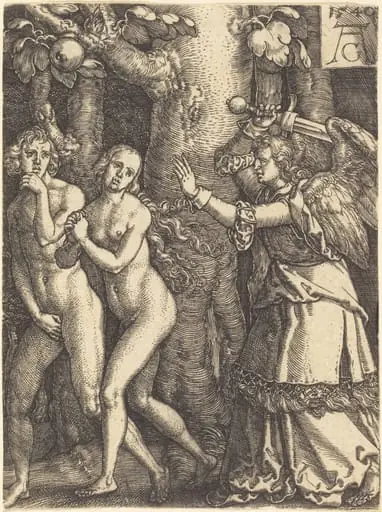
Albrecht Dürer’s woodcut entitled The Fall of Man, executed around 1510, presents a biblical scene on a sheet of laid paper. The print portrays the first humans, Adam and Eve, within a forest setting, illuminated by scattered shafts of light. The composition is notable for its tranquil atmosphere, where surrounding creatures, including a coiled serpent, appear calm rather than tumultuous.
Own this work as a print
Artist & collection
Artist
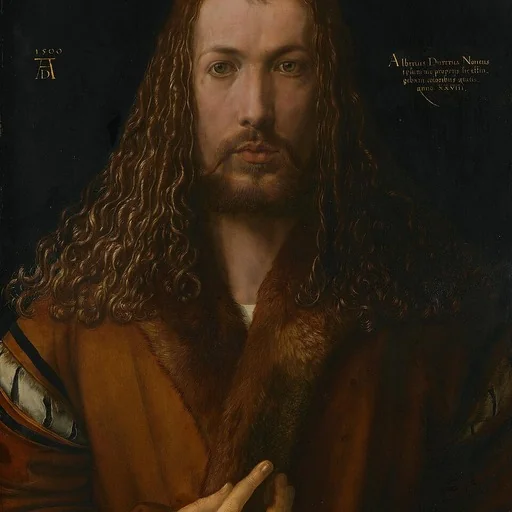
Albrecht Dürer spent his life in Nuremberg, a busy German city where artists traded prints like currency.

![Madonna and Child [obverse], by Albrecht Dürer](https://artifactworldgallery.com/img/albrecht-durer--madonna-and-child-obverse--d7b8ebf05d22ebe5-w320.webp)
![Lot and His Daughters [reverse], by Albrecht Dürer](https://artifactworldgallery.com/img/albrecht-durer--lot-and-his-daughters-reverse--b4ebf9b282faa17a-w320.webp)