Artwork
Witch Riding on a Goat
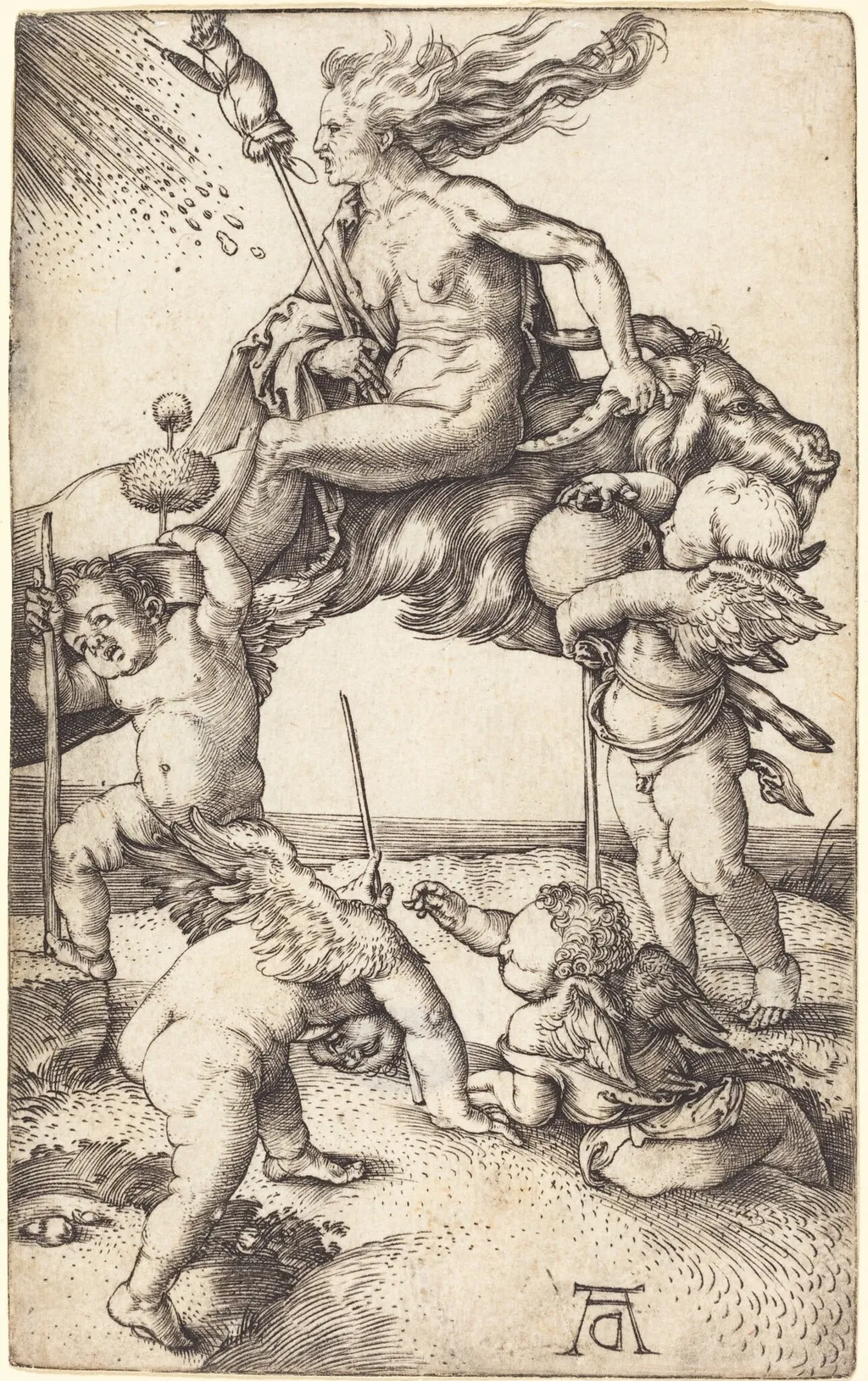
Witch Riding on a Goat is an ink print by the Northern Renaissance artist Albrecht Dürer. It dates from 1500 and is held in the collection of the Herzog Anton Ulrich Museum.
- Inscription
- Inscribed:in plate, lower right: AD [artist's monogram, reversed D]; verso, left center, in graphite by a later hand: C.10518; verso, lower left, in graphite by a later hand: C [?] d [?] c [?]; verso, lower left, in graphite by a later hand: B / 67; verso, lower left, in graphite by a later hand: 94 [?]; verso, lower left, in graphite by a later hand: u [?]; verso, lower right, in graphite by a later hand: B 67; verso, lower center, in graphite by a later hand: 76 [upside down]; verso, bottom center, in graphite by a later hand: 67; verso, lower left, in graphite by a later hand: B'' [?]
- Markings
- Marked:none
About this work
Albrecht Dürer’s Witch Riding a Goat shows a bony witch in mid-air, legs spread, riding backward on a scrawny goat.
Albrecht Dürer’s Witch Riding a Goat shows a bony witch in mid-air, legs spread, riding backward on a scrawny goat. Her wild hair and tattered dress flutter behind her. The goat looks uneasy, as if it knows the ride’s bad news.
Dürer carved this in 1501 using fine lines and tiny cross-hatches. That method makes shadows look real. The small devil-child below adds a creepy joke, like the witch’s failed magic.
See it close up at the National Gallery of Art, Washington.
Subject & Meaning
The print shows a naked, emaciated woman riding a hybrid capricorn creature, symbolizing a witch in a chaotic, demonic inversion of natural order. Her hair flies against the wind, and four putti at her feet are immobilized, suggesting entrapment by magic. This scene reflects contemporary German fascination with witchcraft and demonology, with Dürer drawing on Andrea Mantegna’s depiction of a similarly gaunt figure. The D in the artist’s monogram appears reversed, reinforcing the theme of disrupted order.
The work was created in Nuremberg around 1500 and quickly influenced contemporaries such as Marcantonio Raimondi and Agostino Veneziano, who copied its composition.
Technique & Style
Created around 1500, this work is a copper engraving executed on laid paper. The print measures approximately 11.4 cm in height and 7 cm in width. Stylistically, the composition depicts a diabolical inversion of natural laws, featuring a naked, emaciated witch riding backward on a capricorn, a hybrid creature with the body of a goat and the tail of a fish. The scene includes four putti grounded by a curse, while the witch's hair flies contrary to the expected direction of movement. A distinctive formal element is the artist's monogram, where the letter 'D' appears reversed to signify this world turned upside down. The figure of the witch draws inspiration from Andrea Mantegna's depiction of an aged nude woman in his Battle of Sea Gods.
History & Provenance
The work was created by Albrecht Dürer in Nuremberg around 1500 as an engraving on laid paper, part of his exploration of mythological themes during the German Renaissance. Its early ownership passed through several documented collectors: Giuseppe Archinto of Milan (active 1783-1861), documented in 1783; Alfred Morrison of London and Fonthill (1821-1897); the Langmaak Collection in Hamburg (catalogued as Lugt 2801a); and Lessing J. Rosenwald (1891-1979) of Jenkintown, Pennsylvania (catalogued as Lugt 1760b and Lugt 1932d). In 1943, Rosenwald gifted the piece to the National Gallery of Art in Washington, D.C., where it remains in the institution's collection as part of the Rosenwald Collection. The print depicts a witch astride a hybrid goat-fish creature known as a putto, a motif rooted in contemporary German demonological imagery, with the artist’s monogram subtly reversed in the composition. Dürer drew on Renaissance influences, particularly the figure of a withered woman from Andrea Mantegna’s works, to construct a scene of cosmic inversion. This engraving, titled *Witch Riding on a Goat*, reflects Dürer’s engagement with supernatural themes and his technical mastery of printmaking, marking a significant example of mythological subject matter in Northern European art. The engraving is held by the National Gallery of Art in Washington, D.C., where it entered the collection in 1943 as part of the Rosenwald Collection. Its provenance traces back through the collections of Giuseppe Archinto in Milan, Alfred Morrison in London, and the Langmaak Collection in Hamburg before reaching Lessing J. Rosenwald in Jenkintown, Pennsylvania. While the National Gallery of Art holds a specific impression, other institutions such as the Chester Beatty Library, the Germanisches Nationalmuseum, the Metropolitan Museum of Art, and the British Museum also possess copies of this work. The provided sources do not list specific inventory numbers or a detailed exhibition history for any of these holdings.
Context
Created around 1500, *Witch Riding on a Goat* exemplifies the German Renaissance's engagement with demonology and the inversion of natural laws. The work depicts a diabolical disorder where a skeletal witch rides a capricorn, causing hail and reversing the direction of her hair, while the artist's monogram itself appears mirrored. Scholars note that Dürer derived the witch's emaciated features from Andrea Mantegna's *Battle of the Sea Gods*, integrating Italian influences into a distinctly Germanic context. The engraving achieved immediate notoriety and was rapidly copied by contemporaries. It served as a direct source of inspiration for Marcantonio Raimondi and Agostino Veneziano, who referenced its imagery in works such as *The Corpse* (c. 1520-1530). This rapid dissemination underscores the print's significance within early 16th-century artistic discourse.
Legacy
The engraving has remained a reference point for how later artists approached the visual representation of witchcraft and supernatural inversion. Dürer’s striking composition, featuring a naked witch riding a hybrid capricorn on a stormy backdrop, was rapidly copied and served as a model for printmakers such as Marcantonio Raimondi and Agostino di Musi. Their works, produced around 1520-1530, explicitly borrowed the motif of the witch on a goat and the reversal of natural order that Dürer had pioneered. The image continued to circulate in collections across Europe, influencing both contemporary and modern interpretations of the witch figure in printmaking.
Own this work as a print
Artist & collection
Artist
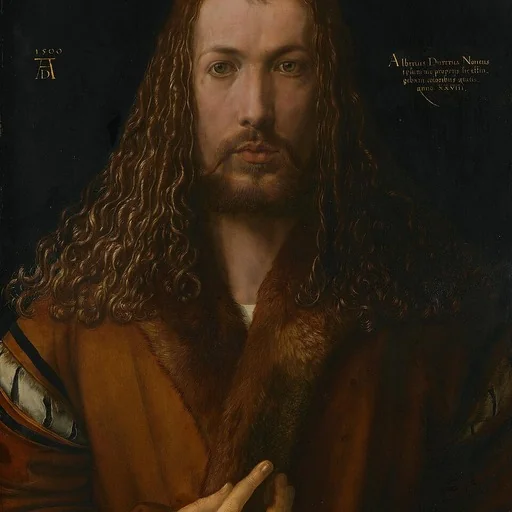
Albrecht Dürer spent his life in Nuremberg, a busy German city where artists traded prints like currency.

![Madonna and Child [obverse], by Albrecht Dürer](https://artifactworldgallery.com/img/albrecht-durer--madonna-and-child-obverse--d7b8ebf05d22ebe5-w320.webp)
![Lot and His Daughters [reverse], by Albrecht Dürer](https://artifactworldgallery.com/img/albrecht-durer--lot-and-his-daughters-reverse--b4ebf9b282faa17a-w320.webp)