Artwork
Des oeufs de Pâques longs â couver
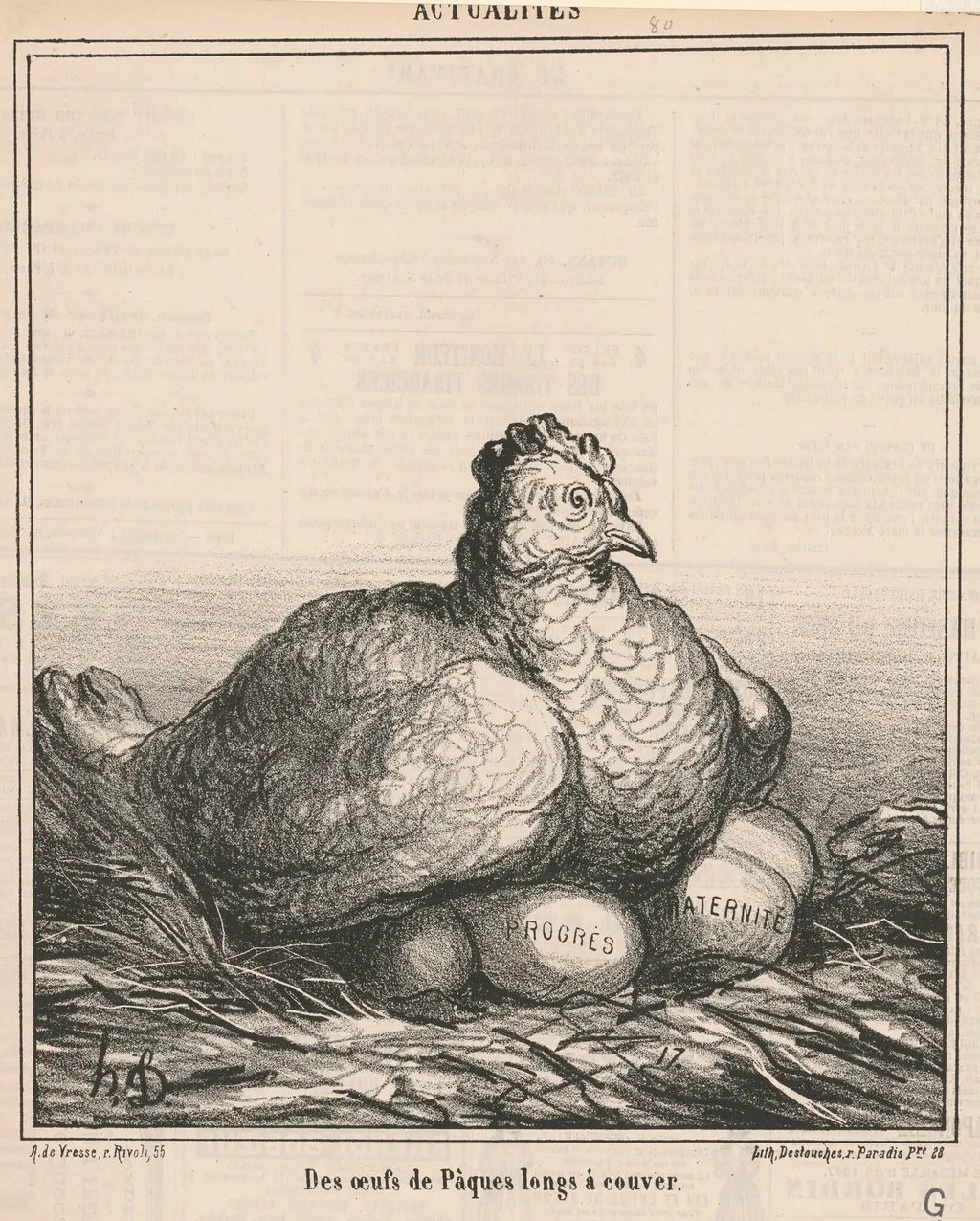
Des oeufs de Pâques longs â couver is an ink print by the Impressionist artist Honoré Daumier. It dates from 1868 and is held in the collection of the National Gallery of Art.
About this work
Overview
Honoré Daumier’s 1868 lithograph, titled Des œufs de Pâques longs à couver, presents a solitary hen perched on a nest of eggs. Each egg bears a single word, such as “PROGRÈS” and “FRATERNITÉ”, rendered in a simple, handwritten script. The composition is rendered in stark black lines against an unadorned background, focusing attention on the bird and its fragile cargo.
Subject & Meaning
The hen, rendered with meticulous feather detail, serves as a neutral observer while the inscribed words on the eggs reference the optimistic slogans of the Second French Empire and early Third Republic. By pairing a domestic, nurturing animal with abstract ideals, Daumier hints at the precariousness of political promises and the way societal hopes are incubated, yet remain vulnerable.
Technique & Style
Executed as a lithographic print, the work relies on bold, confident lines and subtle cross‑hatching to model the hen’s plumage and the texture of the eggs. Daumier’s use of contrast, dark outlines against a plain surface, creates a graphic clarity that emphasizes the textual elements while preserving a sense of immediacy characteristic of his satirical prints.
History & Provenance
Created in 1868, the lithograph belongs to a prolific period when Daumier produced numerous politically charged images for newspapers and pamphlets. It was issued as part of a series of caricatures that circulated among the literate public, reflecting contemporary debates about progress, liberty, and fraternity in post‑revolutionary France.
Context
The mid‑nineteenth century in France was marked by rapid industrialization and the rise of republican ideals, often expressed through slogans like “Liberté, Égalité, Fraternité.” Daumier’s work engages directly with this climate, using the domestic scene to critique the gap between lofty rhetoric and everyday reality.
Legacy
While less widely reproduced than Daumier’s newspaper cartoons, this lithograph exemplifies his ability to fuse humor with social critique. It continues to be cited in studies of 19th‑century French political art as an illustration of how visual satire can comment on the fragility of collective aspirations.
Own this work as a print
Artist & collection
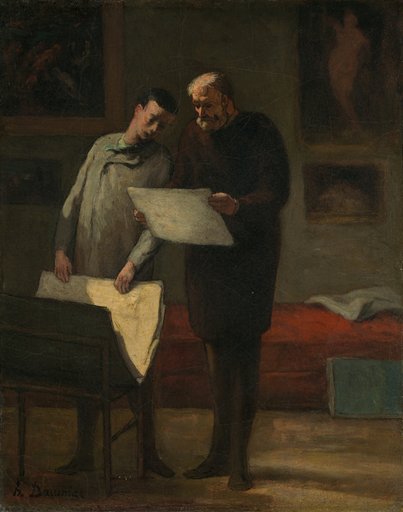
Artist
Honoré-Victorin Daumier (French: ; 26 February 1808 – 10 or 11 February 1879) was a French painter, sculptor, and printmaker, whose many works offer commentary on the social and political life in France, from the…