Artwork
Feast of the Gods
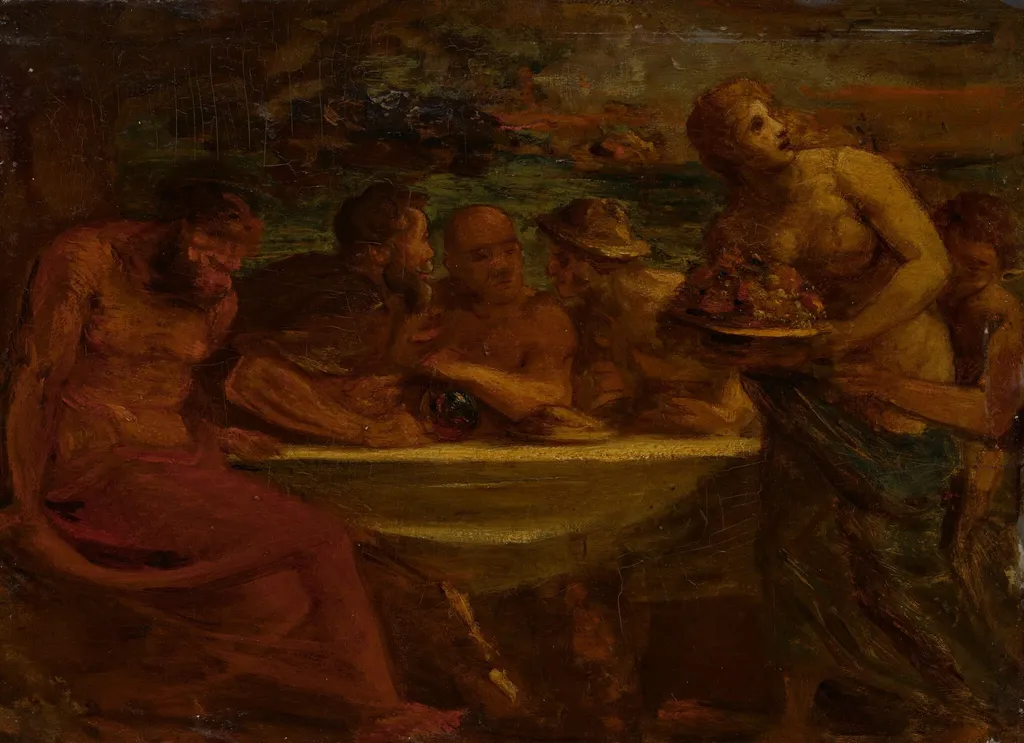
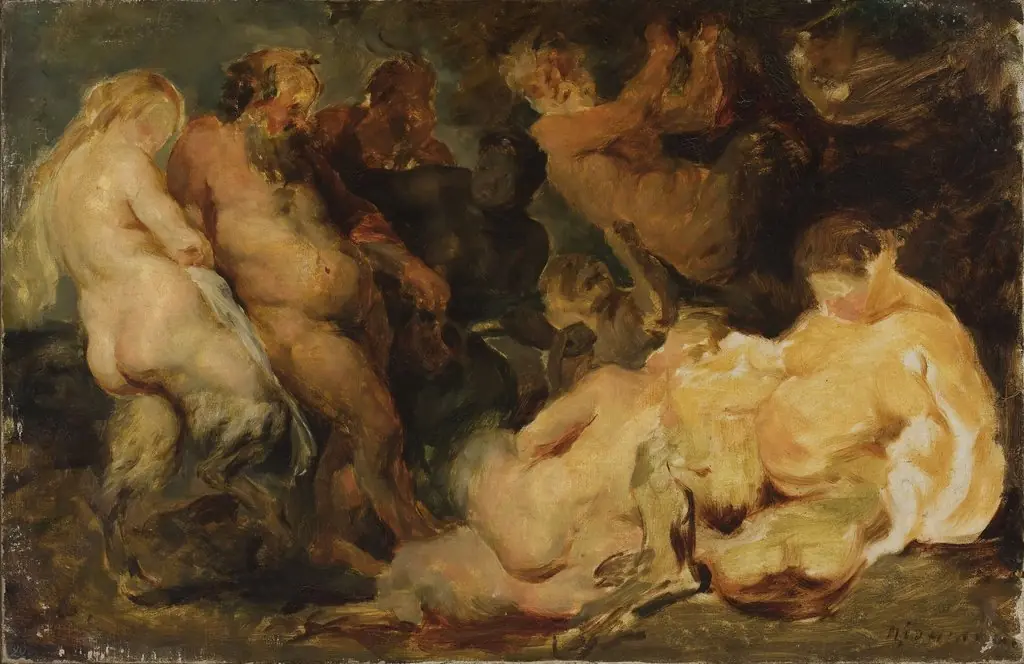
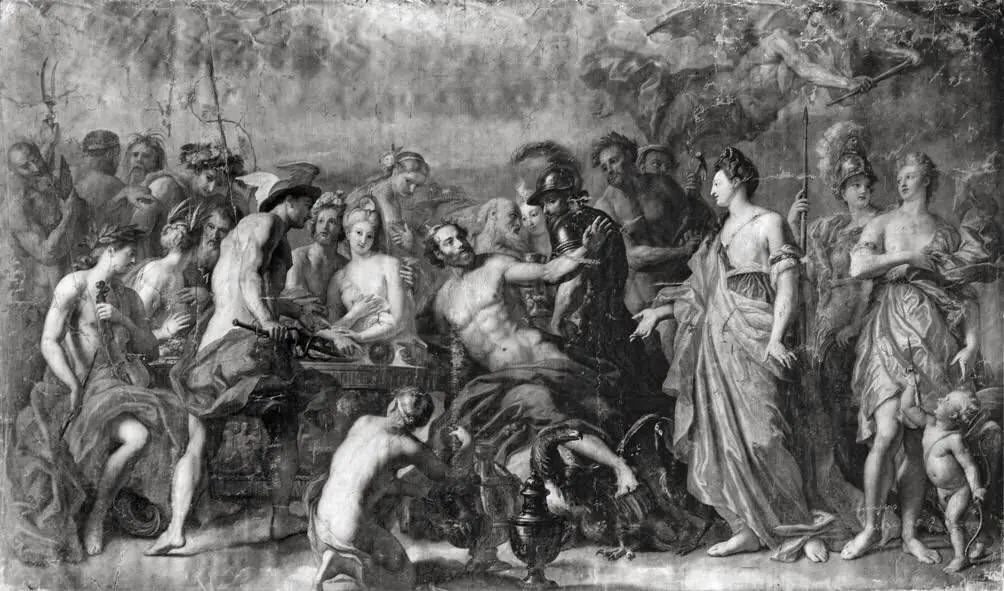
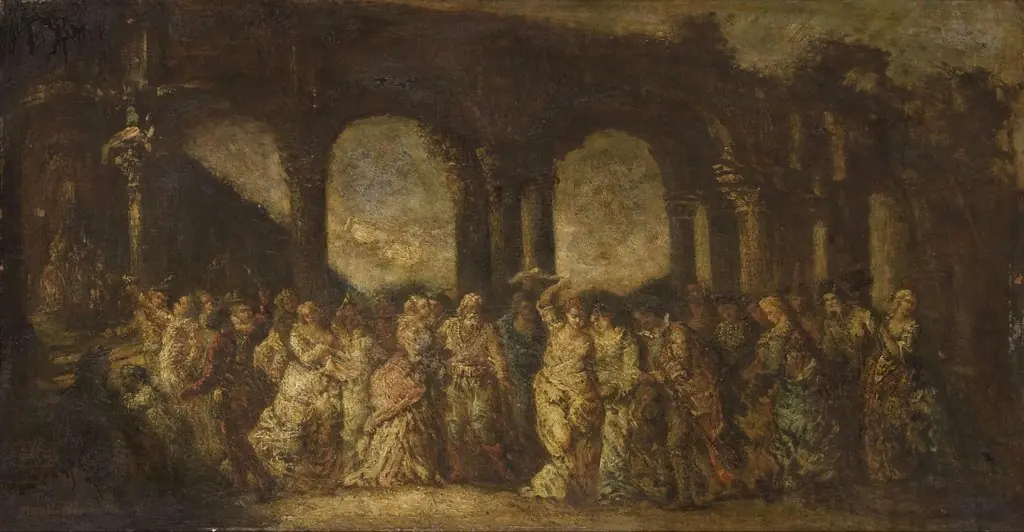
Feast of the Gods is an oil painting by the Realist artist Honoré Daumier. It dates from 1850 and is held in the collection of the National Gallery of Art.
About this work
Subject & Meaning
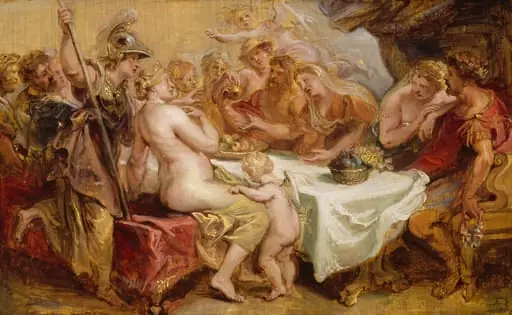
The work portrays a convivial banquet populated by mythological figures, centering on the Greek god Bacchus amid reveling companions. Daumier’s composition draws on classical iconography of feasting deities, using the banquet as an allegory for excess and social commentary. The painting’s theme underscores the satirical critique of bourgeois leisure that runs through much of the artist’s oeuvre.
History & Provenance
It was lent by Ackermann to an exhibition in Saint Petersburg in 1912 and by Skaller to the Galerie Matthiesen in Berlin in 1926.
The painting was commissioned by the dealer and collector Otto Ackermann in Paris by 1908 and remained in his possession at least until 1912, when it was lent to an exhibition in Saint Petersburg. It was later owned by Julius Meier-Graefe in Berlin before passing to Oskar Skaller, also in Berlin, by 1926. Skaller lent the work to a 1926 exhibition at the Galerie Matthiesen. It next entered the collection of François Monod in Paris.
By 1930, the painting was in the United States with Lessing J. Rosenwald, who gifted it to the National Gallery of Art, Washington, D.C., in 1943.
The painting is currently held in the collection of the National Gallery of Art in Washington, D.C., where it was accessioned in 1943 as a gift from Lessing J. Rosenwald. Prior to this donation, the work passed through the hands of several private collectors, including O. Ackermann in Paris, Julius Meier-Graefe in Berlin, and Oskar Skaller, also in Berlin. By 1930, it was in the possession of François Monod in Paris before Rosenwald acquired it in Jenkintown, Pennsylvania.
The work has a documented exhibition history spanning the early twentieth century. It was lent by Ackermann to an exhibition in Saint Petersburg in 1912 and by Skaller to the Galerie Matthiesen in Berlin in 1926. Additionally, Lessing J. Rosenwald lent the piece to the Museum of Modern Art for an exhibition in 1930.
Legacy
Feast of the Gods exerted limited but documented influence through exhibitions that shaped its provenance and scholarly attention. Its inclusion in the 1912 Saint Petersburg exhibition, facilitated by its then-owner Ackermann, marked an early public appearance beyond private collections.
Subsequent lendings to major institutions, such as the 1926 Galerie Matthiesen exhibition in Berlin and the 1930 showing at the Museum of Modern Art via Lessing J. Rosenwald's loan, contributed to its visibility within modernist and post-impressionist discourse. These exhibitions, alongside its acquisition by the National Gallery of Art in 1943, established its institutional presence and facilitated later study of Daumier's late works and stylistic experimentation.
The painting's legacy remains anchored in its role as a representative example of Daumier's genre scenes and his exploration of historical and satirical themes through narrative composition.
Overview
Created around 1850, this oil-on-wood work by French artist Honoré Daumier depicts a convivial gathering around a table. The composition is illuminated by a warm, golden glow that highlights a woman in a deep red dress presenting a fruit platter, while the surrounding figures, dressed in muted browns and beiges, share the feast in a dimly lit interior.
Technique & Style
Executed in the realist tradition, the painting employs soft lighting and a limited, warm palette to convey intimacy. The careful rendering of textures, such as the sheen of the fruit and the folds of the garments, demonstrates Daumier's skill in translating observational detail onto a wooden support.
Context
At the time of its creation, Daumier was chiefly known for caricatures published in periodicals like La Caricature and Le Charivari. While his satirical prints targeted the monarchy, aristocracy, and clergy, this canvas extends his critical eye to the realm of domestic and social rituals, reflecting the realist movement’s focus on unembellished contemporary life.
Own this work as a print
Artist & collection
Artist
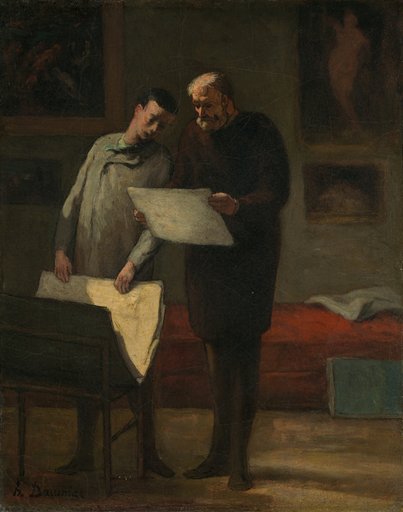
Honoré-Victorin Daumier (French: ; 26 February 1808 – 10 or 11 February 1879) was a French painter, sculptor, and printmaker, whose many works offer commentary on the social and political life in France, from the…