Artwork
The Third-Class Carriage
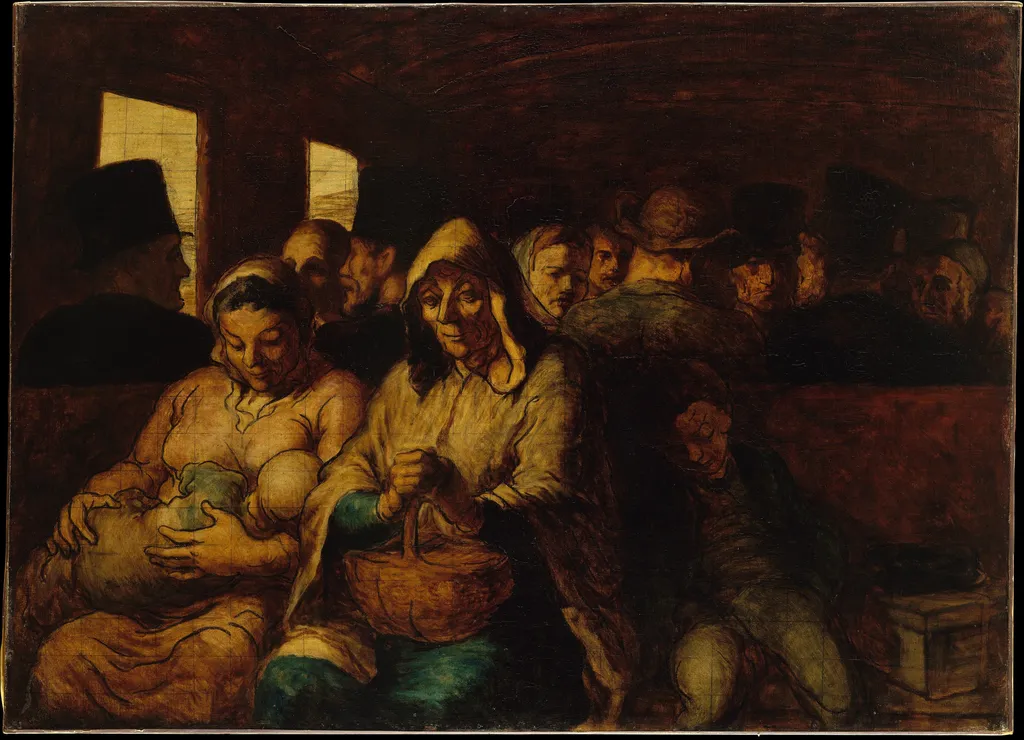
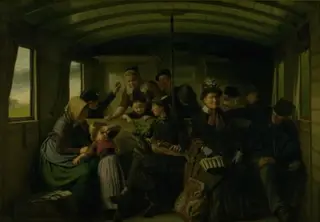
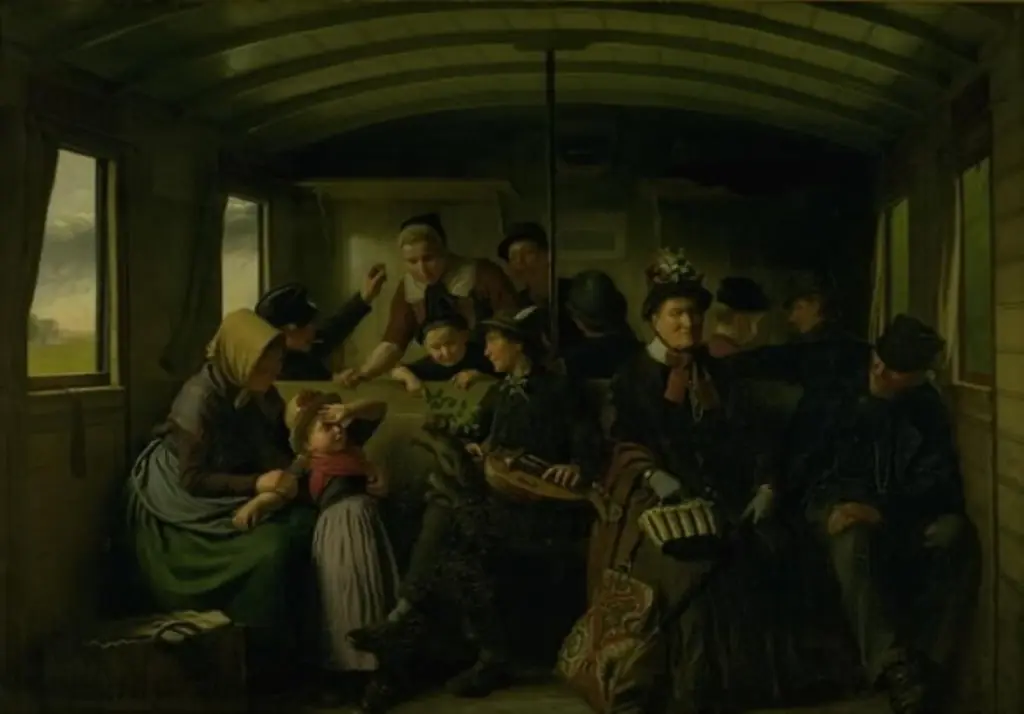
The Third-Class Carriage is an oil painting by the Realist artist Honoré Daumier. It dates from 1862 and is held in the collection of the Metropolitan Museum of Art.
About this work
Subject & Meaning
Influenced by Jean-François Millet’s peasant imagery, the figures’ unidealized forms reject academic refinement, instead conveying dignity amid deprivation.
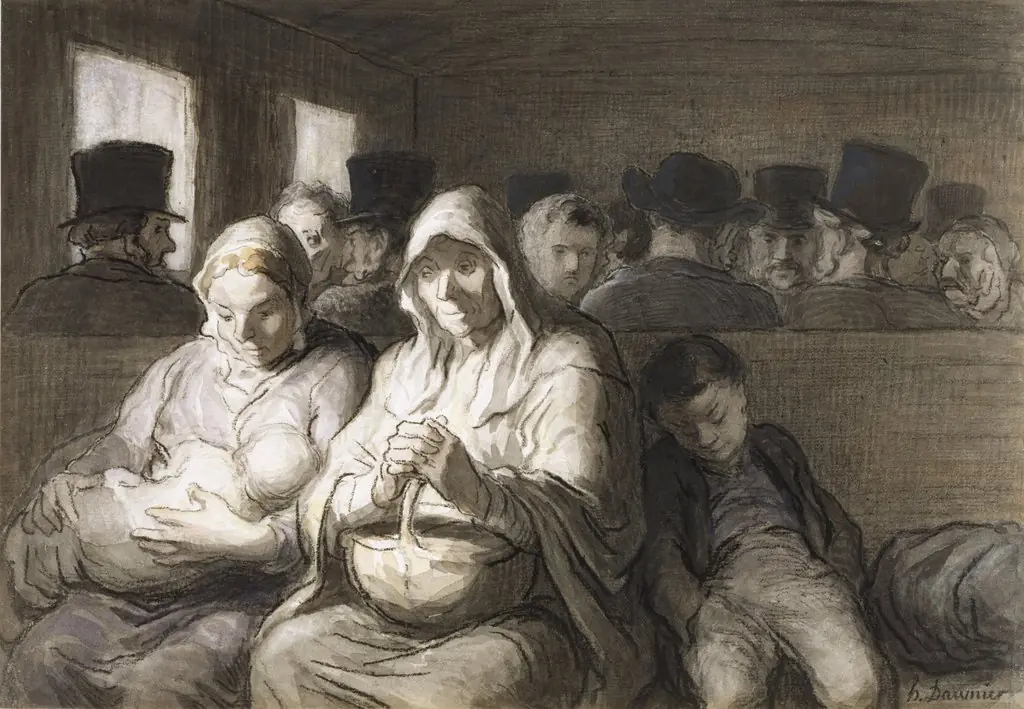
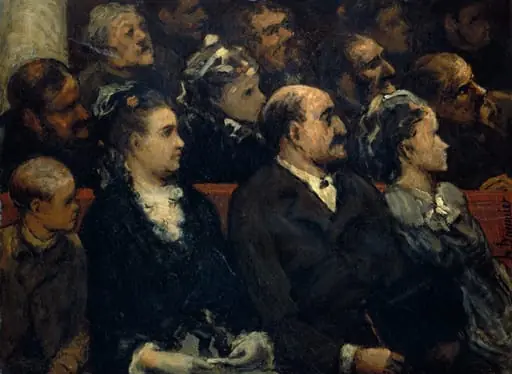
Daumier’s The Third-Class Carriage depicts the harsh realities of working-class life during France’s mid-19th-century industrial expansion. The paintings center on anonymous travelers in crowded, unadorned railway compartments, emphasizing their physical and social marginalization. A nursing mother, an elderly woman clutching a basket, and a sleeping child occupy the foreground, their exhaustion and resignation underscoring the economic disparities of rail travel.
Background figures, men and women in worn attire, further highlight the collective hardship of third-class passengers, who endured cramped, unheated spaces with minimal comfort. The iconography reflects Daumier’s broader engagement with social critique, aligning with French Realism’s focus on contemporary inequities. Influenced by Jean-François Millet’s peasant imagery, the figures’ unidealized forms reject academic refinement, instead conveying dignity amid deprivation.
The recurring theme across multiple versions (c. 1856–1865) reinforces the work’s symbolic power: the railway carriage becomes a microcosm of societal neglect, where the poor bear the burdens of modernity.
Technique & Style
Honoré Daumier executed at least three versions of this subject using oil paint, employing different supports to varying effect. The Metropolitan Museum of Art holds an unfinished canvas (c. 1862–1864) measuring 65.4 × 90.2 cm, which retains visible squaring marks and black outlines intended for transfer, indicating a preparatory stage. A completed companion piece on canvas of identical dimensions resides in the National Gallery of Canada (c. 1863–1865), distinguished by its signed baggage detail.
A third, smaller iteration (26 × 33.9 cm) in the Fine Arts Museums of San Francisco utilizes an oil-on-panel support and dates earlier to c. 1856–1858. Stylistically, the works exemplify French Realism through a gritty depiction of working-class fatigue within cramped railway compartments. Daumier eschews academic idealization, focusing instead on the awkward postures and resigned expressions of peasants and laborers on hard wooden benches, a thematic approach influenced by Jean-François Millet and anticipating later Expressionist drama.
History & Provenance
Honoré Daumier created at least three versions of The Third-Class Carriage between roughly 1856 and 1865. The earliest, an oil-on-panel work held by the Fine Arts Museums of San Francisco, dates to circa 1856–1858. Two larger canvas versions followed: an unfinished piece in the Metropolitan Museum of Art (c. 1862–1864) and a completed painting in the National Gallery of Canada (c. 1863–1865).
These oils relate to watercolors commissioned in 1864 by George A. Lucas for William Thompson Walters. Daumier's paintings remained largely unknown until Paul Durand-Ruel exhibited them in Paris in 1878. The Metropolitan's unfinished version passed through dealers J. Duz and Durand-Ruel before being purchased by M.C.D. Borden in 1896; it was later acquired by Louisine Havemeyer in 1913 and bequeathed to the museum in 1929. The Canadian version, once owned by dealer Hector Brame, was purchased from Gordon Cameron Edwards in 1946.
Three distinct oil versions of The Third-Class Carriage exist in major public collections. The unfinished canvas (c. 1862–1864) resides at the Metropolitan Museum of Art in New York, acquired in 1929 via the H. O. Havemeyer bequest after passing through dealers J. Duz and Paul Durand-Ruel; it was notably exhibited at the École des Beaux-Arts in Paris in 1888. A completed canvas variant (c. 1863–1865) is held by the National Gallery of Canada in Ottawa, purchased in 1946 from Gordon Cameron Edwards; this work was previously owned by dealer Hector Brame and shown in Paul Durand-Ruel's 1878 Paris exhibition.
The third version, an oil on panel dated c. 1856–1858, belongs to the Fine Arts Museums of San Francisco, having been acquired in 1996 using funds from various bequests.
Context
Daumier’s The Third-Class Carriage is emblematic of French Realism’s focus on social observation, aligning with the movement’s mid-19th-century emphasis on the lives of the working class. Though primarily known as a lithographer and satirist, Daumier’s paintings, including this work, remained obscure until a posthumous 1878 exhibition organized by Paul Durand-Ruel, which introduced his oil paintings to wider audiences. The composition’s unidealized portrayal of poverty and endurance in a cramped railway carriage anticipated later Expressionist tendencies, influencing artists such as Munch and Kirchner.
Scholars note the work’s connection to Daumier’s earlier graphic series Les Chemins de Fer (1843–1858), which critiqued class disparities in railway travel. The painting’s formal austerity, rejecting academic refinement, further solidifies its place in Realism’s rejection of idealized subjects in favor of raw social documentation.
Legacy
The Third‑Class Carriage has come to symbolize Daumier’s commitment to the working class and helped shape a realist visual language that later modernists adopted. After remaining in the artist’s studio, the painting was first shown publicly in Paul Durand‑Ruel’s 1878 Paris exhibition, the first major platform that brought Daumier’s paintings to attention. Critics highlighted its unidealized figures and stark composition, noting a “dramatic realism that anticipates the expressionist focus on social tension”.
The work’s presence in the Metropolitan Museum, the National Gallery of Canada and the Fine Arts Museums of San Francisco has kept it in public view, reinforcing its reputation as a benchmark for depicting marginalized travelers and influencing subsequent depictions of poverty in art.
Overview
Honoré Daumier, a French painter, created a series of oil paintings titled The Third-Class Carriage. These works realistically portray the daily lives of working-class individuals traveling in the cheapest sections of railway cars. Daumier explored the human condition within these confined spaces, capturing both the hardships and the inherent dignity of his subjects. Several versions exist, each offering a distinct yet consistent vision of this common 19th-century experience.
Own this work as a print
Artist & collection
Artist
Honoré-Victorin Daumier (French: ; 26 February 1808 – 10 or 11 February 1879) was a French painter, sculptor, and printmaker, whose many works offer commentary on the social and political life in France, from the…

![Interieur d'un omnibus [bottom half], by Charles Maurand](https://artifactworldgallery.com/img/charles-maurand--interieur-d-un-omnibus-bottom-half--56e13655b1da7619-w320.webp)