Artwork
Wandering Saltimbanques
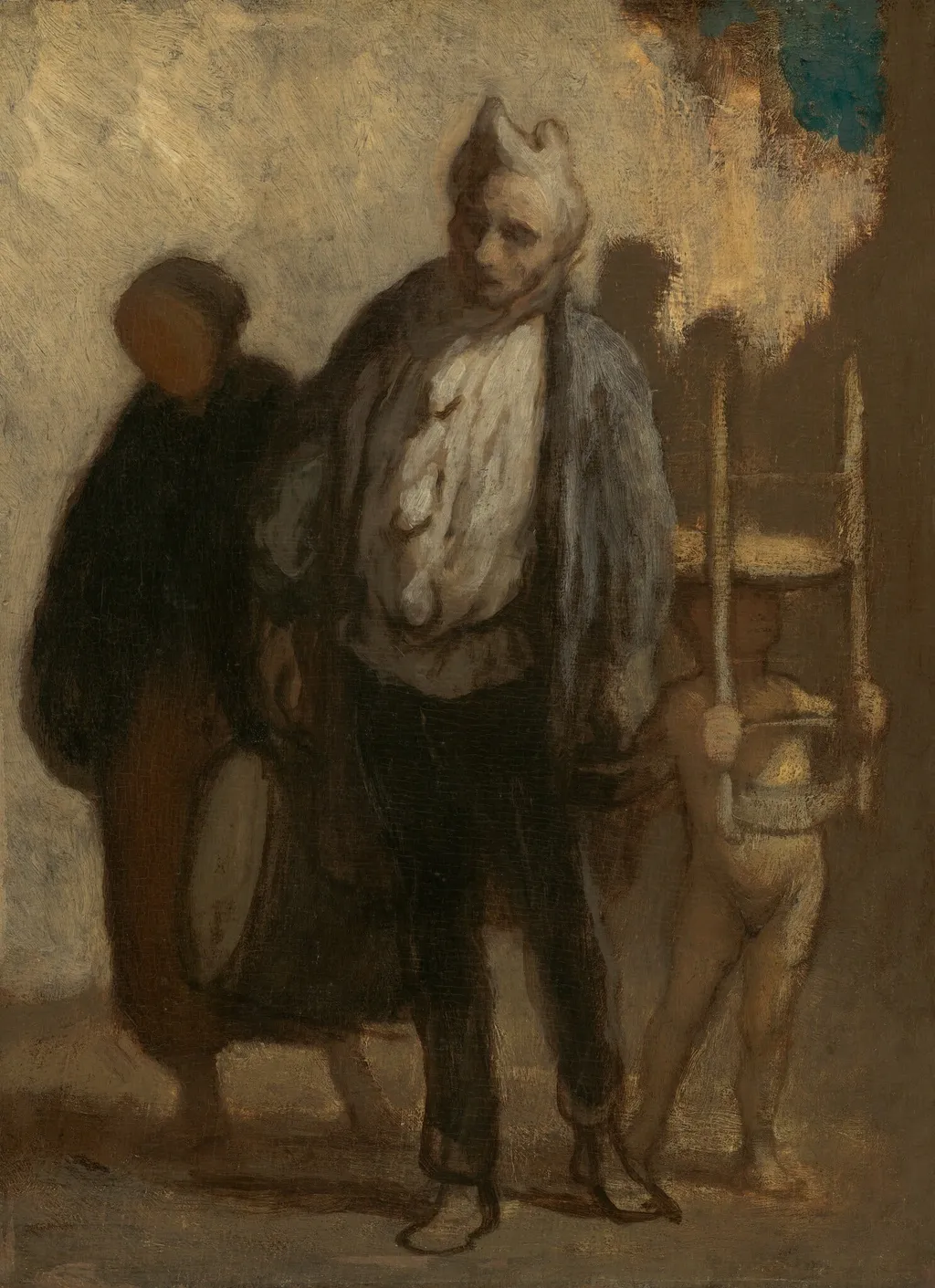
Wandering Saltimbanques is an oil painting by the Realist artist Honoré Daumier. It dates from 1848 and is held in the collection of the National Gallery of Art.
About this work
Technique & Style
Honoré Daumier executed Wandering Saltimbanques in 1850 using oil paint applied to a wooden panel. The work measures 32.6 cm in height and 24.8 cm in width. As a genre scene, the painting captures the artist's characteristic handling of figures within a compact, intimate format defined by the rigid support of the wood panel.
History & Provenance
The work was displayed at the 1901 Exposition Daumier at the Ecole des Beaux-Arts in Paris, with a red wax seal confirming Alexis Rouart's ownership.
Daumier painted Wandering Saltimbanques in 1850 as an oil on wood work. Alexis Rouart owned the painting by 1901 and likely inherited it from his father, Henri Rouart. The work was displayed at the 1901 Exposition Daumier at the Ecole des Beaux-Arts in Paris, with a red wax seal confirming Alexis Rouart's ownership.
Galerie Étienne Bignou handled its sale in July 1933 to Chester Dale, who bequeathed it to the National Gallery of Art in 1963.
The painting entered the National Gallery of Art's collection through Chester Dale's bequest, where it remains on view in Washington, D.C.
Wandering Saltimbanques has been held by the National Gallery of Art in Washington, D.C., since it entered the collection as part of the bequest of collector Chester Dale in 1963. The painting's documented provenance traces back to Alexis Rouart in Paris by 1901, and it was probably inherited from his father, Henri Rouart. It subsequently passed through Galerie Étienne Bignou in Paris and New York before being purchased by Dale in July 1933.
The work's recorded exhibition history includes a loan by Alexis Rouart to the 1901 Exposition Daumier at the École des Beaux-Arts in Paris. A red wax seal on the reverse of the panel, reading "Alexis Rouart," attests to this early ownership.
Overview
Honoré Daumier’s Wandering Saltimbanques (1848) is an oil painting on wood that captures a brief moment in a narrow, dimly lit alley. Two figures, one in a tall hat and a threadbare coat, the other in dark attire holding the first’s arm, move through a setting marked by rough walls and a leaning ladder, rendered with a muted palette and soft illumination.
Subject & Meaning
The work depicts itinerant entertainers, a motif that underscores the precariousness of marginal lives in mid‑nineteenth‑century France. By focusing on these wandering performers, Daumier highlights themes of transience, economic hardship, and the social invisibility of those who exist on the periphery of urban life.
Own this work as a print
Artist & collection
Artist
Honoré-Victorin Daumier (French: ; 26 February 1808 – 10 or 11 February 1879) was a French painter, sculptor, and printmaker, whose many works offer commentary on the social and political life in France, from the…









- The Burden (The Laundress)
 Taterkvinde med sit barn på heden
 The chalk sellers-In the morning
 Study for the Pawnbroker's Shop
 Țărani
 Woman with a Broom
 The Little Shepherdess
 Meisje bij een deuropening.
 Peasant Woman in a Field
 A Little Boy being Presented to a Priest
 Țărani (din ciclul „1907”)
 Creeping like Snail unwillingly to School