Artwork
Advice to a Young Artist
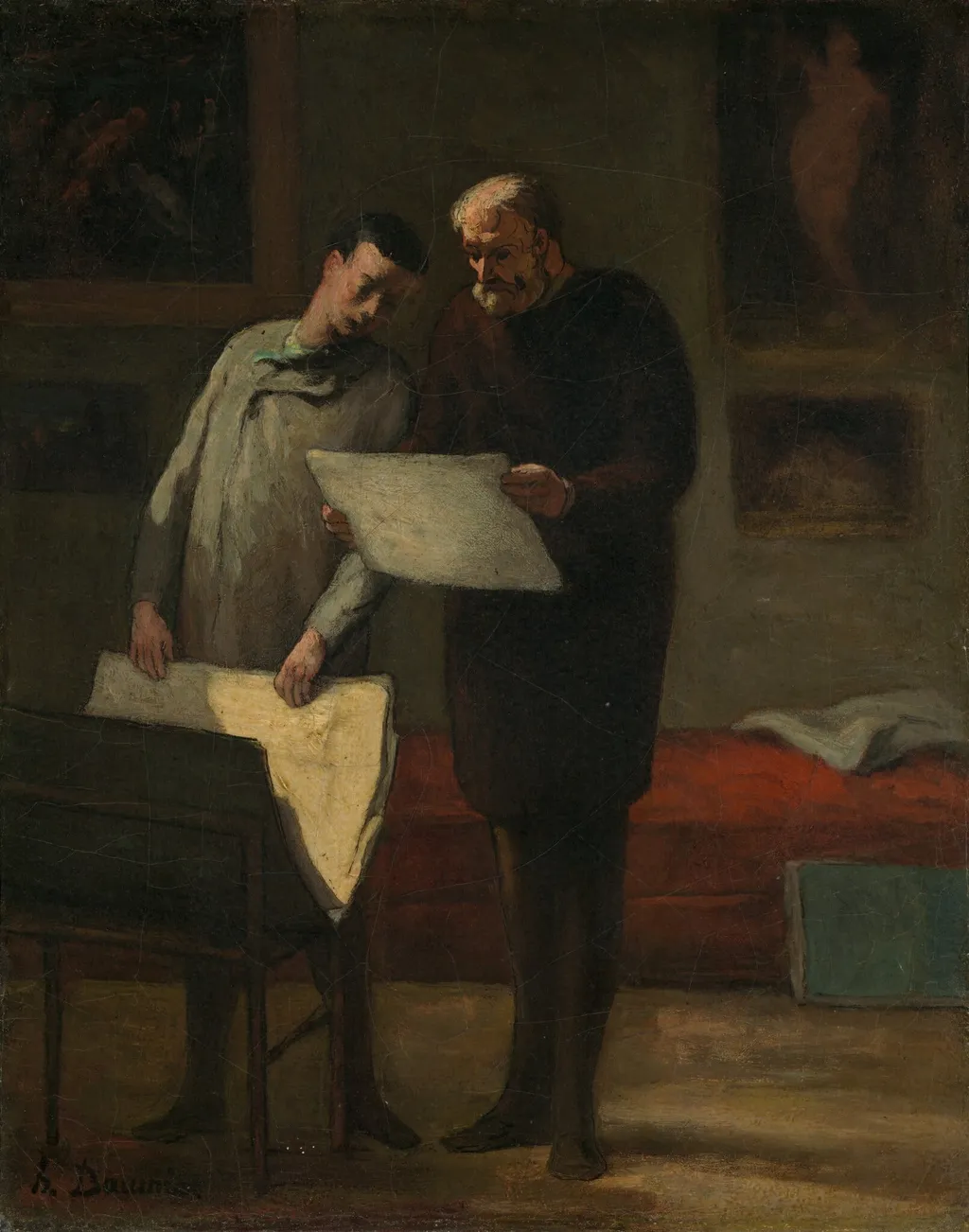
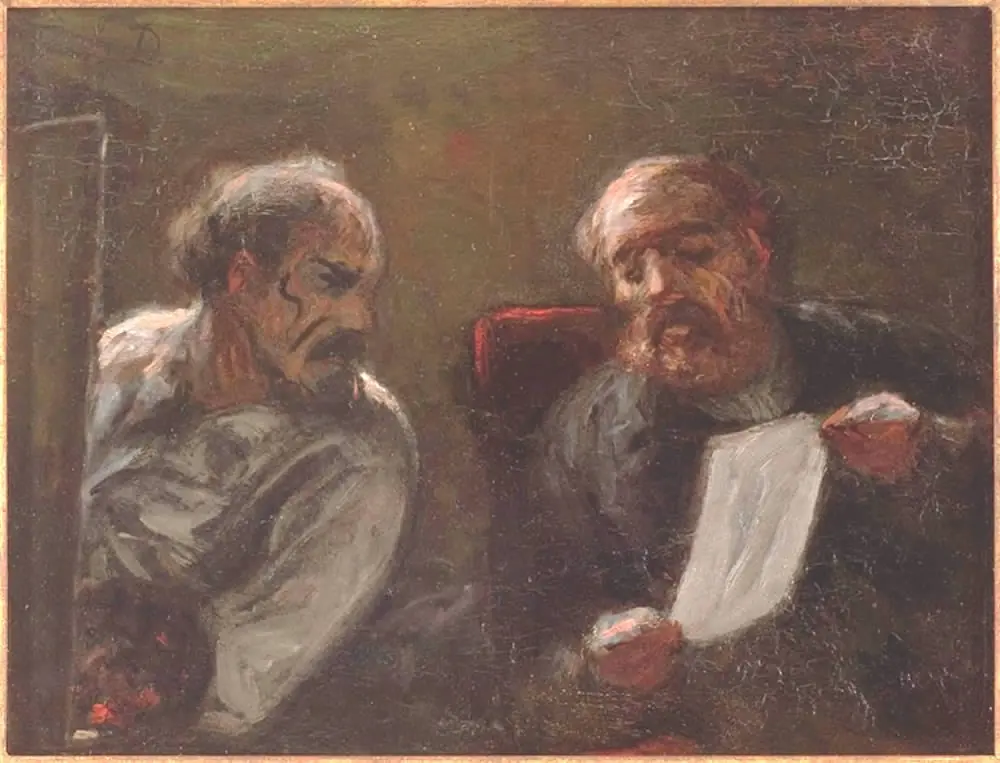
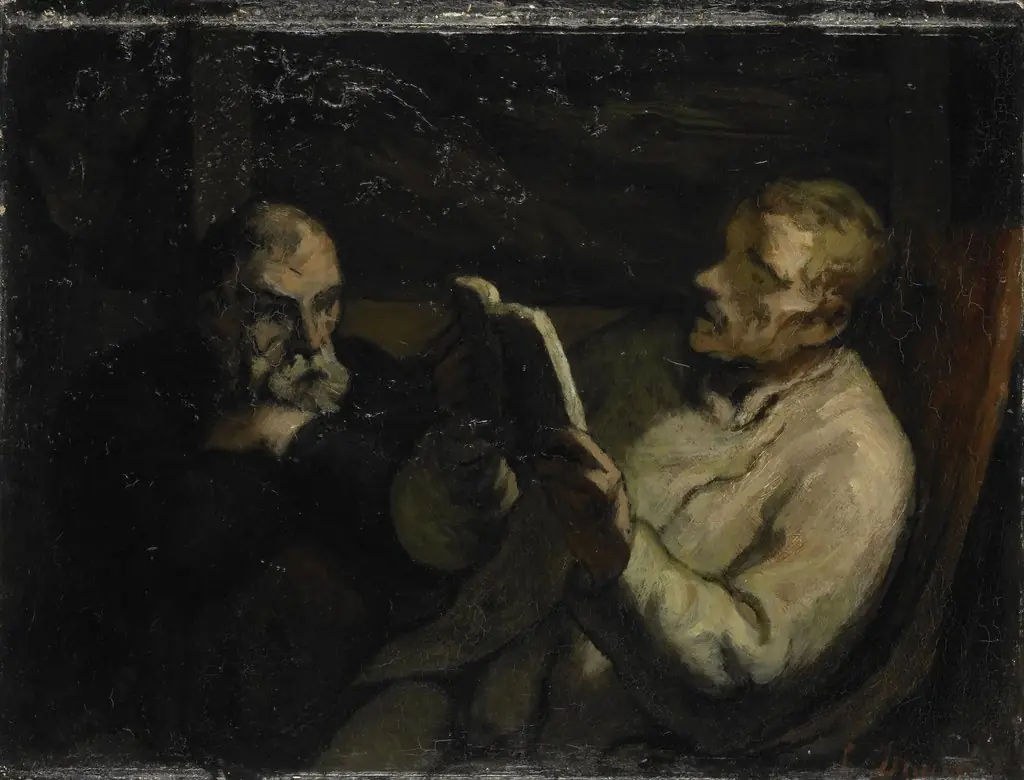
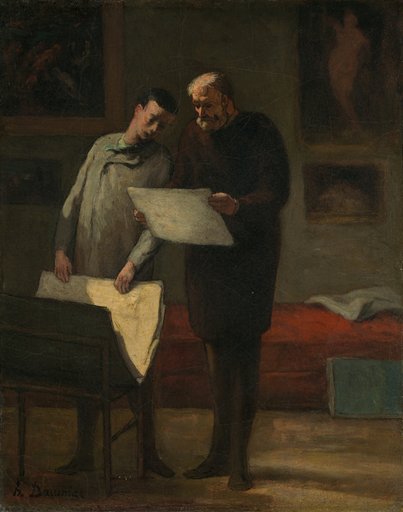
Advice to a Young Artist is an oil painting by the Impressionist artist Honoré Daumier. It dates from 1866 and is held in the collection of the National Gallery of Art.
- Inscription
- Inscribed:lower left: h. Daumier
About this work
Technique & Style
As an oil painting, the medium allows for the texture and layering characteristic of Daumier's handling during this period.
Honoré Daumier created Advice to a Young Artist in 1865 using oil paint applied to a canvas support. The work measures 41.3 cm in height and 33 cm in width. As an oil painting, the medium allows for the texture and layering characteristic of Daumier's handling during this period.
The piece is currently held in the collection of the National Gallery of Art in Washington, D.C., where it remains part of the public display.
History & Provenance
The work was painted in 1865 by Honoré Daumier. It entered the market through the posthumous estate sale of Jean-Baptiste-Camille Corot in Paris in June 1875, where it was purchased by Arthur Stevens.
By 1901 it was with Adolphe A. Tavernier, who lent it to a Daumier exhibition in Paris. It passed to Ernest Cronier by 1904, then to Goerg in Reims by 1905, and to A. Bergeaud in 1910, who included it in a 1910 exhibition at Galeries Georges Petit. It was later handled by Alex Reid & Lefèvre by 1927 and sold to D.W.T. Cargill in Glasgow.
M. Knoedler & Co. acquired it in New York in 1928 before selling it to Duncan Phillips in Washington, D.C. Phillips donated the painting to the National Gallery of Art in 1941.
The work is held by the National Gallery of Art in Washington, D.C. It entered the collection through a series of transactions beginning with its purchase by Arthur Stevens following the 1875 sale of Jean-Baptiste-Camille Corot's estate at Hôtel Drouot in Paris.[1] The painting subsequently passed through several owners including Adolphe A. Tavernier, who exhibited it in Paris in 1901,[2] and A. Bergeaud, who lent it to a 1910 French school exhibition in Paris.[3] It was later sold by Alex Reid & Lefèvre to D.W.T. Cargill in 1928,[4] and finally acquired by Duncan Phillips, who gifted it to the National Gallery of Art in 1941.
The National Gallery of Art (Washington, D.C.) is the current institutional holder.[2] Its accession is recorded under the purchase from Arthur Stevens in 1875 and transfer via gift from Duncan Phillips in 1941.
Exhibition history includes displays at the 1901 Daumier exhibition at the Ecole des Beaux-Arts in Paris,[2] the 1910 Galeries Georges Petit exhibition,[3] and Knoedler's 1928 New York exhibition following its acquisition by Cargill.[4]
Legacy
Advice to a Young Artist exerted lasting impact on subsequent generations of illustrators and cartoonists, particularly in its satirical treatment of artistic ambition and institutional critique. Its presence in major exhibitions, including the 1910 Galeries Georges Petit retrospective and the 1928 Knoedler show, reinforced its status as a touchstone of modern French draftsmanship. The work's journey through prominent private collections, from Corot's estate to Arthur Stevens and later to Arthur Cargill before its acquisition by Duncan Phillips, reflected evolving attitudes toward modern art in the early 20th century.
Its 1941 donation to the National Gallery of Art cemented its institutional legacy, where it remains part of the permanent collection. The painting's compositional strategies and social commentary continue to inform scholarly discourse on 19th-century political caricature and the development of modern visual satire.
Overview
Honoré Daumier’s 1866 oil painting Advice to a Young Artist presents an intimate interior scene in which two men engage in a quiet exchange. Rendered in a realist manner, the work focuses on ordinary figures rather than idealized subjects, employing strong contrasts of light and shadow to emphasize the central interaction.
Subject & Meaning
The composition shows a younger figure listening attentively as an older, white‑haired man holds out a sheet of paper, suggesting the transmission of professional counsel. The setting, likely a studio or workshop, underscores the theme of mentorship and the practical guidance required for an aspiring artist navigating the French art world of the mid‑nineteenth century.
Context
The work emerges from a France marked by political upheaval and shifting class structures, subjects that Daumier routinely critiqued through caricature. By turning his attention to a private, instructional moment, the painting extends his social commentary to the personal realm of artistic development, linking individual ambition with the broader societal climate.
Own this work as a print
Artist & collection
Artist
Honoré-Victorin Daumier (French: ; 26 February 1808 – 10 or 11 February 1879) was a French painter, sculptor, and printmaker, whose many works offer commentary on the social and political life in France, from the…