Artwork
Ventre affamé n'a pas d'orleilles
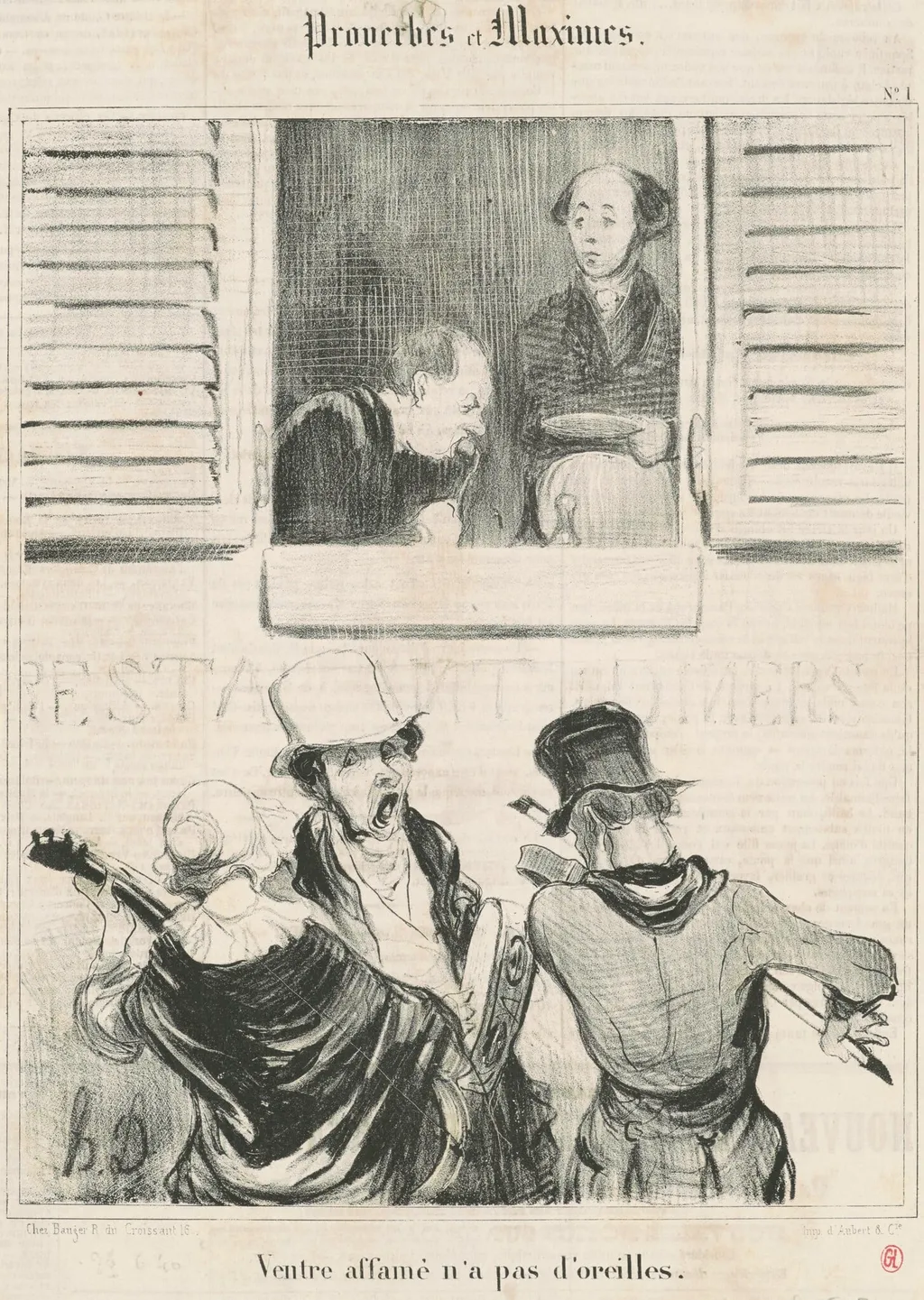
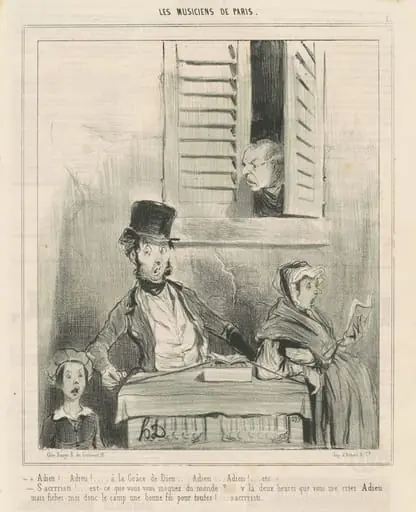
Ventre affamé n'a pas d'orleilles is an ink print by the Romanticist artist Honoré Daumier. It dates from 1840 and is held in the collection of the National Gallery of Art.
About this work
You see a lithograph. A window frame cuts the scene in two. Above, two people watch the street. Below, three musicians play for coins. Daumier used sharp lines to show their hunger and hope.
This print shows how life looked in 1840 Paris. The musicians play on dirty pavement. The watchers lean in, but don’t toss coins. It feels honest.
Look up lithography next. That’s the technique Daumier used here.
Overview
Honoré Daumier’s 1840 lithograph, titled Ventre affamé n’a pas d’orleilles, presents a bifurcated street tableau divided by a window frame.
Honoré Daumier’s 1840 lithograph, titled Ventre affamé n’a pas d’orleilles, presents a bifurcated street tableau divided by a window frame. The upper portion shows two onlookers peering outward, while the lower section captures three street musicians performing on a grimy pavement, hoping for a coin. The composition offers a concise snapshot of everyday Parisian life in the early nineteenth century.
Subject & Meaning
The work juxtaposes observation and performance: the two figures above act as silent witnesses, their posture suggesting curiosity or indifference, whereas the trio of musicians below actively seek generosity from passers‑by. This contrast underscores themes of poverty, public entertainment, and the social divide between spectator and performer that Daumier frequently explored.
Technique & Style
Executed in lithography, the image relies on crisp, linear marks that delineate the window’s edge and the figures’ gestures. Daumier’s use of stark contrasts between light and shadow accentuates the grime of the pavement and the tension in the musicians’ faces, while the clean lines convey immediacy and a documentary quality.
Context
Created during a period of rapid urbanization in Paris, the print reflects the bustling street culture of the 1840s, when itinerant musicians were common sights on cobblestone avenues. Daumian’s attention to such quotidian scenes aligns with his broader interest in the social realities of the French capital, documenting both its vitality and its hardships.
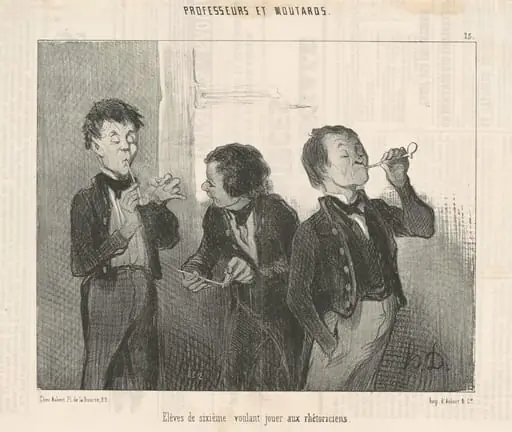
Own this work as a print
Artist & collection
Artist
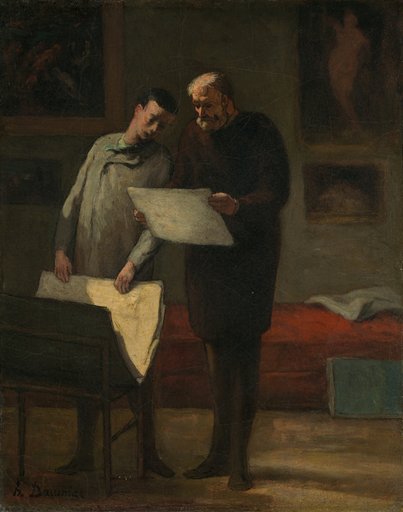
Honoré-Victorin Daumier (French: ; 26 February 1808 – 10 or 11 February 1879) was a French painter, sculptor, and printmaker, whose many works offer commentary on the social and political life in France, from the…