Artwork
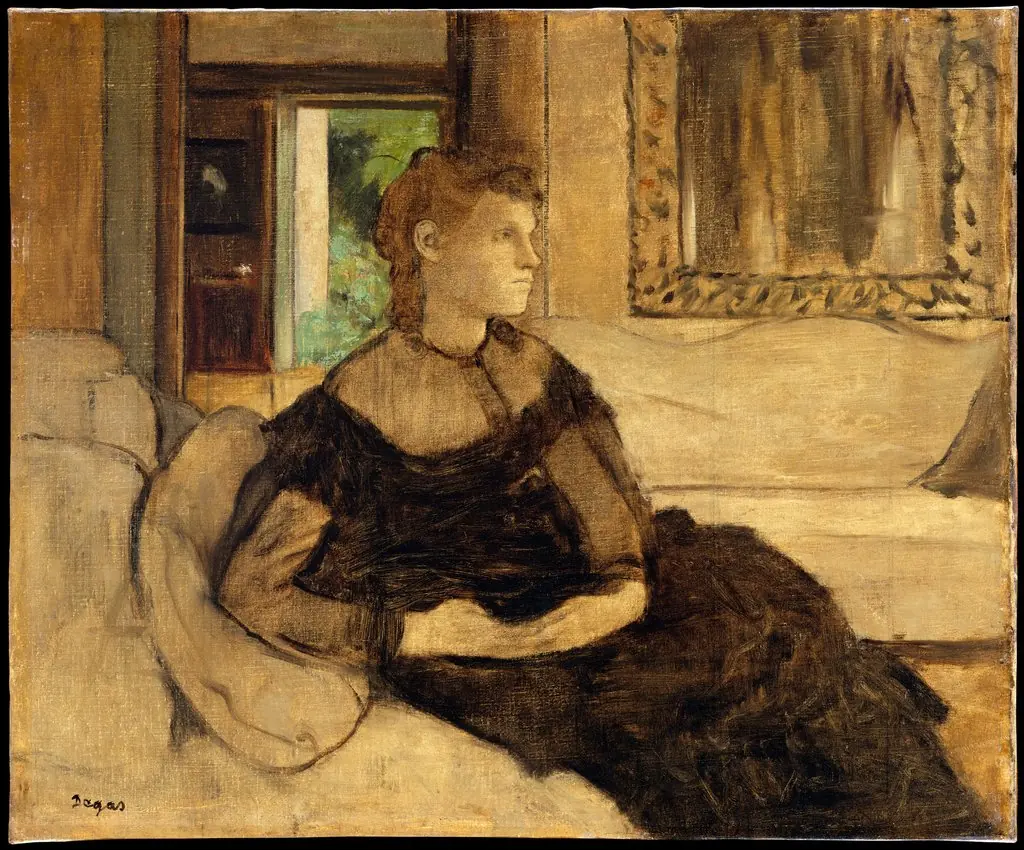
Madame René de Gas
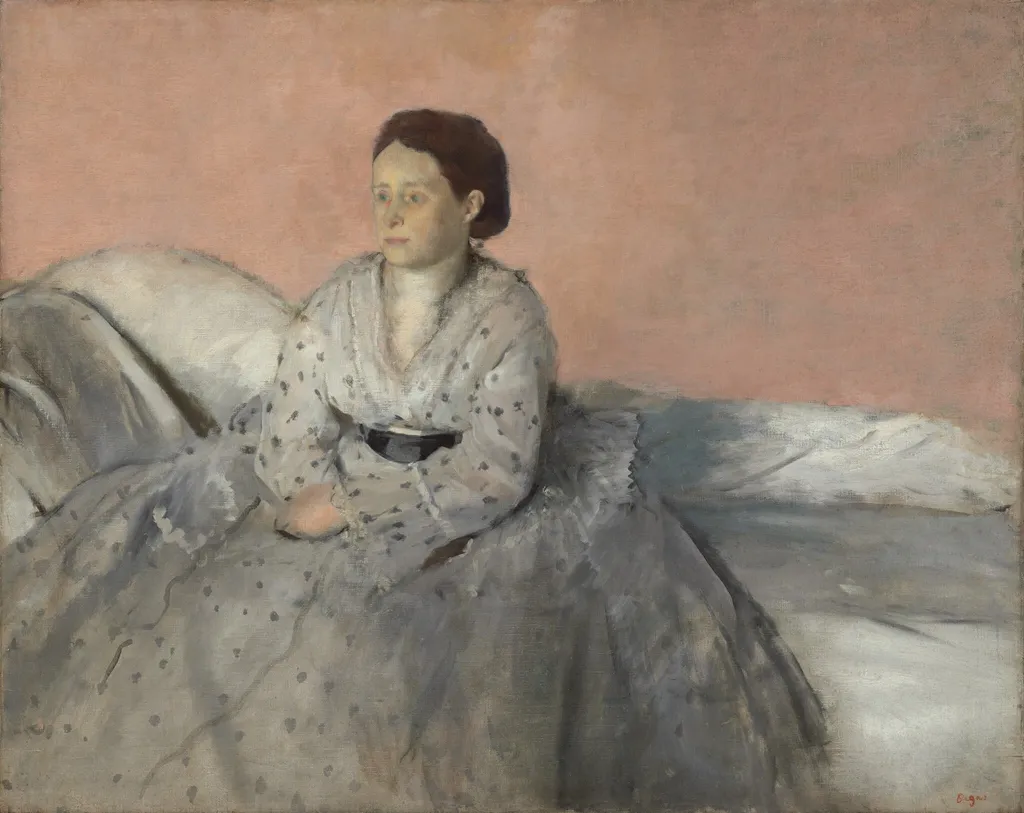
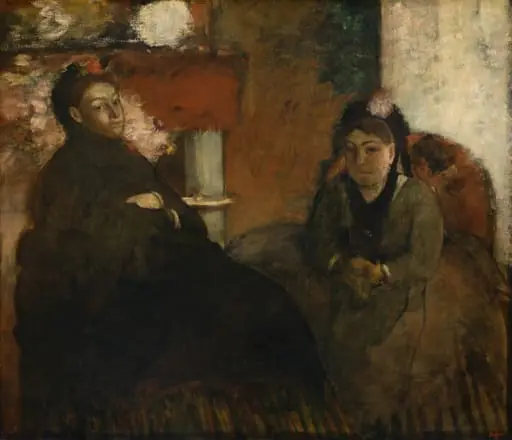
Madame René de Gas is an oil painting by the Impressionist artist Edgar Degas. It dates from 1872 and is held in the collection of the National Gallery of Art.
- Inscription
- Inscribed:lower right with atelier stamp: Degas
About this work
Technique & Style
Executed in oil on canvas in 1872, the work is painted in a fluid manner that emphasizes the play of light across the sitter’s gown and the background wall.
Executed in oil on canvas in 1872, the work is painted in a fluid manner that emphasizes the play of light across the sitter’s gown and the background wall. Degas employed rapid, broken brushwork to capture soft transitions of tone, particularly in the rendering of the fabric’s folds and the luminous skin of the figure. The handling balances a sketch-like immediacy with carefully observed detail, especially in the delineation of the lace collar and the subject’s poised yet relaxed posture.
The composition’s formal qualities pivot on a viewpoint that directs attention to the sitter’s direct gaze and the delicate modeling of her features. The subdued palette, punctuated by accents of white in the costume, reinforces a restrained elegance consistent with Degas’s portrait practice of the early 1870s.
History & Provenance
The work was painted by Edgar Degas in 1872. It entered the artist’s holdings in Paris and was later included in his atelier sale at Galerie Georges Petit, Paris, on 6–8 May 1918 as lot 97, where it was purchased by Jacques Seligmann for his private collection.
Seligmann sold the painting at the American Art Galleries, New York, on 27 January 1921 as lot 51 to M. Knoedler & Co. The firm then sold it in 1921 to Henry D. Hughes of Philadelphia. It was subsequently on consignment with the Marie Sterner Galleries and sold on 10 November 1928 to Chester Dale, who bequeathed it to the National Gallery of Art, Washington, D.C., in 1963.
Madame René de Gas is held in the collection of the National Gallery of Art in Washington, D.C., where it was accessioned in 1963 as a bequest from Chester Dale. No specific exhibition history is detailed in the provided records.
Context
The portrait Madame René de Gas exemplifies Degas's nuanced approach to bourgeois identity through psychological realism and unconventional compositional framing. Contemporary scholarship identifies its 1872 execution as part of the artist's transitional period exploring domestic interiors while subverting academic portrait conventions through asymmetrical arrangements and cropped viewpoints. Art historical analysis situates the work within Degas's broader engagement with modernity, particularly his reinterpretation of portraiture as psychological study rather than status display.
Its journey from the artist's atelier to private collections before acquisition by Chester Dale reflects evolving 20th-century patterns of art market participation by American collectors, while its current display at the National Gallery of Art underscores institutional recognition of Degas's role in redefining portraiture as an arena for experimental visual language.
Overview
Created in 1872, this oil on canvas by Edgar Degas presents a seated woman within a modest interior. The composition is restrained, employing a limited palette that lends the work a tranquil atmosphere. Degas, though often linked to Impressionism, approached the portrait with a realist’s eye for precise form and subtle illumination.
Subject & Meaning
The figure is identified as Madame René de Gas, portrayed in formal attire and gazing directly at the viewer. Her poised stance and the simplicity of the setting suggest a focus on personal dignity rather than narrative drama, reflecting Degas’s interest in capturing the quiet presence of his subjects.
Own this work as a print
Artist & collection

Artist
Born Hilaire-Germain-Edgar De Gas on 19 July 1834 in Paris, Edgar Degas came from an affluent banking family with aristocratic roots and spent his childhood among the cultivated circles of the French capital.

- Portrait of a Woman in Gray
 Portrait of Jenny Kamerlingh Onnes
 From a Walk
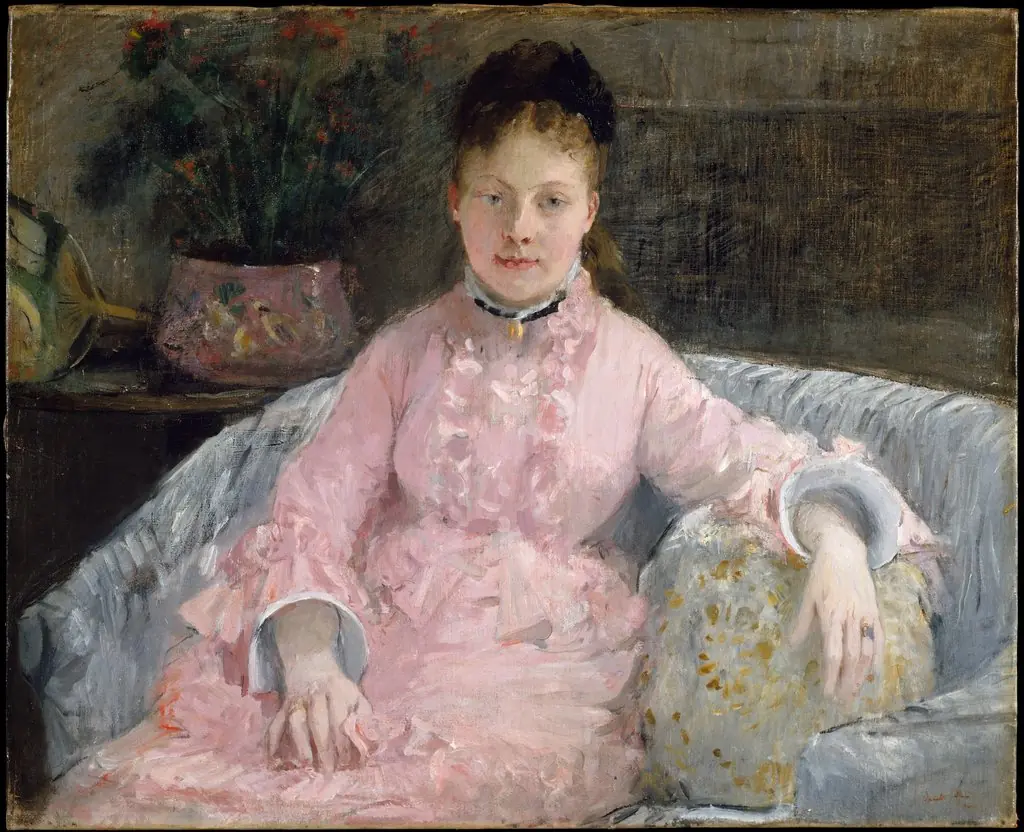 The Pink Dress (Albertie-Marguerite Carré, later Madame Ferdinand-Henri Himmes, 1854–1935)
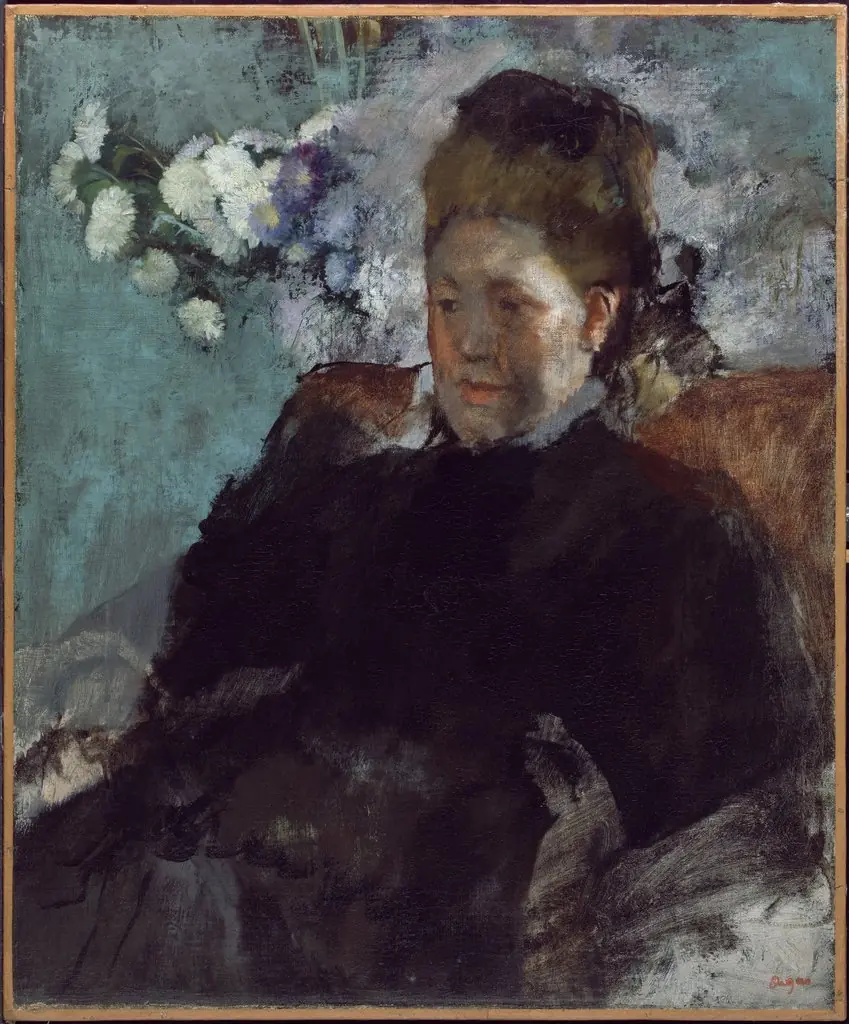 Portrait of a Woman
 Mademoiselle Malot
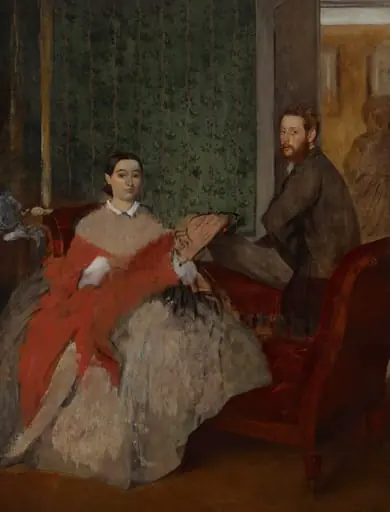 Edmondo and Thérèse Morbilli
 Ballet Dancer with Arms Crossed
 Mother of Pearl and Silver: The Andalusian
 Portrait of Mme. Lisle and Mme Loubens
 Girl in Red
 Portrait of Mme Lisle and Mme Loubens