Artwork
Falls of Schaffhausen
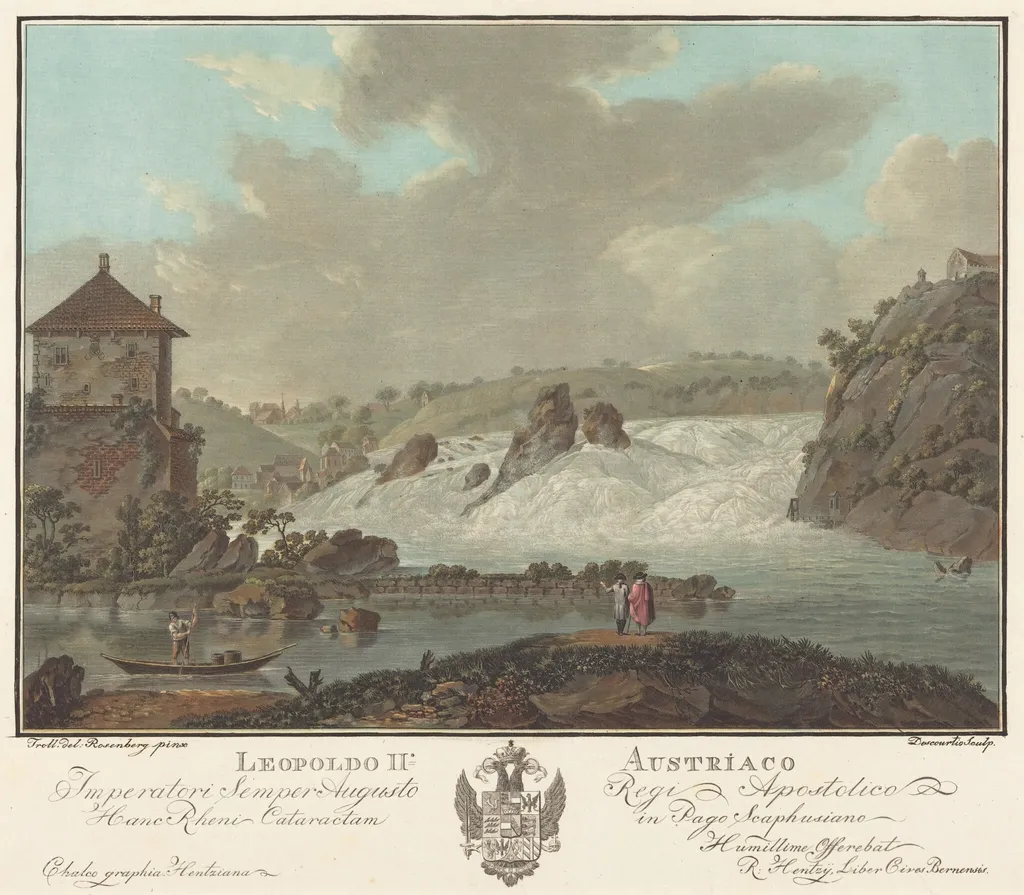
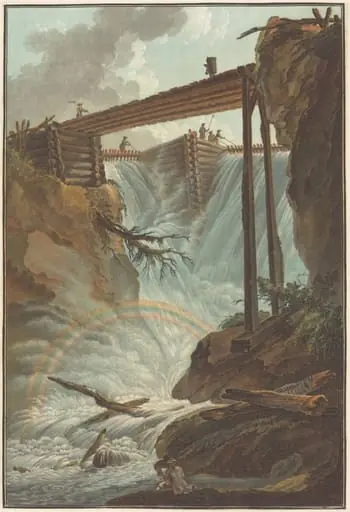
Falls of Schaffhausen is an ink print by the Romanticist artist Charles-Melchior Descourtis. It dates from 1784 and is held in the collection of the National Gallery of Art.
- Inscription
- Inscribed:lower left in plate: Troll. del: Rosenberg pinx; lower right inplate: Descourtis sculp.; lower center in plate: LEOPOLDO II AUSTRIACO / Imperatori Semper August Regi Apostolico / Hanc Rheni...Liber Cives Bernensis; lower left in plate: Chalco graphia Hentziana
About this work
Overview
This print by Charles-Melchior Descourtis depicts the Falls of Schaffhausen, a natural cascade on the Rhine River. Executed around 1784, it employs etching combined with a wash manner technique, producing an image in blue, red, yellow, and black inks. The composition balances natural grandeur with human presence, offering both a topographical record and a picturesque interpretation of the site.
Subject & Meaning
A modest stone structure and a lone boat anchor the foreground, while two figures observe the spectacle from a narrow path.
The scene captures the Rhine’s powerful waterfall near Schaffhausen, a landmark of geological and scenic significance. A modest stone structure and a lone boat anchor the foreground, while two figures observe the spectacle from a narrow path. The inclusion of Emperor Leopold II’s name in the inscription suggests an association with patronage or commemoration, framing the natural wonder within a broader cultural or political narrative.
Technique & Style
Descourtis employed etching, a intaglio process in which acid bites lines into a metal plate, allowing for fine detail. The addition of a wash manner, applying tonal variations through selective inking, enhances the depiction of water’s movement and the landscape’s textures. The use of multiple colors, printed in succession, distinguishes this work from monochrome etchings, lending depth and atmospheric effect to the scene.
History & Provenance
Created circa 1784, the print reflects the period’s interest in landscape as both a scientific subject and an aesthetic experience. Its inscription links the work to Leopold II, though the exact circumstances of its commission or initial audience remain unclear. As a print, it would have been produced in limited editions, circulated among collectors or travelers drawn to representations of notable European sites.
Context
During the late 18th century, prints of natural landmarks served multiple purposes: documentary, decorative, and didactic. The Falls of Schaffhausen, a well-known feature of the Rhine, attracted artists and tourists alike. Descourtis’s work participates in this tradition, offering viewers a vivid, multi-colored rendering of a site already celebrated in travel literature and visual arts.
Legacy
While not among the most frequently cited works of its era, this print exemplifies the technical and compositional approaches of late 18th-century landscape etching. Its use of color and attention to natural detail reflect broader trends in printmaking, where artists sought to balance accuracy with expressive effect. The work endures as a record of both a specific place and the artistic practices of its time.
Own this work as a print
Artist & collection

Artist
Charles-Melchior Descourtis (1753–1820) was a French artist, born in Paris.

- Resting Travelers in a Mountainous Landscape
 Lago di Nemi (Lake Nemi)
 Lagoa de Freitas
 Arcadian Landscape with a Doric Temple
 View of Castle Sachsenburg
 Nieder-oesterreich, Schloss Greifenstein
 Heroic Landscape: The Shepherd's Dance on the Bridge
 Lagoa de Freitas
 Vue d’une Laiterie près St. Maur-les-Paris (View of the Dairy near St. Maur-les-Paris)
 Schweizerhuset ved Jægerspris
 Landscape with Four Trees
 Landscape with a Man Resting, Farm Houses, and a Castle