Artwork
The Presentation and Marriage of the Virgin, and the Annunciation
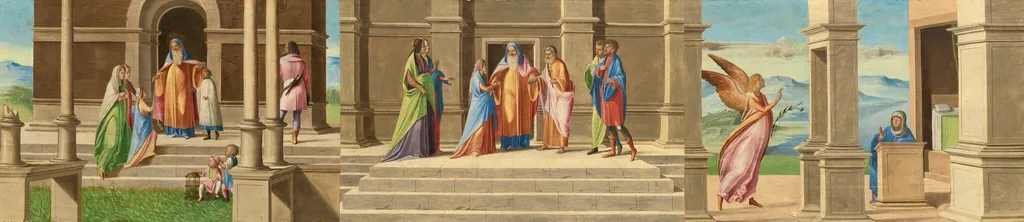
The Presentation and Marriage of the Virgin, and the Annunciation is an oil painting by the Mannerist artist Benedetto Rusconi. It dates from 1522 and is held in the collection of the National Gallery of Art.
About this work
Subject & Meaning
The right side portrays the Annunciation, marking the moment the Archangel Gabriel announces to Mary that she will conceive the Son of God.
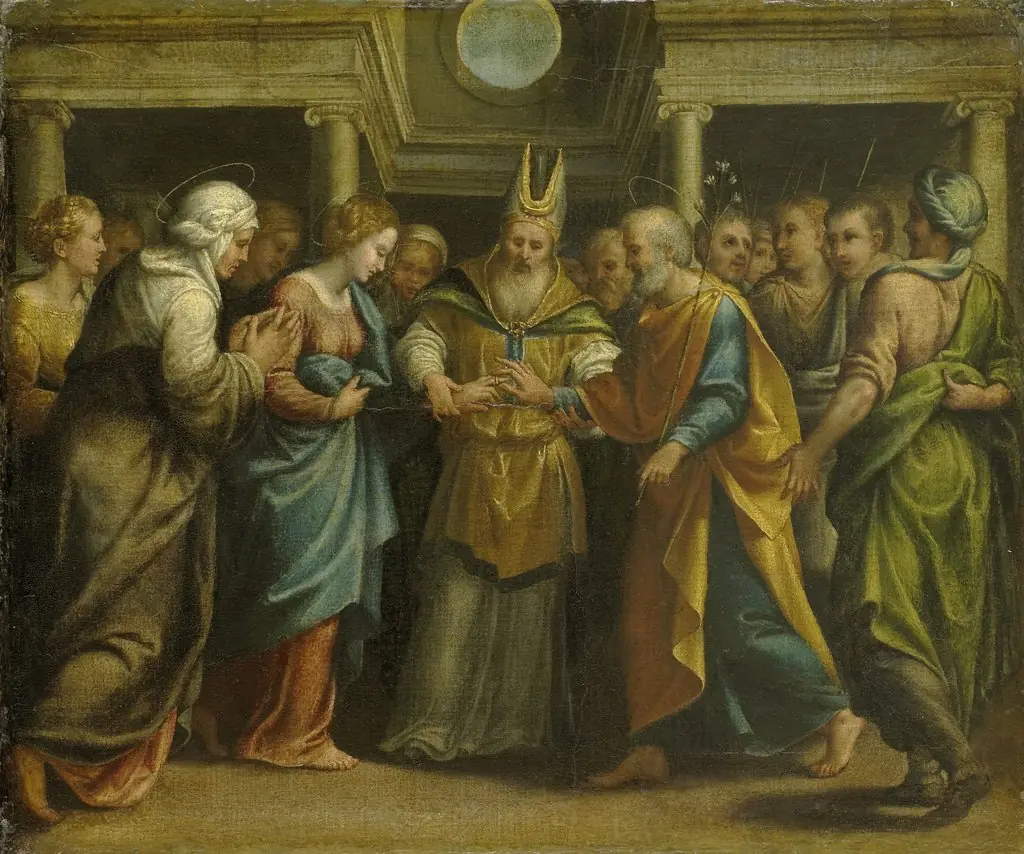
The painting depicts two distinct biblical narratives from the life of the Virgin Mary, united within a single horizontal composition. The left portion illustrates the Presentation and Marriage of the Virgin, a scene drawn from apocryphal tradition where the young Mary is presented at the Temple and subsequently married to Joseph. The right side portrays the Annunciation, marking the moment the Archangel Gabriel announces to Mary that she will conceive the Son of God.
As a work of religious art created in 1520, the piece serves a devotional function, visually connecting the prophetic preparation of the Virgin with the fulfillment of the Incarnation. The juxtaposition of these events emphasizes the theological continuity of Mary's role in salvation history.
Technique & Style
The work is executed in oil on panel, a support typical of Venetian painting practice in the early sixteenth century. Its horizontal format is unusually elongated, measuring 37.1 cm in height by 163.8 cm in width, a proportion suited to a predella-like narrative band combining the Presentation and Marriage of the Virgin with the Annunciation. The religious subject is rendered within this narrow, continuous field, allowing the two episodes to be read in sequence across the panel's length.
History & Provenance
Dated to 1520, this oil on panel by Benedetto Diana was recorded in the collection of William Graham in London by 1879, when it was exhibited at the Royal Academy under the attribution to Cima da Conegliano. Following Graham's death, the work appeared in his estate sale at Christie's in April 1886; it was bought in by the firm Agnew's on behalf of the executor to facilitate division among Graham's daughters. The painting subsequently entered the possession of Sir Kenneth Muir-Mackenzie and was inherited by his daughter, Dorothea Muir-Mackenzie Hambourg, who held it until at least 1936.
Later owned by Count Alessandro Contini Bonacossi, the panel was sold to the Samuel H. Kress Foundation in 1950 and gifted to the National Gallery of Art in 1961.
The painting entered the National Gallery of Art in Washington, D.C., in 1961 as part of the Samuel H. Kress Collection, with the accession number NGA 1961.9.70. It had been acquired by the Samuel H. Kress Foundation in 1950 from Count Alessandro Contini Bonacossi of Florence and Rome. Earlier, the panel descended through the collection of Sir Kenneth Muir-Mackenzie, 1st Baron Muir-Mackenzie, in London, and by inheritance to his daughter, Dorothea Muir-Mackenzie Hambourg, in whose possession it was recorded by 1936.
Before that, the work belonged to the London collector William Graham by 1879, in whose estate sale at Christie's in April 1886 it was bought in by Agnew's for the Graham heirs. The provenance is further documented in the Kress Collection Digital Archive of the National Gallery of Art.
Context
The Presentation and Marriage of the Virgin and the Annunciation, painted in 1520 by Benedetto Diana, is an oil on panel work measuring 37.1 × 163.8 cm.
Its early 19th‑century attribution to Cima da Conegliano at the Royal Academy reflects contemporary uncertainty about the artist’s identity.
Bernard Berenson’s 1936 catalogue entry confirmed its importance, and its acquisition by the Samuel H. Kress Foundation in 1950, followed by donation to the National Gallery of Art in 1961, illustrates the painting’s integration into the canonical narrative of Renaissance religious art.
Legacy
The work was shown at the Royal Academy, London, in 1879 and entered the collection of William Graham by 1879. It later passed through the holdings of Sir Kenneth Muir‑Mackenzie and was sold at the 1886 Agnew auction (no. 330), after which the Samuel H. Kress Foundation purchased it in 1950. The painting was gifted to the National Gallery of Art in 1961 and has been part of its permanent collection ever since.
Bernard Berenson listed the composition in his 1936 catalogue of Italian Renaissance paintings, underscoring scholarly attention to the piece. Its presence in the Kress Collection and subsequent donation to the National Gallery of Art have contributed to a sustained reputation as an important example of early‑16th‑century religious art.
Overview
Created in 1522, The Presentation and Marriage of the Virgin, and the Annunciation is an oil-on-panel work by the Venetian painter Benedetto Diana. The composition unites two distinct episodes from the life of the Virgin Mary within a single architectural setting. On the left, the Marriage of the Virgin depicts the moment Mary receives her wedding ring from the High Priest, surrounded by suitors and witnesses.
On the right, the Annunciation shows the Archangel Gabriel delivering the divine message to Mary. Diana arranges the figures in a stacked, tiered formation to create spatial depth within the confined panel format. The painting is characterized by a soft, diffused color palette reminiscent of early morning light, avoiding the dramatic chiaroscuro of later Mannerism.
The figures possess a serene, calm demeanor, reflecting the artist's adherence to the High Renaissance ideals of balance and harmony prevalent in Venice during the early 16th century. This work exemplifies Diana's mature style, bridging the traditions of his teacher, Giovanni Bellini, with the evolving aesthetic of the period.
Artist & collection
Artist
Benedetto Rusconi, nicknamed the Diana, (c. 1460 – 1525) was an Italian Renaissance painter, a companion of Vittore Carpaccio and Giovanni di Niccolò Mansueti, who lived in the latter part of the 15th and early part of…