Artwork
Concert
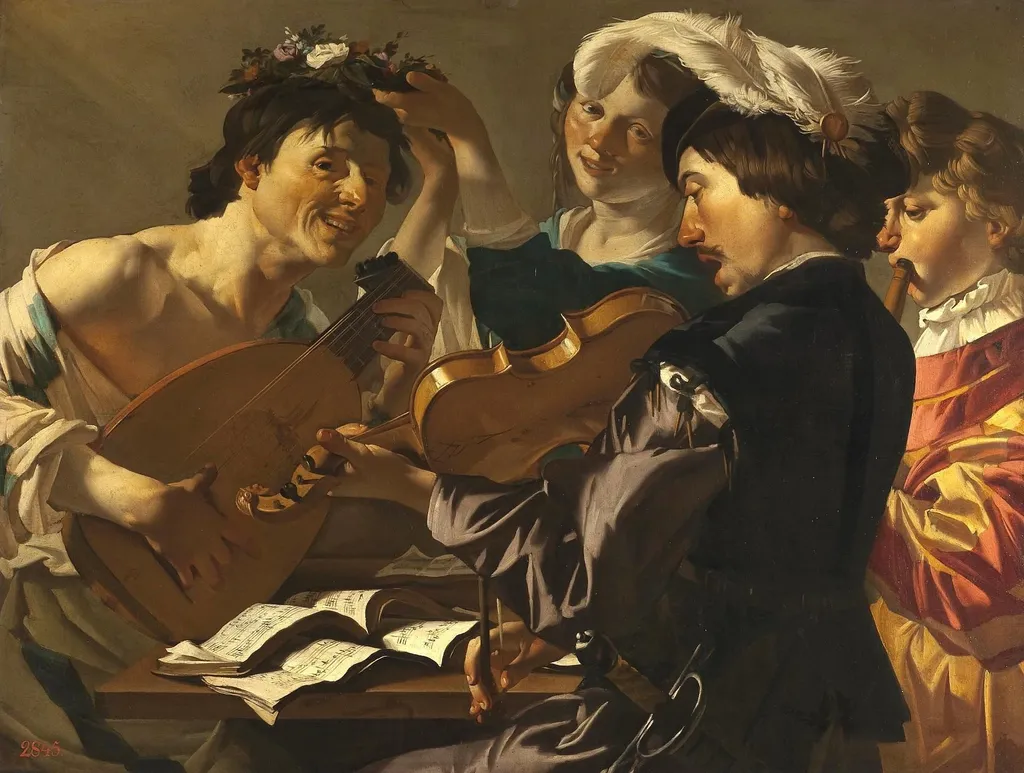
Concert is an oil painting by the Early Baroque Italian artist Dirck van Baburen. It dates from 1622 and is held in the collection of the Hermitage Museum.
About this work
Overview
Concert is an oil on canvas painting by Dirck van Baburen, dated 1622 by the authoritative corpus record, though some sources give 1623.
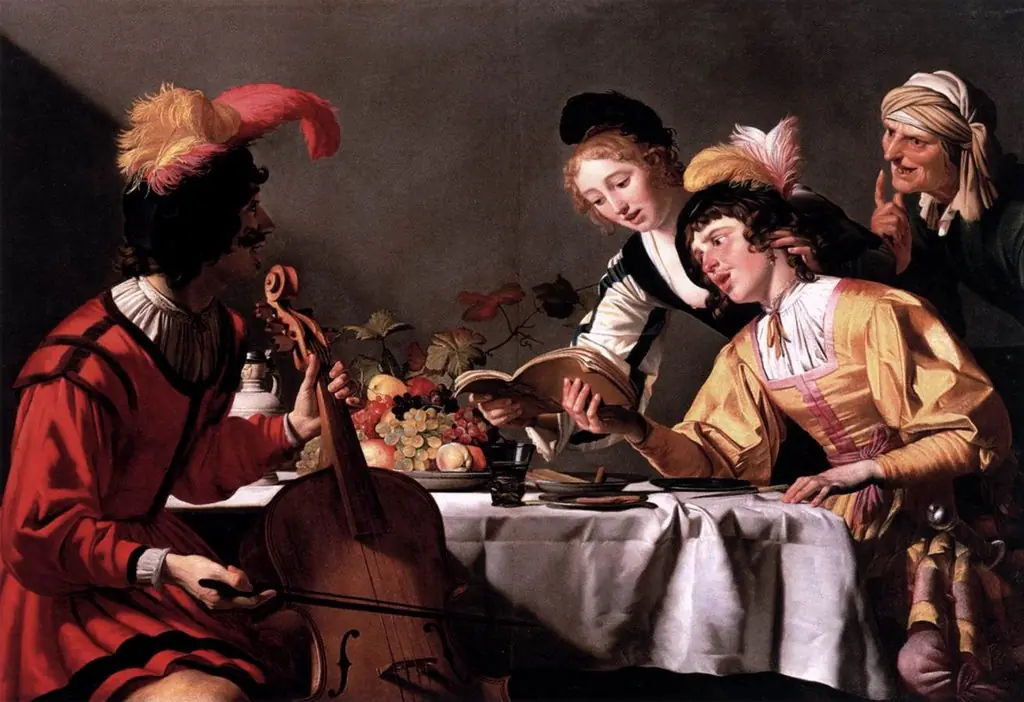
Concert is an oil on canvas painting by Dirck van Baburen, dated 1622 by the authoritative corpus record, though some sources give 1623. Measuring 99.5 by 130.5 cm according to museum records, it depicts four musicians gathered around a table in a dim interior, rendered with the dramatic chiaroscuro that defines the Utrecht Caravaggisti. The work is held in the Hermitage Museum in Saint Petersburg, where it is catalogued under inventory number 2845, visible in the lower left corner of the canvas. Painted during the final years of Baburen's brief career, the picture exemplifies the transformation of Dutch genre painting through Italianate naturalism and stands as a significant document of musical culture in the Dutch Republic.
Subject & Meaning
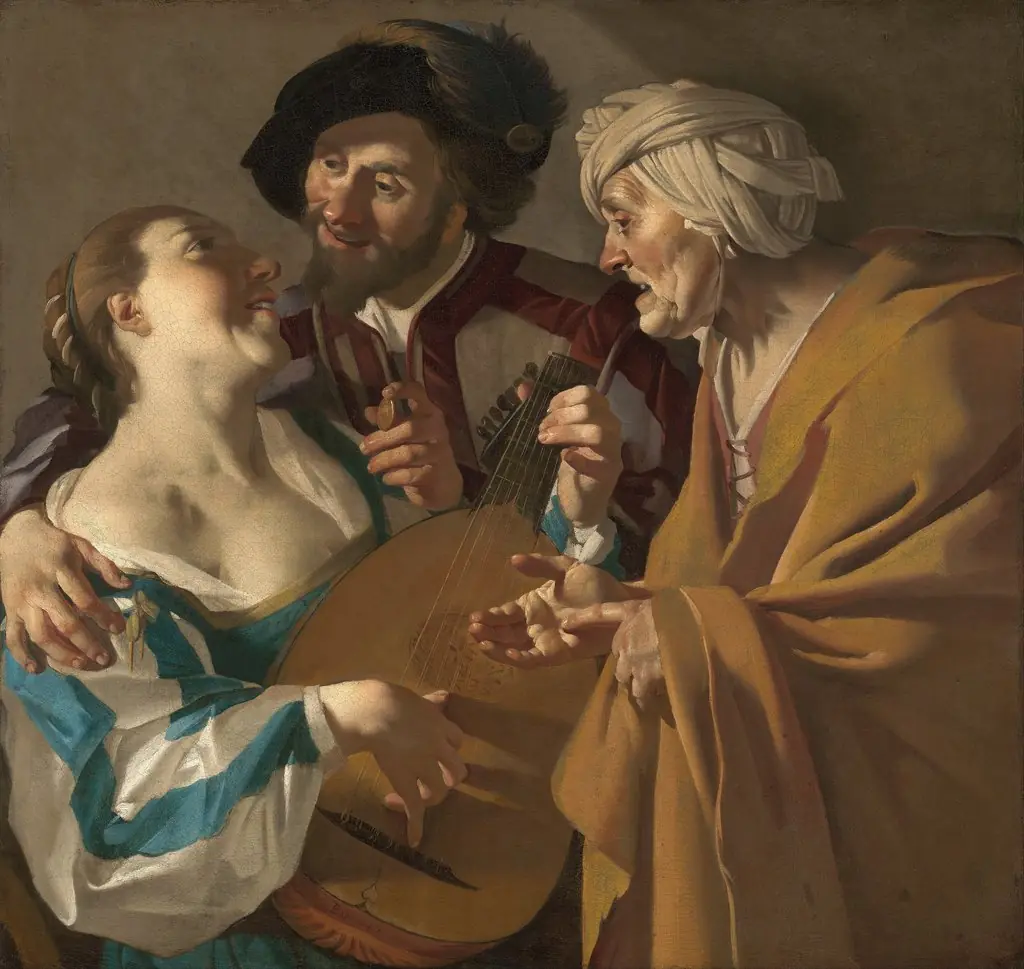
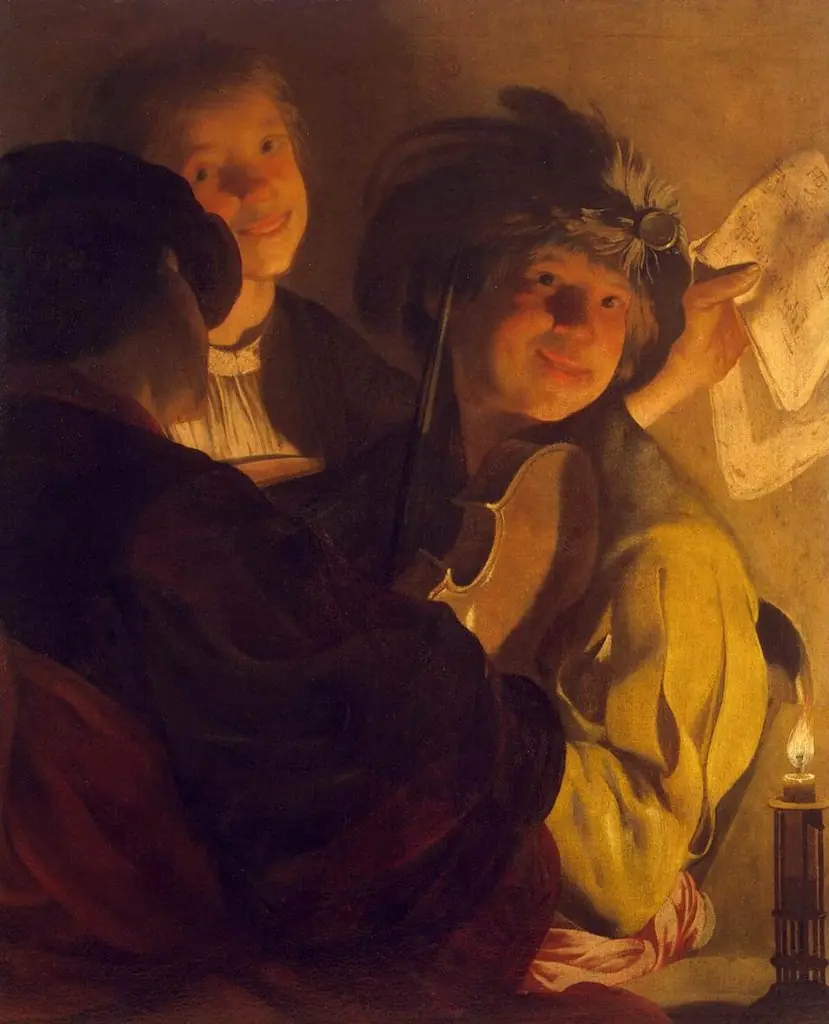
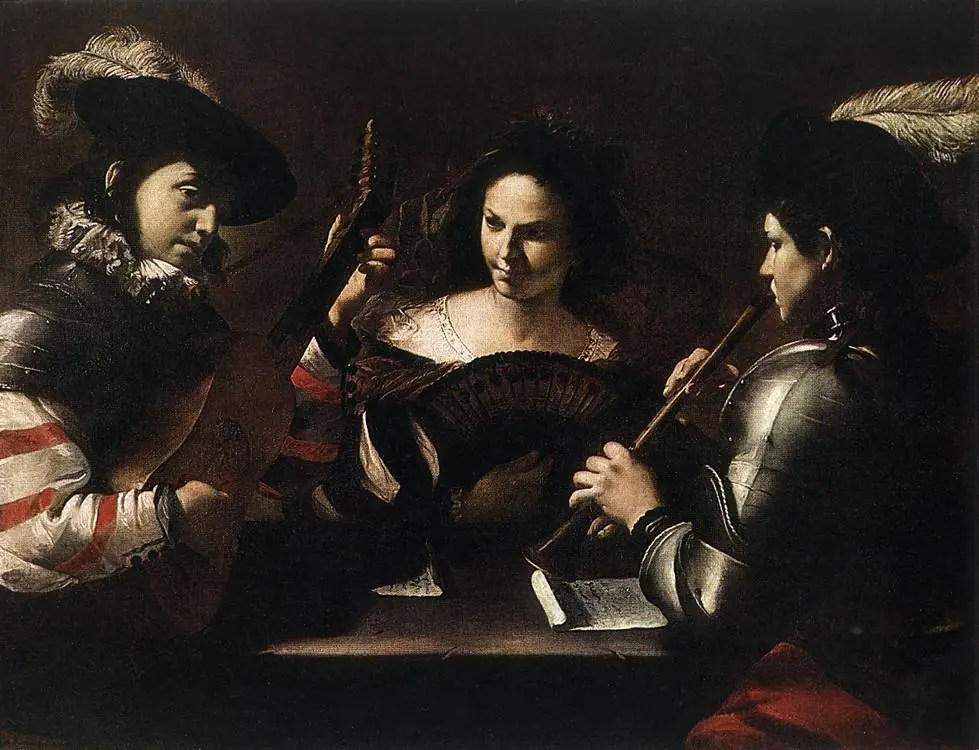
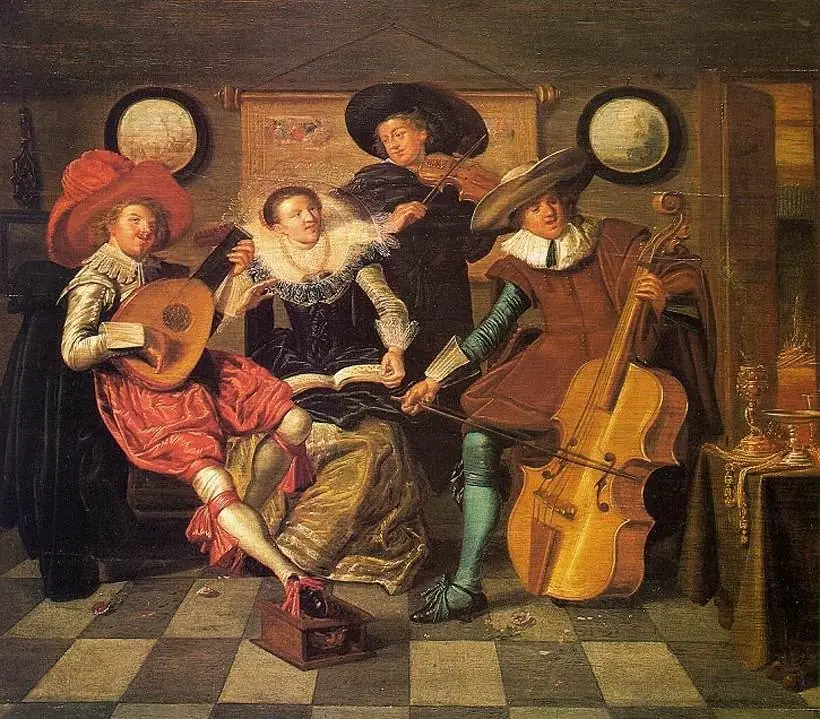
The scene presents four figures clustered closely around a wooden table, absorbed in making music. On the left, a bare-chested man wearing a flower wreath grins while playing a lute; beside him, a woman in white and blue raises her arm to adjust or place the wreath. At center, a man in dark clothing and a white feathered hat draws a bow across a violin, while to the right a fourth figure in a striped pink and yellow garment plays a flute. Open books of musical notation rest on the table. The woman's gesture of crowning the lutenist with flowers carries symbolic resonance, suggesting a theatrical troupe welcoming or honoring a musician of quality. The mixed costumes, ranging from historic to contemporary dress, and the combination of ancient and modern instruments, create a temporal blend that elevates the scene treatrical and possibly allegorical dimensions. The subject of music-making itself held deep cultural significance in seventeenth-century Dutch society, associated with leisure, social harmony, and refined communal activity.
Technique & Style
The painting is executed in oil on canvas, with a palette of warm browns, deep blacks, creamy whites, and touches of blue and rose. Strong directional light falls from the upper left, carving the figures out of shadowy darkness and highlighting faces, hands, and the polished wood of the instruments, a direct legacy from Caravaggio that defines the Utrecht Caravaggisti style. The brushwork shows smooth modeling on flesh and fabric, with thicker, more textured strokes in the highlights and shadows. The background is an undefined, muted brown wall that pushes the figures forward into the viewer's space. This handling transforms a simple genre scene into a living tableau, where the shimmer of silk doublets, the varnished wood of the violin, and the paper of the sheet music all contribute to the work's tactile immediacy. The lateral lighting sculpts expressive faces and makes textures shimmer, demonstrating Baburen's mastery of chiaroscuro to create depth, drama, and psychological presence.
History & Provenance
The painting was created in the Netherlands in 1622, during the final phase of Baburen's career after his return from Rome. Its provenance includes ownership by Prince Rohan in Vienna, where it was attributed to Gerrit van Honthorst, Baburen's fellow Utrecht Caravaggisti. The work subsequently passed to Dr. Alajos Paikert, Royal Court Physician in Budapest, and then by descent to his son, Alajos de Paikert. During the 1950s, the widow of the latter entrusted the painting to Mrs. Vera Meyer-Grebe for safekeeping in Switzerland; it was held back from export and deposited by Hungarian authorities in the Swiss Embassy in Budapest. The painting is now in the collection of the Hermitage Museum in Saint Petersburg. It was exhibited in 'Dutch Masters from the Hermitage,' though specific dates for this exhibition are not provided in the sources. The work is to be included in a forthcoming monograph on the artist by Dr. Wayne Franits.
Context
Dirck van Baburen was one of the Utrecht Caravaggisti, a group of Dutch-speaking artists who absorbed Caravaggio's revolutionary naturalism and dramatic lighting during sojourns in Rome. Born around 1595 in Wijk bij Duurstede, Baburen trained under Paulus Moreelse before traveling to Italy between 1612 and 1615. In Rome he collaborated with David de Haen, befriended Bartolomeo Manfredi, and came to the attention of major patrons including Vincenzo Giustiniani and Cardinal Scipione Borghese. He returned to Utrecht in late 1620 and, alongside Hendrick ter Brugghen and Gerard van Honthorst, helped establish the stylistic and thematic innovations of the Utrecht School. His career was meteoric but brief, cut short by his death in February 1624 at approximately twenty-nine years old. The Concert belongs to his final productive period, when he merged visual characteristics learned from Caravaggio and Manfredi into genre, mythological, and history painting. Baburen was among the first artists to make use of genre subjects such as musicians and cardplayers, and several of his musician paintings probably contain self-portraits, as they feature recurring male figures. The attribution history of Concert, once given to Honthorst, reflects the close stylistic affinities among the Utrecht Caravaggisti and the challenges of distinguishing their hands.
Legacy
Despite his premature death, Baburen's influence endured well beyond his brief existence, permanently marking the art of the Dutch Republic. Around 1629, Constantijn Huygens noted Baburen as one of the important Dutch painters active in the early decades of the seventeenth century. The Concert exemplifies how Baburen revolutionized Dutch genre painting by infusing everyday scenes with unprecedented dramatic intensity and psychological truth. His treatment of amusical gatherings helped establish a pictorial tradition that resonated through subsequent Dutch painting. The work's current residence in the Hermitage ensures its continued visibility and scholarly attention, while its inclusion in exhibitions such as 'Dutch Masters from the Hermitage' attests to its canonical status in the study of Northern Caravaggism and Dutch genre painting. The forthcoming monograph by Dr. Wayne Franits will provide further scholarly consolidation of its place in Baburen's oeuvre.
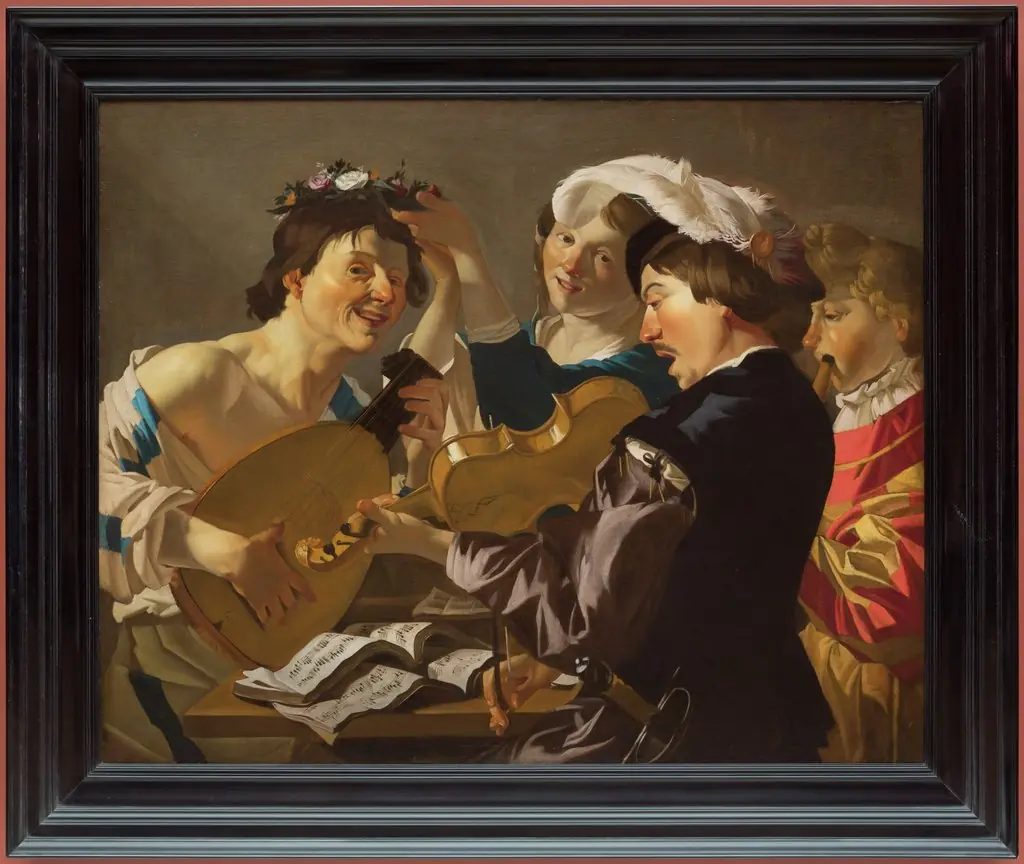
Own this work as a print
Artist & collection